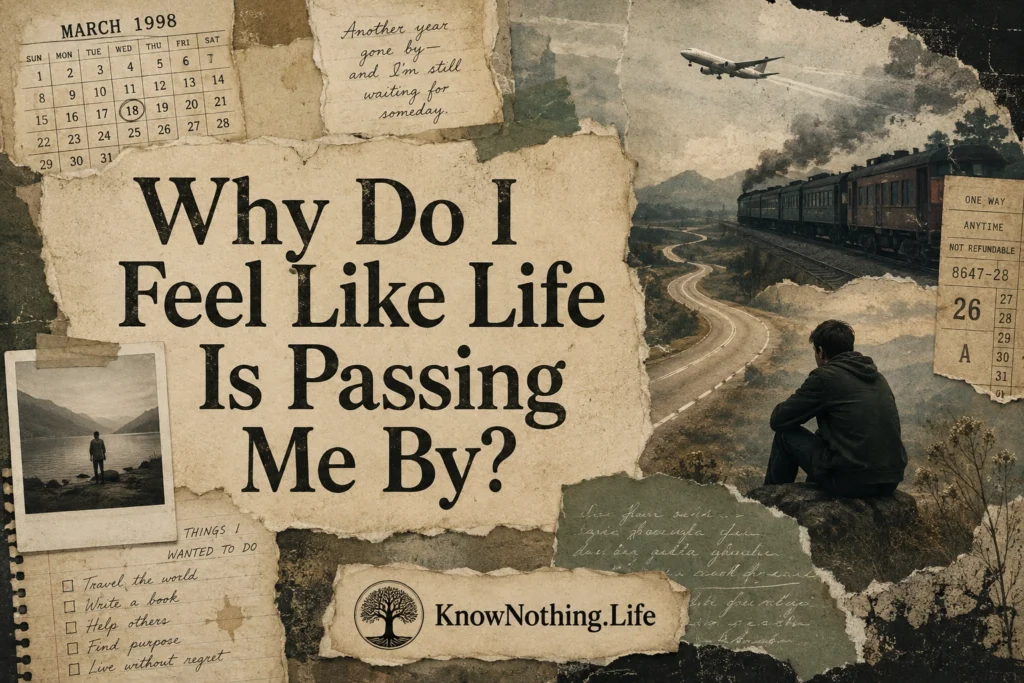
There are periods when life seems to be happening somewhere just beyond reach. Weeks disappear into work, errands, routines, screens, and responsibilities, while other people appear to be traveling, falling in love, building careers, starting families, creating things, or experiencing the milestones you imagined for yourself. Nothing necessarily catastrophic has happened, yet an unsettling thought keeps returning: My life is moving forward, but I am not really moving with it. Birthdays arrive faster than expected, old photographs suddenly feel distant, and plans once described as “someday” begin to look as though someday may have quietly passed.
Psychologically, this feeling is not simply about getting older. It can arise from several processes occurring at once: the way routine compresses remembered time, the gap between the life you are living and the life you expected to live, social comparison with other people’s visible milestones, unresolved regret, and the growing realization that time and possibilities are finite. Research on autobiographical time perception, self-discrepancy, future time perspective, fear of missing out, and psychological well-being suggests that “life is passing me by” is often less a literal judgment about time than an emotional evaluation of how fully life feels inhabited.
Routine Can Make Entire Periods of Life Seem to Disappear
One reason life can seem to pass without you is surprisingly mechanical: repetitive periods can become compressed in memory. Dinah Avni-Babad and Ilana Ritov of the Hebrew University of Jerusalem investigated this phenomenon across four experiments and two field studies. Their research found that periods filled with routine tended to be remembered as shorter than less routine periods. When experiences are repetitive, fewer distinctive events may remain available as markers when we later reconstruct how much happened.
This can produce a strange contradiction. A repetitive Tuesday may feel slow while you are living it, yet six months of similar Tuesdays can seem to vanish when viewed retrospectively. There are fewer psychological boundaries separating one day from another. Work, dinner, television, sleep, repeat. Nothing is necessarily wrong with any individual day, but memory begins packaging many similar days together.
Recent research from Young-Ju Ryu and Mark Landau at the University of Kansas, Samuel Arnold, and Jamie Arndt at the University of Missouri adds nuance to this explanation. Across nearly 2,000 participants, their studies examined why meaningful periods of life are often remembered as moving quickly. Remembered routine was one predictor of faster perceived passage in part of their research, but growth, nostalgia, and satisfaction also influenced judgments of how quickly periods seemed to have passed. In other words, “time flew” does not always mean life was empty. What matters is how memory organizes and evaluates the period afterward.
You May Be Comparing Your Real Life With an Imagined One
Sometimes the sensation that life is passing by has less to do with time itself than with an internal timeline. By a certain age, you may have expected to own a home, have a particular career, find a partner, have children, travel extensively, become financially secure, write a book, start a business, or simply feel more certain about who you are. When reality does not resemble that anticipated life, time can start feeling accusatory. Every passing year seems to enlarge the distance between where you are and where you thought you would be.
Psychologist E. Tory Higgins’ influential self-discrepancy theory, introduced in Psychological Review in 1987, provides a useful framework. Higgins distinguished among the actual self, representing who we believe we currently are; the ideal self, representing hopes and aspirations; and the ought self, representing duties and expectations. His theory proposed that discrepancies between the actual and ideal self tend to produce emotions such as disappointment, dissatisfaction, and sadness, whereas discrepancies involving the ought self can produce anxiety, threat, and agitation.
Feeling that life is passing you by often contains exactly this kind of comparison. You are not merely observing what happened this year. You are unconsciously comparing it with the year that should have happened. The painful part may therefore be less “I am getting older” than “I thought I would be somewhere else by now.”
Other People’s Milestones Can Become a Clock
Human beings have always judged their progress partly by observing peers, but modern life provides an extraordinary amount of information about what everyone else appears to be doing. Social media presents engagements, promotions, houses, vacations, pregnancies, transformations, awards, businesses, friendships, graduations, and adventures in a nearly continuous stream. Someone else’s milestone can unintentionally become evidence that you are late.
This helps explain why fear of missing out, or FoMO, is closely connected with social comparison. A 2025 study by researchers at the University of Szeged and Deakin University examined university students and found relationships among FoMO, social comparison, loneliness, perfectionism, and problematic social-media involvement. Other research involving scholars at the University of Vienna and Utrecht University has similarly found that social comparison and FoMO play important roles in the relationship between subjective well-being and problematic social-network use.
The distortion is subtle because you usually compare the continuous, unedited experience of your own life with selected events from other people’s lives. You experience your waiting, uncertainty, repetition, disappointment, and boring Wednesday afternoons. You see someone else’s wedding photographs, new job announcement, or month in Italy. Enough of these comparisons can create the impression that everybody else is living while you are merely preparing to live.
The Number of Possible Lives Shrinks Over Time
Another reason the feeling becomes powerful is that aging changes the meaning of possibility. When people are young, many futures remain psychologically available at once. You could potentially live in another city, enter several careers, form many different relationships, develop new identities, and reorganize your life repeatedly. With time, decisions accumulate. Choosing one path necessarily means not choosing countless others.
Stanford psychologist Laura Carstensen’s socioemotional selectivity theory argues that human motivation changes according to how much future time people perceive themselves as having. When the future feels expansive, people tend to prioritize exploration, information, novelty, and opportunities that may provide future benefits. When time horizons feel constrained, emotionally meaningful experiences and relationships become more important. Importantly, Carstensen’s work emphasizes that these motivational changes depend heavily on perceived future time, not simply chronological age.
This can make certain birthdays or transitions psychologically significant even when nothing objectively dramatic happens. At 20, “I could do that someday” may feel almost limitless. Later, the same thought is accompanied by a second calculation: How many somedays do I realistically have? The awareness can be uncomfortable, but Carstensen’s research also points toward a constructive response. A more limited sense of time often encourages people to become more selective about relationships and experiences that genuinely matter.
Regret Makes Lost Time Feel More Visible
The feeling that life is slipping away can also intensify around unresolved regrets. Regret is fundamentally counterfactual: the mind constructs an alternative world in which a different decision produced a better outcome. We imagine the relationship we might have pursued, the career change we might have made, the place we might have moved, or the opportunity we declined.
Psychologists Neal Roese and Amy Summerville of the University of Illinois examined which areas of life generate the greatest regrets and why. Their research found that regrets are particularly common in domains where people perceive opportunities for corrective action. Education, career, and romance have frequently appeared among major sources of regret because these areas contain consequential choices while also offering enough possibility that the mind can imagine alternatives.
Regret becomes especially painful when it changes from “I wish I had done that differently” into “I have wasted my life.” The latter transforms a particular choice into a global judgment. Yet regret has an adaptive function: it identifies values and unrealized goals. The fact that you regret not traveling may reveal that exploration matters to you. Regret about neglected friendships may reveal the importance of connection. Properly interpreted, regret can provide information about what the remaining portion of life should contain.
Sometimes the Problem Is Living According to Someone Else’s Goals
A person can also be extremely busy and still feel life is passing by. This happens when activity and personal agency separate. Days are filled, tasks are completed, responsibilities are handled, but very little of what happens feels deliberately chosen.
Self-determination theory, developed by psychologists Edward Deci and Richard Ryan at the University of Rochester, emphasizes autonomy, competence, and relatedness as basic psychological needs. Autonomy does not mean having no responsibilities; it means experiencing behavior as sufficiently aligned with one’s own values and choices. Research by Kennon Sheldon, Ryan, Deci, and Tim Kasser has found that psychological well-being depends not only on the goals people pursue but also on why they pursue them. Autonomous motives and more intrinsically oriented goals are generally associated with better well-being than goals primarily driven by pressure or external rewards.
This helps explain why an outwardly successful life can still feel strangely absent. You may be advancing, but along a path you never consciously selected. The feeling that life is passing you by may sometimes be the mind’s way of saying, I am spending time, but I do not recognize myself in what I am spending it on.
Meaning Matters More Than Packing Life With Experiences
The obvious response is to try to do more: travel more, socialize more, accomplish more, create a bucket list, and fill the calendar. Sometimes novelty helps. New experiences generate stronger memories and create boundaries that make periods feel more distinct. But constant stimulation does not automatically produce a satisfying life.
Psychologist Carol Ryff of the University of Wisconsin–Madison developed an influential model of psychological well-being that includes purpose in life, personal growth, autonomy, positive relationships, environmental mastery, and self-acceptance. Decades of research based on this framework have emphasized that well-being involves active engagement with meaningful goals and the realization of one’s capacities, not simply pleasure or a large number of experiences.
A quiet year spent caring for someone you love may therefore be more deeply lived than a year filled with impressive experiences chosen mainly for status. A difficult period of learning may matter more than a superficially exciting one. The relevant question is not simply “How much did I do?” but “Did the things I did belong to a life I actually value?”
How to Stop Feeling Like Life Is Passing You By
The answer is unlikely to be maximizing every moment. Trying to make every week unforgettable can become another source of pressure. A more realistic strategy is to create distinctiveness, agency, and meaning. Distinctiveness means introducing enough novelty that months do not collapse into indistinguishable repetitions: visiting unfamiliar places, learning something, changing routines, beginning projects, or creating experiences that produce memory markers. Agency means asking which parts of your schedule represent deliberate choices and which are continuing only because they became default settings.
Meaning requires a more difficult question: What would make this period worthwhile even if nobody else were impressed by it? That question removes much of the social-comparison problem. It may lead toward relationships, creative work, learning, contribution, adventure, family, solitude, service, craftsmanship, or something else entirely. The answer is personal because a meaningful life cannot be constructed solely from somebody else’s milestones.
Carstensen’s research offers one final useful reversal. Awareness that time is limited does not have to diminish life; it can clarify it. Stanford’s research on appreciation of remaining time finds that valuing the time one has left is positively associated with emotional well-being, happiness, and life satisfaction. The recognition that life does not continue indefinitely can therefore become a reason for greater selectivity rather than panic.
Why Life Can Feel Like It Is Passing You By
Life can feel as though it is passing you by when routine compresses memory, when reality diverges from an imagined life timeline, when other people’s milestones become measurements of your progress, and when accumulating choices make lost possibilities increasingly visible. The sensation becomes particularly strong when your days contain activity without enough autonomy, novelty, connection, growth, or meaning.
But noticing the feeling can itself be valuable. It means you have become conscious of the relationship between your time and what you care about. The goal is not to prevent time from passing—that is impossible—or to squeeze every imaginable experience into one life. Every life necessarily excludes thousands of other possible lives.
The more useful aim is to become present enough in the life you actually have that its passage does not feel identical to its disappearance. Time will continue moving whether you are ready or not. What can change is how deliberately you inhabit it: choosing more carefully, paying greater attention, creating memories instead of merely consuming days, and allowing your own values—not somebody else’s timeline—to determine whether your life is moving forward.