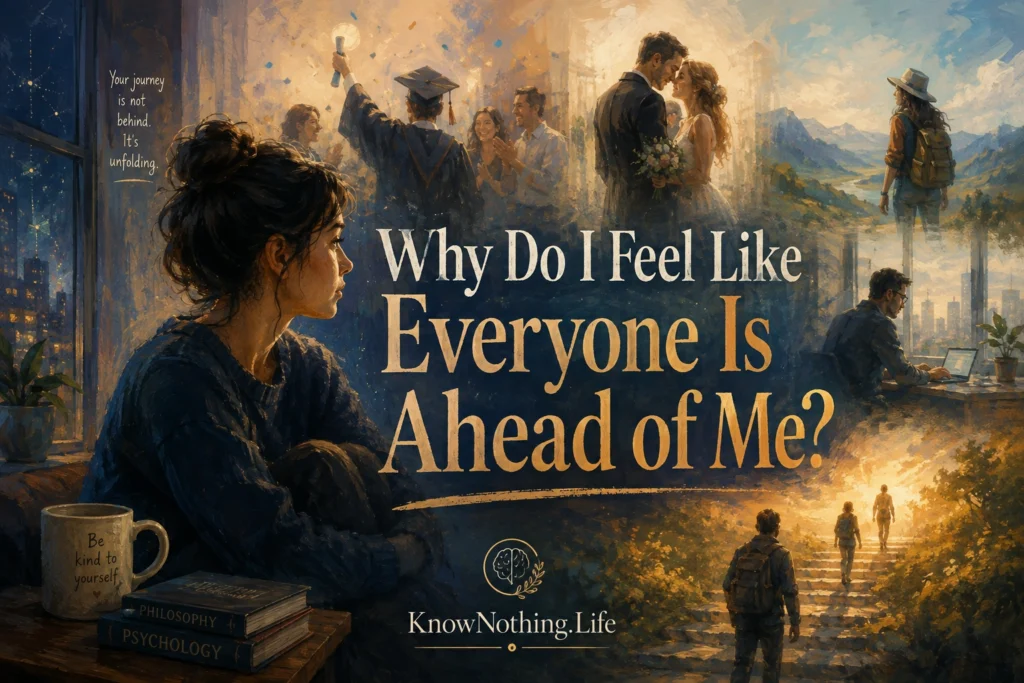
The feeling that everyone else is ahead of you can appear at almost any age. You may look around and see friends buying homes, advancing in their careers, getting married, having children, traveling, building businesses, publishing work, or simply seeming more certain about what they are doing. Your own life, by comparison, may feel delayed or unfinished. The painful part is often not simply that somebody else has something you want. It is the impression that there is a schedule you were supposed to follow and that other people are keeping up with it while you are somehow falling behind.
Psychology suggests that this feeling is rarely an objective measurement of where a person stands. It is usually produced by several mental processes operating at once: social comparison, cultural expectations about when important milestones “should” happen, selective exposure to other people’s successes, and the gap between the life you have and the life you once imagined you would have by now. Understanding those processes does not make every practical problem disappear, but it can reveal why the sense of being behind often feels much more certain than the evidence supporting it.
Why the Mind Measures Life Against Other People
One of the most influential explanations comes from psychologist Leon Festinger’s 1954 paper “A Theory of Social Comparison Processes.” Festinger argued that people possess a powerful drive to evaluate their opinions and abilities, and when objective standards are unavailable, they often evaluate themselves by comparing themselves with other people. Many areas of adult life have no clear scoreboard. There is no universally correct salary at thirty-five, relationship status at forty, number of friends at fifty, or age by which a person must discover meaningful work. In the absence of objective standards, the people around us easily become our measuring sticks.
The problem is that comparison is rarely neutral. Psychologists Frederick Gibbons and Bram Buunk later demonstrated that people differ in what they called social comparison orientation—the degree to which they habitually evaluate themselves in relation to other people. Their research involved thousands of participants in the United States and the Netherlands and produced the Iowa-Netherlands Comparison Orientation Measure. When comparison becomes habitual, another person’s promotion, engagement, home purchase, creative success, or financial achievement can quietly stop being information about that person and start feeling like evidence about you. The mind turns “they reached this milestone” into “I should have reached it already,” even though the second statement does not logically follow from the first.
The Invisible Power of the Social Clock
The sensation of being behind also depends on what sociologists and developmental psychologists have described as age norms or the social clock. In their influential 1965 work on “Age Norms, Age Constraints, and Adult Socialization,” Bernice Neugarten, Joan Moore, and John Lowe examined the expectations societies attach to the timing of major adult roles and transitions. People learn that certain events are considered early, on time, or late: finishing an education, establishing a career, marrying, becoming a parent, purchasing a home, retiring, and so forth. These expectations can remain psychologically powerful even when society itself changes and individual lives become far more varied.
This explains why someone can be doing reasonably well and still experience a persistent sense of lateness. You are not necessarily comparing your life only with your own desires; you may also be comparing it with an inherited timetable. Some of that timetable comes from parents and relatives, while other parts come from peers, class expectations, cultural traditions, movies, advertising, or the generation in which you grew up. You might genuinely be satisfied with one aspect of your life and still become unsettled when friends begin passing a conventional milestone. Their progress reminds you that time is moving. What feels like envy can therefore sometimes be anxiety about your own relationship with time.
You See Other People’s Outcomes but Live Through Your Own Process
Comparison is further distorted because you have radically unequal access to information. You experience your own existence from the inside. You know about every rejection, financial worry, stalled project, uncertain decision, lonely weekend, argument, mistake, and period in which nothing seems to be happening. Other people are usually visible from the outside. You see the new job but not the unsuccessful applications, the marriage but not every private conflict, the successful company but not necessarily the debt, and the confident personality without access to the private insecurity that may exist underneath it.
Research led by Alexander Jordan at Stanford University demonstrated a closely related bias. Across four studies, Jordan, Benoît Monin, Carol Dweck, Benjamin Lovett, Oliver John, and James Gross found that people tended to underestimate how commonly their peers experienced negative emotions and sometimes overestimated their positive emotions. Negative experiences were more likely to remain private or suppressed, creating a distorted picture of other people’s emotional lives. Participants who believed negative experiences were less common among others also reported greater loneliness and rumination and lower life satisfaction. In other words, people can easily compare the messy, unedited version of their own existence with an incomplete version of everyone else’s.
Social Media Makes Upward Comparison Almost Frictionless
Social media did not invent social comparison, but it dramatically expanded the comparison pool. Instead of primarily comparing yourself with relatives, coworkers, neighbors, and a small circle of friends, you can compare your career with a former classmate, your body with a fitness influencer, your home with a stranger, your relationship with an acquaintance, and your productivity with an entrepreneur—all within a few minutes. The comparison targets are also disproportionately selected from moments people consider worth displaying. Ordinary afternoons, unfinished projects, disappointments, debt, boredom, self-doubt, and failed attempts are considerably less likely to become polished public updates.
A 2014 study by Erin Vogel, Jason Rose, Lindsay Roberts, and Katheryn Eckles found that frequent Facebook use was associated with lower trait self-esteem through greater exposure to upward social comparisons. In an experimental component, exposure to profiles containing upward-comparison information also produced lower state self-esteem and less favorable relative self-evaluations. A later University of Pennsylvania experiment led by psychologist Melissa Hunt randomly assigned 143 undergraduates either to limit Facebook, Instagram, and Snapchat to ten minutes per platform per day or continue using them normally. After three weeks, the limited-use group experienced significant reductions in loneliness and depression compared with the control group. Social media is not inherently harmful, but research shows why constant exposure to carefully selected comparison targets can alter how people evaluate their own lives.
The Gap Between Who You Are and Who You Thought You Would Be
Another reason feeling behind becomes so painful is that other people often activate an internal standard rather than merely an external comparison. Psychologist E. Tory Higgins described this process in his influential 1987 self-discrepancy theory. Higgins distinguished between the “actual self,” representing who you believe you currently are; the “ideal self,” representing who you hope or wish to become; and the “ought self,” representing who you believe you have a responsibility or obligation to become. Different gaps between these identities are associated with different forms of psychological discomfort.
The thought “everyone is ahead of me” can contain both discrepancies simultaneously. You may feel disappointed because your actual life does not resemble the ideal life you imagined, while feeling anxious because you believe you ought to have achieved more by this point. Other people then become reminders of these gaps. Your friend’s success may hurt not because you resent your friend, but because it suddenly makes an old expectation vivid: I thought I would be there by now. This helps explain why comparison can intensify around birthdays, weddings, reunions, promotions, graduations, pregnancies, or other major transitions. Such moments become psychological checkpoints at which the mind audits the distance between expectation and reality.
When Upward Comparison Helps and When It Hurts
Importantly, looking at people who are doing better than you is not automatically harmful. Psychologists Penelope Lockwood and Ziva Kunda demonstrated this in their 1997 study “Superstars and Me.” Successful role models could inspire participants when the success appeared relevant and attainable. When people believed they still had sufficient time to achieve something comparable, or believed that their abilities could improve, exposure to successful people could actually enhance motivation and self-perception. When equivalent success seemed unattainable, however, the same comparisons were more likely to produce self-deflation.
Later research by Lockwood and colleagues found that people undergoing unfamiliar life transitions may deliberately seek upward comparisons because successful examples reduce uncertainty and demonstrate that progress is possible. The important question, therefore, is not simply whether you compare yourself with other people. It is what conclusion you draw from the comparison. If someone’s achievement provides information, inspiration, or a possible strategy, comparison can become useful. If it produces only the conclusion that your opportunity has passed, then it is no longer functioning as guidance. Another person’s life can demonstrate one possible path without becoming proof of the schedule you were required to follow.
How to Stop Organizing Your Life Around Being “Ahead”
One useful psychological shift is replacing ranking with direction. The question “Am I ahead?” requires another person as the reference point. The question “Am I moving toward something I value?” does not. This means identifying goals because they genuinely matter to you rather than because they symbolize status, adulthood, normality, or success. It may also require abandoning goals that no longer make sense. Research by Carsten Wrosch, Michael Scheier, Gregory Miller, Richard Schulz, and Charles Carver found that the ability to disengage from unattainable goals and reengage with meaningful alternatives can be associated with greater subjective well-being. Giving up an outdated timeline is therefore not necessarily surrender. Sometimes revising a goal is an adaptive form of self-regulation.
Self-compassion can also reduce the harshness that makes comparison so corrosive. University of Texas psychologist Kristin Neff conceptualizes self-compassion around three elements: self-kindness, common humanity, and mindful awareness of difficult thoughts and emotions. The idea of common humanity is particularly relevant because feeling behind usually contains an isolating assumption: everyone else is progressing normally while you alone are struggling. Research on hidden negative emotions suggests that this assumption is frequently inaccurate. Uncertainty, detours, abandoned plans, reinvention, disappointment, and uneven progress are not unusual deviations from human life. They are part of human life.
There Is No Single Place You Were Supposed to Be by Now
The feeling that everyone is ahead of you is powerful because it combines genuine desires with imaginary rankings. You may sincerely want more financial security, deeper relationships, better health, meaningful work, a family, creative accomplishment, or a clearer sense of purpose. Those desires deserve attention. But they become unnecessarily painful when they are translated into the belief that every human life can be placed on one track and that your worth can be determined by where you stand relative to everybody else.
Lives do not unfold along one shared timeline. People advance rapidly in one domain and slowly in another. They reach goals and later discover that those goals do not satisfy them. They lose things that once made them appear successful. They change careers, relationships, identities, priorities, and definitions of a good life. Some people begin important chapters precisely when conventional expectations tell them they are late. The useful question, therefore, is not whether everyone else is ahead of you. It is whether the comparisons you are making are helping you create the life you actually want. Once that distinction becomes clearer, other people’s progress can stop serving as evidence of your lateness and start becoming what it really is: information about a life that is not yours.