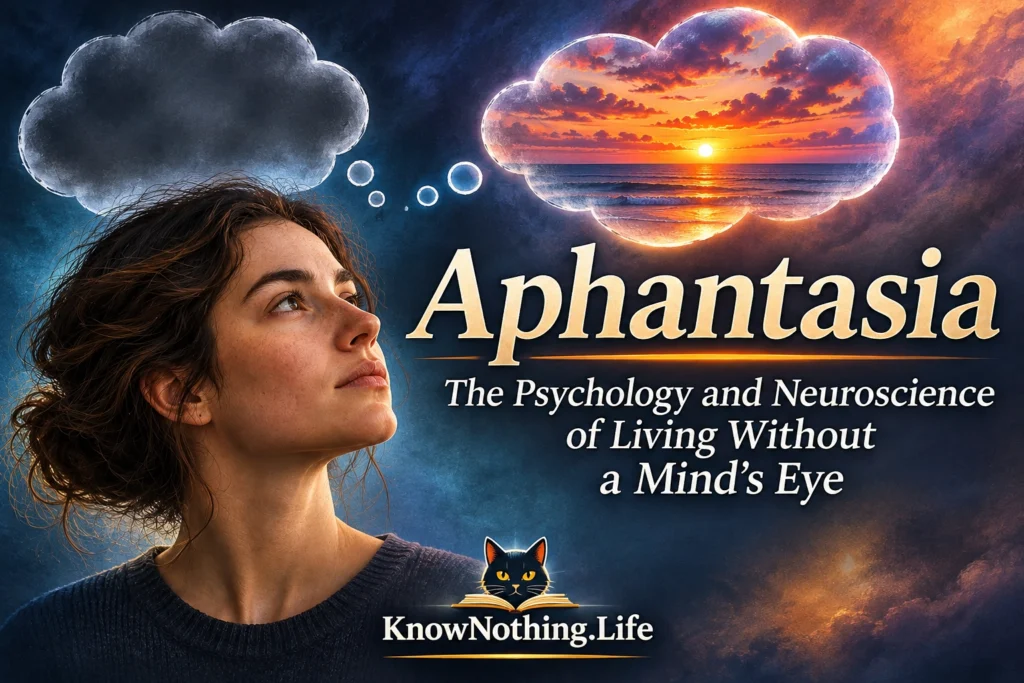
Close your eyes and imagine a beautiful sunset over the ocean. Picture the orange sunlight reflecting across the water, the distant horizon, and the clouds changing color as evening approaches. For many people, this simple exercise produces something resembling a visual experience within the mind. They may perceive colors, shapes, and spatial details without actually seeing anything through their eyes. For others, however, the instruction produces no visual imagery whatsoever. They understand what a sunset looks like, remember seeing one, and can describe its appearance, but no internal picture emerges. This experience is known as aphantasia, a distinctive variation in the human capacity for mental imagery.
Aphantasia challenges familiar assumptions about imagination, memory, creativity, and consciousness. People often presume that thinking about an object involves mentally seeing it, yet research demonstrates that individuals can recognize faces, understand visual concepts, solve spatial problems, and develop creative ideas without experiencing vivid internal pictures. The discovery has raised important questions about how the brain represents information and whether visual imagination is necessary for complex thought. Far from being merely an unusual curiosity, aphantasia provides scientists with an opportunity to investigate the remarkable diversity of subjective experience and the many different ways human beings think.
What Is Aphantasia?
Aphantasia refers to the inability or markedly reduced ability to voluntarily generate visual mental imagery. Someone with aphantasia can usually recognize a familiar face when looking at it but cannot deliberately recreate that face as a visual experience within the mind. Similarly, they may know the appearance of their childhood home without being able to picture its rooms, furniture, or surroundings. This distinction is essential because aphantasia does not ordinarily involve impaired eyesight, an inability to understand visual information, or a complete absence of imagination. The difference concerns the subjective experience of mentally visualizing something that is not physically present.
Mental imagery varies considerably between individuals. Some people experience extraordinarily vivid internal pictures, a characteristic known as hyperphantasia, while others report faint, fragmented, or completely absent imagery. Research generally places these experiences along a continuum rather than treating every person as belonging to a rigid category. In a 2024 study, An International Estimate of the Prevalence of Differing Visual Imagery Abilities, researchers examined questionnaire responses from an international sample and subsequently analyzed combined data from 9,063 participants. Their larger analysis estimated that approximately 0.9% experienced a complete absence of voluntary visual imagery, while another 3.3% reported very weak imagery. These findings suggest that reduced mental visualization is uncommon but far from exceptionally rare.
The History of Aphantasia and the Discovery of the Mind’s Eye
Although the word aphantasia is relatively new, scientists have recognized differences in mental imagery for more than a century. In 1880, British researcher Francis Galton published Statistics of Mental Imagery in the journal Mind. Galton asked participants to imagine familiar scenes, including their breakfast tables, and describe the vividness, colors, and details they could mentally experience. He discovered striking differences between individuals, including people who reported little or no visual imagery. Describing his surprise, Galton observed that some respondents insisted that “mental imagery was unknown to them.” His findings challenged the assumption that everyone experiences imagination in fundamentally the same way.
Modern scientific interest accelerated through the work of neurologist Adam Zeman and colleagues. In 2010, Zeman’s research team described a man known as MX who reported losing his capacity for voluntary visual imagery following a medical procedure, despite retaining considerable ability to perform tasks traditionally associated with mental visualization. The case attracted attention from individuals who reported never having possessed a mind’s eye. In 2015, Zeman, Michaela Dewar, and Sergio Della Sala published Lives Without Imagery – Congenital Aphantasia in Cortex, describing 21 people who reported a lifelong absence of visual imagery. The researchers introduced the term aphantasia, drawing from the Greek concept of phantasia, associated with imagination and mental appearance. Their publication helped establish aphantasia as a distinct subject of contemporary cognitive and neurological research.
How Scientists Study Mental Imagery
Studying aphantasia presents an unusual challenge because mental imagery is a subjective experience. Researchers cannot directly observe what another person sees within their imagination, making self-report an important starting point. One widely used assessment is the Vividness of Visual Imagery Questionnaire, developed by psychologist David Marks in 1973. Participants are asked to imagine familiar people, objects, or scenes and rate how clearly they experience the resulting images. Someone with vivid imagery may report detailed colors and visual features, while someone with aphantasia may understand the requested scene without experiencing a corresponding picture.
However, subjective reports alone cannot answer every scientific question. People may interpret terms such as seeing, picturing, and imagining differently, creating difficulties when comparing experiences. Researchers have therefore developed behavioral and physiological methods to investigate imagery more objectively. These approaches examine how imagined visual information influences perception or produces measurable bodily responses. The growing agreement between some subjective reports and experimental findings suggests that aphantasia is not simply a misunderstanding of language. Nevertheless, no single test can fully capture every dimension of imagination, and researchers continue debating how best to define and measure the condition.
The Neuroscience of Aphantasia
Visual imagination involves complex interactions among brain systems associated with perception, attention, memory, and higher-level cognitive control. When individuals imagine an object, activity in parts of the visual system can resemble certain aspects of the activity associated with actually perceiving that object. However, imagination and perception are not identical neurological events. Visual imagery involves reconstructing or generating internal representations without corresponding external sensory input. Researchers have investigated whether aphantasia reflects differences in visual cortical activity, communication between brain networks, or the ability to consciously access imagery-related representations.
In their 2021 review, Aphantasia: The Science of Visual Imagery Extremes, Rebecca Keogh, Joel Pearson, and Adam Zeman examined evidence connecting imagery differences with visual brain function. A later 2024 review by Zeman explored possible differences in connectivity between frontoparietal networks and visual processing systems. These findings suggest that the ability to generate vivid internal pictures may depend partly on how distributed brain systems interact. However, neuroscientists have not established one universal brain abnormality responsible for all cases of aphantasia. Individuals may arrive at similar subjective experiences through different cognitive and neurological mechanisms, and available evidence does not support describing lifelong aphantasia as a form of brain damage.
What Experiments Reveal About the Invisible Mind
One of the most convincing lines of evidence comes from experiments examining the relationship between imagery and visual perception. In their 2018 study, The Blind Mind: No Sensory Visual Imagery in Aphantasia, Rebecca Keogh and Joel Pearson used a technique known as binocular rivalry. When different images are presented simultaneously to each eye, perception alternates between them. Previous research showed that imagining one of these images beforehand can influence which image becomes perceptually dominant. Participants reporting aphantasia showed substantially reduced imagery-related effects, suggesting that their experiences involved genuine differences in visual imagery strength rather than merely different descriptions of internal experience.
Another significant discovery concerned the eyes themselves. In their 2022 study, The Pupillary Light Response as a Physiological Index of Aphantasia, Sensory and Phenomenological Imagery Strength, Lachlan Kay, Rebecca Keogh, Thomas Andrillon, and Joel Pearson investigated how pupils respond when people imagine bright or dark objects. Participants with typical imagery demonstrated pupil responses associated with imagined brightness, while the aphantasia group did not show the same significant imagery-related response. Importantly, their pupils responded normally to actual visual stimulation and showed responses to increased cognitive effort. These findings provide physiological evidence that voluntary visual imagery can differ in measurable ways between individuals, even when ordinary visual perception remains intact.
Aphantasia, Memory, and Remembering the Past
One of the most fascinating questions concerns how people without mental imagery remember their lives. Many individuals experience autobiographical memories as vivid mental scenes, mentally revisiting childhood celebrations, meaningful conversations, or important places. People with aphantasia may remember the same events through factual knowledge, verbal descriptions, emotional associations, or an understanding of spatial relationships without visually reconstructing the experience. They may know who attended a birthday celebration, what happened, and why it mattered while being unable to mentally see the event. This distinction suggests that remembering information and reexperiencing it through visual imagery are related but separable processes.
Research by Alexei Dawes and colleagues, published in Scientific Reports in 2020 as A Cognitive Profile of Multi-Sensory Imagery, Memory and Dreaming in Aphantasia, investigated differences in memory and imagination. Participants with aphantasia reported less vivid autobiographical recollections and imagined future experiences, alongside differences in other sensory imagery domains. Similarly, Wilma Bainbridge and colleagues examined visual memory through drawing in their 2021 paper, Quantifying Aphantasia Through Drawing: Those Without Visual Imagery Show Deficits in Object but Not Spatial Memory. Participants with aphantasia tended to reproduce fewer object details from remembered scenes while preserving important spatial relationships. These findings suggest that visual imagery contributes to certain aspects of memory without being necessary for remembering or understanding the past.
Can People With Aphantasia Dream?
Dreaming creates an intriguing distinction between voluntary and involuntary imagination. Some individuals who cannot deliberately summon a visual image while awake nevertheless report vivid visual dreams during sleep. Others describe dreams involving reduced imagery, abstract awareness, emotions, or knowledge of events without clear visual scenes. This variation challenges the assumption that all visual mental experiences depend on exactly the same mechanisms. The conscious effort required to imagine a familiar face may involve different processes from those producing dream imagery during sleep.
Research by Zeman and colleagues has documented preserved visual dreaming among some people with aphantasia, while Dawes and colleagues identified group differences in reported dream experiences. In 2024, researchers examining aphantasia and involuntary imagery emphasized that the condition may affect more than deliberate visualization and that the relationship between voluntary imagery, spontaneous imagery, and dreaming remains incompletely understood. These findings are important because they suggest that aphantasia is not necessarily the complete absence of every internally generated visual experience. Instead, it may involve particular limitations in accessing, generating, or consciously experiencing imagery under different circumstances.
How Aphantasia Influences Emotion
Mental imagery can amplify emotional experiences because imagined situations may evoke reactions similar to those associated with actual events. Someone imagining a frightening encounter might experience tension, increased alertness, or physical discomfort even when no danger is present. Researchers have therefore investigated whether individuals without visual imagery respond differently to emotionally charged descriptions. The question is not whether people with aphantasia experience emotions, but whether mental pictures contribute to the intensity of certain emotional responses.
In a 2021 study published in Proceedings of the Royal Society B, Marcus Wicken, Rebecca Keogh, and Joel Pearson investigated this relationship in The Critical Role of Mental Imagery in Human Emotion: Insights From Fear-Based Imagery and Aphantasia. Participants read frightening fictional scenarios while researchers measured physiological arousal through skin conductance. Participants with typical imagery demonstrated increasing physiological responses as threatening scenarios developed, while the aphantasia group showed substantially reduced responses during the imagined stories. The findings support the idea that visual imagery can intensify fear associated with imagined events. However, they do not imply that people with aphantasia lack empathy, emotional depth, or the ability to experience fear in real situations. Emotional responses arise through multiple cognitive and neurological pathways.
Does Aphantasia Affect Creativity and Intelligence?
A common misconception is that people without mental imagery must be less imaginative or creative. This assumption confuses visualization with creativity itself. Creative thinking can involve abstract reasoning, conceptual connections, language, problem-solving, musical relationships, spatial knowledge, and the ability to combine existing ideas in original ways. A novelist may develop compelling characters through verbal and emotional understanding without mentally seeing their faces. An engineer might design a complex system through mathematical relationships and conceptual reasoning instead of vivid internal pictures. The absence of one form of imagery does not establish the absence of imaginative thought.
Research has not demonstrated that aphantasia necessarily produces lower intelligence or eliminates creative ability. In their 2024 review, Aphantasia and Hyperphantasia: Exploring Imagery Vividness Extremes, Adam Zeman and colleagues emphasized that the effects of imagery differences on everyday functioning are often subtle despite dramatic contrasts in subjective experience. Some people with aphantasia report preferences for analytical or scientific thinking, but such patterns should not be interpreted as universal advantages or limitations. Creativity depends on multiple abilities, experiences, opportunities, and cognitive strategies. Aphantasia may influence how someone approaches a creative task without determining whether they can perform it successfully.
Different Forms of Aphantasia and Individual Experience
Aphantasia is not necessarily identical across everyone who experiences it. Some individuals report an absence of voluntary visual imagery while retaining the ability to imagine sounds, tastes, physical sensations, or other sensory experiences. Others report substantially reduced imagery across several sensory domains. Researchers sometimes use the term multisensory aphantasia when describing broader limitations, although definitions remain under development. Another distinction concerns congenital and acquired aphantasia. Congenital aphantasia generally describes a lifelong absence of visual imagery, while acquired aphantasia involves losing an ability that previously existed, sometimes following neurological injury or illness.
These differences complicate attempts to define aphantasia through one rigid criterion. Philosophers and cognitive scientists continue debating whether it reflects a complete absence of sensory imagery, difficulty consciously accessing imagery, or different representational strategies that do not generate ordinary visual experiences. In Aphantasia: In Search of a Theory, philosopher Filipe Dorsch and other contemporary scholars’ debates about mental imagery illustrate how questions concerning subjective experience intersect with cognitive science. Further conceptual work has emphasized the distinction between visual-object imagery and spatial representation. Someone may be unable to picture an object while still understanding its dimensions, orientation, and location. Recognizing these differences is essential for constructing more accurate theories of imagination.
Is Aphantasia a Medical or Psychological Disorder?
Aphantasia is not generally classified as a mental disorder, and lifelong aphantasia does not automatically indicate a medical problem. Many individuals discover their unusual imagery experience during adulthood after learning that other people can generate vivid internal pictures. Until that discovery, they may have assumed that expressions such as picture this or imagine a beach were primarily metaphorical. Their education, careers, relationships, and everyday activities may have developed without significant difficulty. In a 2023 paper examining the pathological significance of aphantasia, researchers argued that the available evidence does not establish it as a general mental disorder and that it is better understood, in many cases, as a cognitive variation.
Acquired aphantasia requires a different perspective because a sudden change in imagery can sometimes accompany neurological or medical conditions. Someone who unexpectedly loses a previously established capacity for visualization, particularly alongside other neurological symptoms, may benefit from clinical evaluation. There is currently no established, evidence-based treatment that reliably restores mental imagery in people with congenital aphantasia. Claims that visualization exercises, supplements, or particular psychological techniques can universally eliminate the condition are not supported by convincing clinical evidence. For people who experience practical difficulties, alternative strategies involving written descriptions, diagrams, external visual references, and verbal memory may be useful, although individual needs vary.
What Aphantasia Teaches Us About Consciousness
Aphantasia raises profound philosophical questions about the relationship between thought and conscious experience. Philosophers have long debated whether mental representations resemble internal pictures or whether thinking can occur through abstract, symbolic, and conceptual processes. Aristotle discussed phantasia in De Anima, emphasizing its relationship with perception and thought. Modern cognitive science has demonstrated that individuals vary dramatically in the imagery accompanying otherwise similar reasoning tasks. A person may understand the properties of an object without experiencing a corresponding visual image, suggesting that the content of thought cannot always be equated with its sensory appearance.
The phenomenon also reveals the limits of ordinary introspection. People generally assume that other minds operate similarly to their own because subjective experiences are difficult to compare directly. Someone with vivid imagery may find it almost impossible to understand what thinking without pictures feels like, while someone with aphantasia may struggle to imagine how internal images can resemble perception. Neither experience provides a universal standard for consciousness. By studying these differences, researchers can investigate which cognitive functions require sensory imagery, which can operate through alternative representations, and how subjective experiences emerge from brain activity. Aphantasia therefore contributes to the broader scientific effort to understand not simply what the human mind can accomplish, but the different ways those accomplishments can be consciously experienced.
Final Thoughts on Aphantasia
Aphantasia demonstrates that the human imagination is more diverse than everyday language suggests. The inability to voluntarily generate visual mental images does not mean that someone lacks intelligence, creativity, memories, or emotional experience. Instead, it reveals differences in how individuals represent information and experience their own thoughts. Research beginning with Francis Galton’s observations and continuing through Adam Zeman’s work, neuroscientific experiments, and contemporary investigations of memory and emotion has established aphantasia as an important subject in cognitive science.
Perhaps its deepest significance lies in challenging the assumption that everyone experiences reality internally in the same way. Two people can remember the same event, understand the same concept, or create equally meaningful works of art while experiencing fundamentally different forms of inner awareness. For some, imagination involves vivid scenes unfolding within the mind. For others, it consists of knowledge, language, relationships, and abstract understanding without visual pictures. Aphantasia reminds us that consciousness cannot be reduced to a single familiar experience. The mind possesses multiple ways of knowing, remembering, and imagining, and understanding those differences expands our conception of what it means to think.