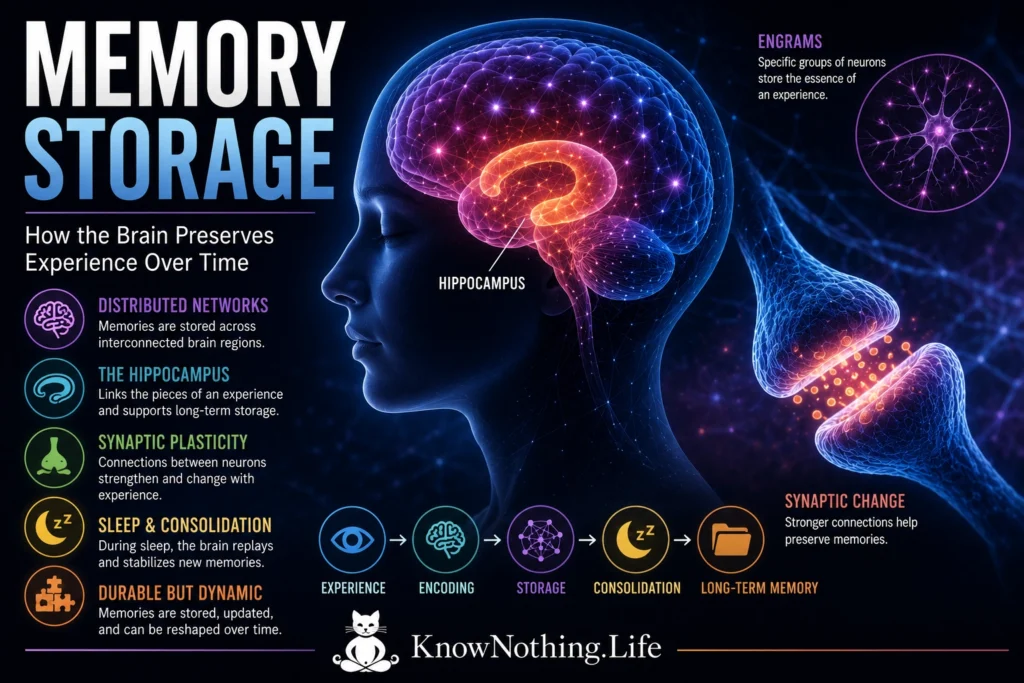
Memory storage refers to the biological persistence of information after an experience has ended. The phrase can make it sound as though the brain places a complete record into a fixed location, but memories are not stored like files in a cabinet. A lasting memory is better understood as a pattern of changes distributed across neurons, synapses, and interconnected brain regions. Visual features may be represented in visual cortex, sounds in auditory regions, emotional significance through amygdala-related circuits, and relationships among the elements through the hippocampal system. Remembering later requires these separated components to be reactivated and coordinated.
Storage is also different from encoding and retrieval. Encoding establishes an initial representation, storage preserves some consequence of that representation, and retrieval reconstructs it when a cue, goal, or context makes it relevant. These functions can be dissociated. In their landmark 1957 report, “Loss of Recent Memory After Bilateral Hippocampal Lesions,” William Scoville and Brenda Milner described severe difficulty forming new lasting memories after extensive medial temporal damage, even though perception, conversation, and brief retention remained possible. The case showed that holding information momentarily and preserving it for later use depend on partly different neural mechanisms.
Multiple Systems for Storing Memory
The brain does not use one storage system for every kind of learning. Episodic memories preserve events and their contexts, semantic memory supports facts and concepts, procedural memory supports skills and habits, and emotional memory allows cues to acquire motivational significance. These forms of memory depend on overlapping but distinguishable circuits. The hippocampus and adjacent medial temporal structures are especially important for declarative and relational memory, whereas habits and skills depend more heavily on basal ganglia, cerebellar, motor, and sensory systems. Storage is therefore a property of several specialized networks rather than one universal memory organ.
Research involving patients with amnesia and Parkinson’s disease provides strong evidence for this organization. Barbara Knowlton, Jennifer Mangels, and Larry Squire found that amnesic patients could gradually learn a probabilistic classification task despite having poor conscious memory of the training episodes. Patients with Parkinson’s disease showed the reverse pattern: impaired habit learning with relatively preserved declarative knowledge of the task. Studies of mirror tracing also found that people with global amnesia could acquire and retain the skill even when they could not consciously remember practicing it. These findings demonstrate that memories can be preserved in one system when another is severely damaged.
The Hippocampus and Distributed Cortical Storage
A new episodic memory depends on rapid interactions between the hippocampus and distributed areas of the cerebral cortex. One influential view describes the hippocampus as an index that links the cortical patterns active during an event. When part of the experience is later encountered, the hippocampus can help reinstate the larger pattern. Over time, repeated reactivation may strengthen direct connections among cortical regions, allowing some memories to become less dependent on hippocampal coordination. In mice, Takashi Kitamura and colleagues found that prefrontal engram cells associated with remote contextual fear memory were generated during initial learning and gradually became functionally mature through interactions with hippocampal and amygdala circuits.
The transition is not a simple transfer in which a memory leaves the hippocampus and moves intact into the cortex. Human imaging studies have detected representations of both recent and remote autobiographical memories in the hippocampus, while remote memories were represented more strongly in the ventromedial prefrontal cortex. Other research has found continued hippocampal involvement during the vivid recollection of events from decades earlier. These findings suggest that memories are reorganized and transformed across time. General knowledge may become increasingly supported by cortical connections, while detailed episodic reconstruction can continue to recruit the hippocampus.
Synaptic Plasticity and Molecular Persistence
At the cellular level, memory storage requires experience to alter communication among neurons. A leading experimental model is long-term potentiation, or LTP, a persistent increase in synaptic strength following particular patterns of activity. Tim Bliss and Terje Lømo’s 1973 experiments showed that brief stimulation of the perforant pathway could produce enhanced responses in the rabbit hippocampus lasting for hours or days. Richard Morris and colleagues later reported that blocking NMDA receptors prevented hippocampal LTP and impaired spatial learning in rats, connecting a mechanism of synaptic plasticity to measurable learning behavior.
LTP is not identical to memory, and no single form of plasticity explains every kind of storage. Some animals can learn spatial tasks under conditions that block particular forms of NMDA-dependent LTP, suggesting that circuits can use alternative mechanisms or strategies. Long-lasting storage may involve changes in receptor trafficking, neurotransmitter release, intracellular signaling, gene expression, protein synthesis, dendritic spines, and the creation or elimination of synapses. In Aplysia neurons, Kelsey Martin, Eric Kandel, and colleagues showed that local protein synthesis could support synapse-specific long-term facilitation, helping explain how cell-wide gene activation can produce durable changes at selected connections.
Engrams and the Physical Trace of Memory
The term engram refers to the physical neural changes that preserve information from an experience. Modern genetic and optogenetic methods allow researchers to label neurons that are active during learning and reactivate them later. In 2012, Xu Liu and colleagues tagged hippocampal neurons activated during fear conditioning. Artificially stimulating that population later caused mice to express the associated freezing response, providing experimental evidence that reactivating a particular neuronal ensemble could retrieve a stored memory.
Engram experiments also indicate that storage depends on patterns of connectivity, not merely on whether individual neurons remain excitable. Thomas Ryan and colleagues interfered with protein synthesis after learning, producing a condition in which mice could no longer retrieve the memory through ordinary environmental cues. Direct stimulation of the tagged engram cells nevertheless restored the learned response. The researchers found that connections among the engram cells had been retained and proposed that memory information can remain stored even when normal retrieval fails. Apparent forgetting may therefore sometimes reflect inaccessible storage rather than the complete destruction of a memory trace.
Sleep and Systems Consolidation
Sleep provides conditions in which recently encoded representations can be reactivated without constant competition from new sensory input. Matthew Wilson and Bruce McNaughton recorded hippocampal place cells while rats explored an environment and during later sleep. Neurons that had fired together during exploration showed increased coordinated activity afterward, indicating that patterns related to waking experience were replayed during sleep. This replay may help stabilize new memories and coordinate communication between hippocampal and cortical networks.
Human experiments provide evidence that reactivation can influence retention. Björn Rasch and colleagues paired an odor with a spatial learning task and presented the odor again during slow-wave sleep. The cue produced hippocampal activation and improved later declarative memory, while the same procedure was ineffective during REM sleep or wakefulness. Lisa Marshall and colleagues also found that strengthening slow oscillation-like activity during early non-REM sleep improved retention of hippocampus-dependent material. Sleep does not merely protect memories from interference; it can strengthen selected information and promote its reorganization across long-term networks.
Storage, Updating, and Forgetting
A stored memory must remain stable enough to guide future behavior while remaining flexible enough to incorporate new information. Retrieval can return a memory to a temporarily modifiable condition, allowing its emotional significance, details, or associations to be updated. Repeated remembering may strengthen certain elements while weakening, generalizing, or distorting others. Memory storage is therefore an ongoing biological process rather than a one-time event completed immediately after learning. The patterns supporting a memory can change while preserving enough continuity for the experience to remain recognizable.
Forgetting is not always evidence that storage has simply decayed. Competing memories can interfere with access, retrieval cues can become ineffective, and executive-control systems can deliberately suppress recollection. Michael Anderson and Carole Green found that repeatedly preventing the retrieval of learned associations made those memories more difficult to recall later. Brain-imaging research linked suppression to increased prefrontal activity and reduced hippocampal activation. Memory storage is maintained through a balance of preservation, reactivation, updating, competition, and selective loss. The brain stores the past not to reproduce it perfectly, but to use it efficiently in perception, prediction, identity, decision-making, and action.