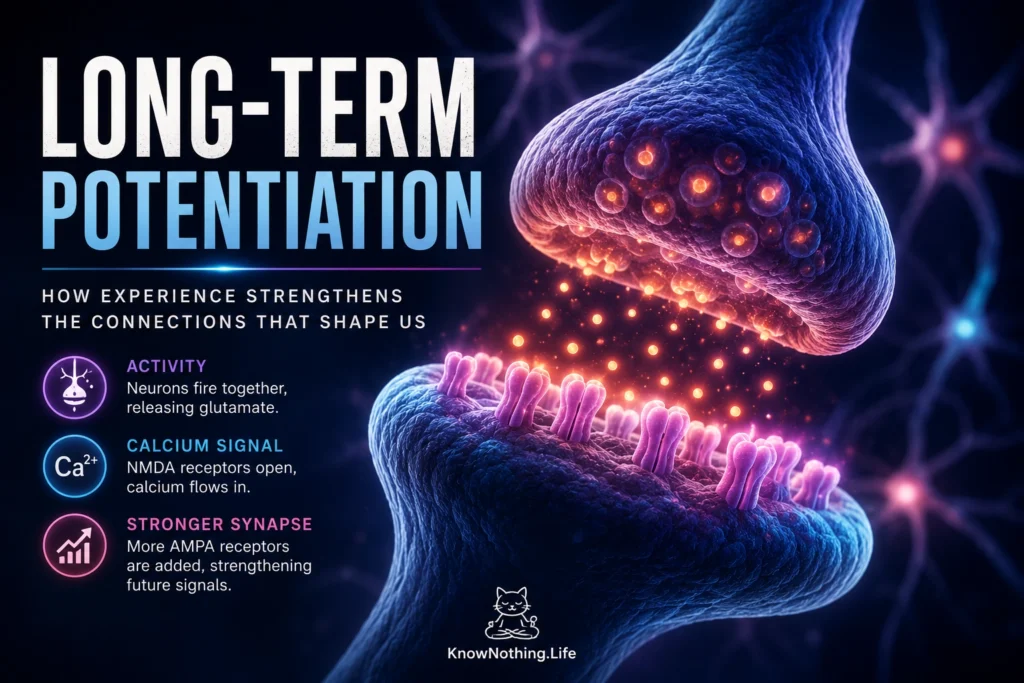
Long-term potentiation, commonly abbreviated LTP, is a persistent increase in the effectiveness of communication between neurons following particular patterns of activity. When an activated presynaptic neuron repeatedly contributes to the firing of a postsynaptic neuron, the connection may become more responsive to later stimulation. This strengthening can last from minutes to hours and, under some experimental conditions, much longer. LTP is therefore one of the clearest cellular examples of synaptic plasticity—the capacity of synapses to change as a result of activity. Because learning requires experience to leave a durable physical trace in the nervous system, LTP has become a leading model for investigating how neural activity may be converted into stored information.
LTP is not important because every memory can be reduced to one strengthened synapse. Its importance comes from properties expected of a memory mechanism: it can be induced rapidly, persist after the triggering event, and remain restricted to active inputs rather than spreading indiscriminately across a neuron. Modern research nevertheless treats LTP as a family of related processes rather than a single uniform event. Its mechanisms differ with brain region, synapse, developmental stage, stimulation pattern, and molecular pathway.
The Discovery of a Lasting Synaptic Change
The modern study of LTP began with experiments conducted by Terje Lømo and later developed with Timothy Bliss. In the landmark 1973 paper “Long-Lasting Potentiation of Synaptic Transmission in the Dentate Area of the Anaesthetized Rabbit Following Stimulation of the Perforant Path,” Bliss and Lømo reported that brief, high-frequency stimulation produced a lasting enhancement of synaptic transmission in the rabbit hippocampal formation. A companion study by Bliss and A. R. Gardner-Medwin found comparable potentiation in awake animals. These results were striking because a short episode of activity caused a change that remained measurable long after the stimulation had ended.
The hippocampus was an especially significant place to observe this effect because it was already strongly associated with the formation of new memories. The discovery also echoed Donald Hebb’s earlier proposal that coordinated activity could strengthen connections between neurons. LTP gave researchers a measurable biological process through which a broadly Hebbian principle could be tested. It soon became a central bridge between cellular electrophysiology, molecular biology, and behavioral research.
How LTP Is Induced
The best-characterized form of LTP occurs at Schaffer collateral synapses onto CA1 pyramidal neurons in the hippocampus. At these excitatory synapses, glutamate activates AMPA and NMDA receptors. During ordinary transmission, AMPA receptors carry most of the immediate current, while NMDA receptor channels remain largely blocked by magnesium ions. When glutamate release coincides with strong postsynaptic depolarization, the magnesium block is relieved and calcium enters through NMDA receptors. The receptor therefore helps the synapse detect that presynaptic activity and postsynaptic excitation occurred together. Experiments by Graham Collingridge, Stephen Kehl, and Hugh McLennan helped establish that NMDA receptor activation is crucial for inducing hippocampal LTP.
The calcium signal activates intracellular pathways that include calcium/calmodulin-dependent protein kinase II, or CaMKII, along with other signaling molecules. These pathways modify existing AMPA receptors and promote the delivery of additional AMPA receptors to the synapse. Later glutamate release can therefore produce a larger postsynaptic response. Structural changes may follow: dendritic spines can enlarge, receptor-scaffolding systems can reorganize, and activated synapses may become more stable. LTP is thus a coordinated alteration of receptor function, protein organization, and synaptic structure rather than a temporary rise in electrical excitability.
Early and Late Phases of Potentiation
Researchers commonly distinguish between early-phase and late-phase LTP. Early LTP can persist for roughly one to several hours and generally relies on modifications of proteins already present at the synapse. Kinases alter receptor function, AMPA receptors are redistributed, and the postsynaptic response increases without necessarily requiring new gene transcription or protein synthesis. This phase shows how a brief burst of activity can rapidly change synaptic strength, although its molecular support may be insufficient to maintain the change indefinitely.
Late-phase LTP recruits processes that stabilize potentiation for longer periods. Stronger or repeated stimulation can activate pathways that regulate gene expression and trigger new protein synthesis. Experiments have shown that blocking protein synthesis can spare early potentiation while disrupting later maintenance. In their influential 1997 study “Synaptic Tagging and Long-Term Potentiation,” Uwe Frey and Richard Morris addressed how proteins produced across a neuron can selectively stabilize particular inputs. Their findings suggested that recently activated synapses set temporary molecular tags, enabling them to capture newly produced plasticity-related proteins while preserving input specificity.
Evidence Connecting LTP with Learning and Memory
Several lines of evidence connect LTP with memory. Many manipulations that interfere with NMDA receptor signaling, kinase activity, AMPA receptor trafficking, or late-phase protein synthesis also impair particular forms of learning. More directly, Jonathan Whitlock and colleagues reported in their 2006 study “Learning Induces Long-Term Potentiation in the Hippocampus” that one-trial inhibitory avoidance learning in rats produced hippocampal changes resembling experimentally induced LTP. Learning increased synaptic transmission in a restricted region of CA1, altered glutamate receptors in the same direction as high-frequency stimulation, and reduced the amount of additional LTP that could later be induced. This occlusion suggested that learning and laboratory-induced LTP had engaged overlapping mechanisms.
A particularly direct demonstration came from the 2014 study “Engineering a Memory with LTD and LTP” by Sadegh Nabavi and colleagues. Using optogenetic stimulation in a fear-conditioning circuit, the researchers showed that a learned response could be weakened by inducing long-term depression and restored by inducing LTP in the same pathway. The study did not prove that all memories are stored solely through LTP, but it provided causal evidence that bidirectional changes in synaptic strength can control the expression of an associative memory. Such findings support the view that memories depend partly on patterned changes across selected synapses within larger neuronal ensembles.
LTP Is Not a Complete Theory of Memory
LTP should not be equated with memory itself. Memories involve distributed networks, interactions among brain regions, changes in neuronal excitability, inhibitory circuitry, neuromodulators, gene regulation, sleep-dependent reactivation, and systems-level consolidation. A potentiated synapse may contribute to a memory trace, but memory content is likely represented by coordinated patterns across many cells and connections. Researchers also continue to debate how much canonical hippocampal LTP is expressed postsynaptically through AMPA receptor changes and how much involves presynaptic alterations in neurotransmitter release; evidence supports contributions from both under some conditions.
There are also multiple forms of LTP. Some require NMDA receptors, while others depend more heavily on voltage-gated calcium channels, metabotropic receptors, or presynaptic mechanisms. Laboratory stimulation patterns can influence which form appears, and artificial high-frequency stimulation does not perfectly reproduce natural activity. Long-term depression, homeostatic plasticity, and metaplasticity are equally important because a useful memory system must prevent saturation, preserve distinctions, and allow old information to be revised. LTP is best understood as one major component within a broader plasticity system.
Why Long-Term Potentiation Still Matters
More than fifty years after its formal description, LTP remains foundational because it shows how experience can alter the future behavior of a neural circuit. It connects events occurring within milliseconds—glutamate release, depolarization, and calcium entry—to biochemical and structural changes that may endure for hours or longer. It also provides a framework for studying how attention, emotional arousal, sleep, aging, disease, and neuromodulators influence whether a transient experience becomes a stable neural change.
The enduring value of LTP lies in its ability to turn the abstract idea of learning into a testable biological sequence. Activity opens receptors; calcium initiates signaling; receptors and synaptic structures are remodeled; gene expression and protein synthesis may stabilize selected changes; and altered networks respond differently when activated again. No single step contains a memory on its own. Together, however, these processes show how the brain can be physically shaped by experience. Long-term potentiation remains one of neuroscience’s strongest demonstrations that remembering is made possible by biology’s capacity to change.