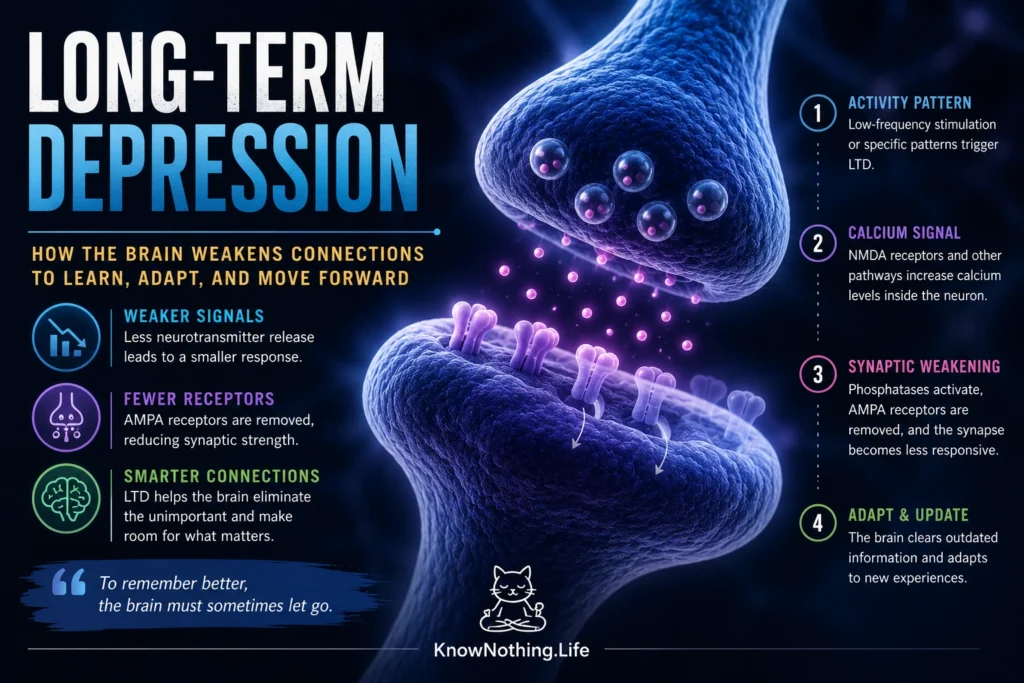
Long-term depression, usually abbreviated LTD, is a sustained reduction in the strength of communication across a synapse. The word “depression” refers to decreased synaptic effectiveness and is unrelated to clinical depression as a mood disorder. After LTD has been induced, the same presynaptic activity produces a smaller response in the postsynaptic neuron than it did before. The change may persist for an hour or much longer, depending on the synapse, stimulation pattern, developmental stage, and molecular pathway involved. Like long-term potentiation, or LTP, LTD is a form of activity-dependent synaptic plasticity through which experience changes the future behavior of neural circuits.
Synaptic weakening is not simply failed learning. A nervous system that could only strengthen its connections would gradually lose flexibility as heavily used pathways approached their functional limits. LTD helps rebalance networks, distinguish important signals from background activity, revise learned associations, and preserve room for further plasticity. Its role is therefore complementary to LTP: potentiation increases the influence of selected inputs, while depression reduces connections that are inaccurate, redundant, or poorly suited to current experience. Experiments demonstrating that LTP and LTD can reversibly control a learned response illustrate the importance of this bidirectional plasticity.
The Discovery of Persistent Synaptic Weakening
One of the earliest influential examples of LTD emerged from research on the cerebellum. In 1982, Masao Ito and colleagues reported that coordinated activation of climbing fibers and parallel fibers produced a prolonged reduction in transmission involving cerebellar Purkinje cells. The result supported theories proposing that climbing-fiber activity could modify the influence of other inputs onto Purkinje cells. Because the cerebellum helps adjust movements through experience, cerebellar LTD became a leading candidate mechanism for motor learning.
Hippocampal LTD was established more clearly a decade later. In their 1992 paper “Homosynaptic Long-Term Depression in Area CA1 of Hippocampus and Effects of N-Methyl-D-Aspartate Receptor Blockade,” Serena Dudek and Mark Bear showed that prolonged stimulation at approximately one to three hertz produced an input-specific depression lasting more than an hour in hippocampal area CA1. Blocking NMDA receptors prevented the effect. Their experiments demonstrated that the hippocampus possessed a durable, synapse-specific form of weakening that could operate as a functional counterpart to LTP.
How NMDA Receptor-Dependent LTD Works
At many hippocampal CA1 synapses, both LTP and LTD begin with glutamate activating NMDA receptors, yet they produce opposite outcomes. The difference depends partly on the magnitude and timing of calcium entry into the postsynaptic neuron. Strong, brief stimulation can produce calcium elevations that favor protein kinases and synaptic strengthening. Prolonged low-frequency activity tends to generate smaller or more sustained calcium signals that recruit protein phosphatases. Robert Mulkey and Robert Malenka showed in 1992 that low-frequency stimulation could induce a synapse-specific, saturable form of CA1 LTD requiring postsynaptic NMDA receptor activation.
The resulting signaling shifts the molecular balance from phosphorylation toward dephosphorylation. Enzymes such as calcineurin and protein phosphatase 1 can alter AMPA-type glutamate receptors and the proteins that regulate them at the postsynaptic membrane. Hyoung-Gon Lee and colleagues demonstrated in 1998 that chemically induced NMDA receptor-dependent LTD was accompanied by persistent dephosphorylation of the GluA1 subunit of AMPA receptors. This change reduces receptor effectiveness and helps prepare receptors for removal from the synaptic surface. LTD therefore involves organized biochemical modification rather than a temporary decline in neuronal excitability.
AMPA Receptor Removal and Structural Change
A major expression mechanism of hippocampal LTD is the internalization of AMPA receptors. Because these receptors carry much of the fast excitatory response at glutamatergic synapses, removing them makes the postsynaptic membrane less responsive to later glutamate release. Elva Beattie and colleagues showed in 2000 that NMDA receptor activation increased AMPA receptor endocytosis through a signaling mechanism also required for LTD. Their work helped establish receptor trafficking as one way a temporary intracellular signal can become a persistent reduction in synaptic transmission.
Functional weakening may also be accompanied by physical changes in dendritic spines, the small postsynaptic protrusions that receive many excitatory inputs. Imaging experiments have found that LTD can coincide with spine shrinkage and, under some conditions, the eventual loss of selected synaptic contacts. These are regulated, activity-sensitive processes that refine circuit organization rather than indiscriminately destroying connections. Other experiments have identified forms of LTD expressed partly through reduced presynaptic neurotransmitter release, showing that LTD is a family of related mechanisms rather than one identical process throughout the brain.
Metabotropic Glutamate Receptor-Dependent LTD
Not all LTD requires NMDA receptors. Another extensively studied form begins when glutamate activates group I metabotropic glutamate receptors, particularly mGluR5 in the hippocampus. Rather than forming ion channels, these receptors initiate intracellular signaling cascades that can stimulate AMPA receptor internalization and change local protein production within dendrites. In a landmark 2000 study, Kimberly Huber, Michael Kayser, and Mark Bear found that hippocampal mGluR-dependent LTD required rapid dendritic protein synthesis. Their findings demonstrated that synapses can recruit locally produced proteins during persistent weakening.
NMDA receptor-dependent LTD and mGluR-dependent LTD can therefore reach a similar functional result through partly distinct molecular routes. This distinction matters because a mutation, drug, or disease-related process may disrupt one form while leaving another relatively intact. Altered mGluR signaling and protein synthesis have received particular attention in experimental models of fragile X syndrome, where researchers have observed abnormal synaptic plasticity that can be modified by changing components of the mGluR5 signaling pathway. The broader lesson is that LTD names a direction of synaptic change, not a single receptor or molecular program.
LTD in Learning, Updating, and Forgetting
Evidence connecting LTD to behavior suggests that synaptic weakening can modify established memories rather than simply erase them. In the 2014 study “Engineering a Memory with LTD and LTP,” Sadegh Nabavi and colleagues used optogenetic stimulation in a fear-conditioning circuit. Inducing LTD suppressed the expression of a learned fear association, while subsequently inducing LTP restored it. The experiment provided unusually direct evidence that bidirectional changes in synaptic strength can control whether an associative memory is expressed.
LTD has also been linked to behavioral flexibility. During spatial reversal learning, an animal must stop navigating toward a previously correct location and learn that the goal has moved. Experiments using two mechanistically different inhibitors of LTD found impaired reversal performance in the Morris water maze, supporting a contribution from hippocampal LTD to updating outdated spatial information. This does not mean LTD is equivalent to forgetting. Memories may become inaccessible through interference or retrieval failure, while LTD more specifically provides a mechanism for weakening, modifying, or recontextualizing selected synaptic relationships.
Cerebellar LTD and Motor Learning
Cerebellar LTD remains an influential model of experience-dependent motor adjustment. At parallel fiber–Purkinje cell synapses, coordinated parallel-fiber and climbing-fiber activity can initiate signaling that reduces the synaptic response to later parallel-fiber input. In 1994, Atsu Aiba and colleagues reported that mice lacking the mGluR1 receptor showed deficient cerebellar LTD together with impaired motor learning and cerebellar motor abnormalities. Studies involving other cerebellar glutamate receptors have also found combinations of impaired synaptic depression, disrupted coordination, and altered motor adaptation.
The relationship between cerebellar LTD and behavior is not perfectly simple, however. Some genetically altered mice appear to retain particular forms of motor learning even when conventional LTD cannot be induced in cerebellar slices. Such findings suggest that other synapses and plasticity mechanisms can compensate or that different motor tasks depend on different forms of plasticity. The cerebellum contains adaptable connections at several sites, including inhibitory synapses and cerebellar nuclei. Cerebellar LTD is therefore an important contributor to motor adaptation, but it is not necessarily the sole cellular explanation for every form of cerebellar learning.
Why Long-Term Depression Matters
Long-term depression reveals that learning depends on selective weakening as well as strengthening. By reducing synaptic influence, LTD can prevent networks from becoming saturated, improve contrast among competing inputs, reshape developing circuits, reverse earlier potentiation, and help replace obsolete predictions. It gives neural networks a biological way to edit their responses. Without mechanisms of synaptic depression, experience could accumulate as increasingly rigid activity patterns rather than remaining open to correction and new information.
The most accurate view of LTD is not that the brain deletes one complete memory at a time. Instead, LTD is one component of a broader system of controlled neural change. Synapses strengthen, weaken, stabilize, and compete while interacting with inhibition, gene expression, intrinsic excitability, and network activity. The evidence collectively suggests that adaptation requires subtraction as well as addition: the brain learns not only by making selected pathways more powerful, but also by reducing the influence of connections that no longer fit its current model of the world.