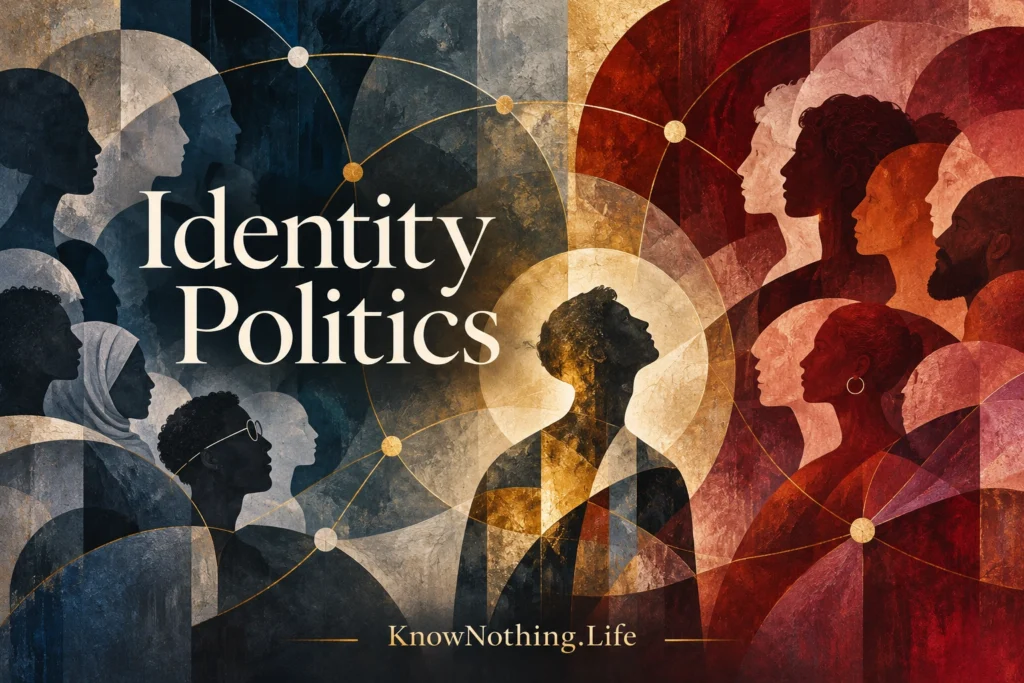
Identity politics is one of the most influential and controversial concepts in modern political philosophy. At its core, it describes political movements and perspectives organized around shared aspects of identity, including race, ethnicity, gender, sexuality, religion, nationality, and cultural background. Rather than viewing individuals exclusively as abstract citizens with identical interests, identity politics emphasizes how social experiences, historical inequalities, and collective identities influence political participation and the distribution of power.
The concept raises fundamental questions about human nature, justice, and democratic society. Should political equality require treating everyone identically, or must governments recognize differences in people’s circumstances? Can movements organized around particular identities advance universal freedom, or do they risk deepening social divisions? Philosophers such as Charles Taylor, Iris Marion Young, Nancy Fraser, and Kwame Anthony Appiah have explored these questions from different perspectives. Their work demonstrates that identity politics is not a single ideology but a continuing debate about the relationship between individuality, collective belonging, recognition, and political justice.
What Is Identity Politics?
Identity politics refers to political organization, advocacy, and interpretation in which shared identity becomes a significant basis for understanding interests, expressing grievances, or pursuing collective goals. These identities may emerge from historical discrimination, cultural traditions, religious commitments, national belonging, or experiences of exclusion from existing political institutions. Identity-based movements frequently seek recognition, legal protections, representation, and greater influence over decisions affecting their communities. However, identity politics can also involve nationalism, religious majoritarianism, or movements seeking to defend established cultural hierarchies.
An important distinction exists between recognizing identity as politically relevant and assuming that identity completely determines an individual’s beliefs or interests. People belonging to the same demographic group frequently disagree about economic policy, religion, morality, and social organization. Their experiences may overlap without producing identical political convictions. Political philosopher Cressida Heyes, in her Stanford Encyclopedia of Philosophy examination of identity politics, emphasizes the diversity of movements and theories associated with the concept. This complexity makes sweeping generalizations misleading because different forms of identity politics can pursue equality, autonomy, recognition, exclusion, or political dominance.
The Historical Origins of Identity Politics
Although political movements organized around collective identities have existed for centuries, the modern expression “identity politics” became especially prominent during the social movements of the twentieth century. Civil rights activism, women’s liberation, Indigenous rights campaigns, and gay liberation movements challenged political institutions that formally proclaimed equality while frequently excluding particular populations from meaningful participation. These movements argued that social categories could influence access to employment, education, legal protection, and political representation. Their demands were therefore not simply about celebrating difference but about confronting structures through which difference had acquired political consequences.
The Combahee River Collective, an organization of Black feminist activists established in Boston during the 1970s, played a foundational role in articulating the modern concept. Its influential 1977 statement declared, “This focusing upon our own oppression is embodied in the concept of identity politics.” The Collective argued that Black women’s experiences could not be adequately understood through political movements addressing racism, sexism, or economic inequality separately. Importantly, its conception of identity politics emphasized cooperation and broader liberation rather than isolation from other groups. Its members maintained that addressing their specific circumstances could contribute to dismantling interconnected systems of oppression affecting many people.
The Philosophy of Recognition and Human Dignity
One of the strongest philosophical foundations for identity politics is the concept of recognition. The German philosopher Georg Wilhelm Friedrich Hegel argued in Phenomenology of Spirit (1807) that self-consciousness develops through relationships with others. Individuals do not construct their identities in complete isolation; their understanding of themselves emerges partly through social interaction and mutual acknowledgment. This insight influenced later theories suggesting that exclusion, humiliation, and the denial of equal standing can undermine individual dignity even when formal legal rights appear secure.
Charles Taylor developed this argument in The Politics of Recognition (1992), asserting that “our identity is partly shaped by recognition or its absence.” Taylor distinguished between a politics of universal dignity, which emphasizes equal rights, and a politics of difference, which seeks acknowledgment of particular cultural and historical identities. The philosophical tension arises because equal treatment does not always require identical treatment. For example, protecting religious freedom may involve accommodating different religious practices, while linguistic equality may require recognizing minority languages. Yet granting special recognition also raises questions about fairness, collective rights, and the limits of state neutrality.
Intersectionality and the Complexity of Identity
A major development within identity politics came through the concept of intersectionality, most closely associated with legal scholar Kimberlé Crenshaw. In Demarginalizing the Intersection of Race and Sex (1989), Crenshaw argued that legal and political frameworks frequently treated racial discrimination and gender discrimination as separate problems, overlooking experiences emerging from their interaction. Her subsequent article, Mapping the Margins: Intersectionality, Identity Politics, and Violence Against Women of Color (1991), examined how overlapping social positions could shape vulnerability, access to protection, and the effectiveness of political responses.
Intersectionality challenges the assumption that identity groups possess internally uniform experiences. A person’s circumstances may be influenced simultaneously by socioeconomic status, disability, gender, race, nationality, and other characteristics. Consequently, political movements organized around one category can overlook differences within their own membership. Patricia Hill Collins expanded related arguments in Black Feminist Thought (1990), examining how systems of power and social knowledge interact. Critics sometimes question whether intersectional frameworks can become excessively complicated or encourage increasingly narrow categories of political identification. Supporters respond that the framework is intended to improve explanations of social inequality rather than divide individuals into endlessly competing identities.
The Psychology of Group Identity and Belonging
Identity politics also has important connections to social psychology because human beings naturally construct parts of their self-understanding through group membership. Henri Tajfel and John Turner developed social identity theory during the 1970s, proposing that individuals derive aspects of their self-concept from groups to which they belong. Tajfel and colleagues’ 1971 minimal-group experiments demonstrated that even relatively arbitrary group classifications could produce preferences favoring one’s own group. These findings suggested that intergroup distinctions do not always require long-standing historical conflict to influence behavior.
Group identification can provide emotional security, social support, collective purpose, and a sense of belonging. However, the same psychological mechanisms may encourage stereotyping, conformity, and hostility toward outsiders under certain conditions. Social identity theory does not imply that every strong group attachment inevitably produces prejudice. Instead, it reveals how the meaning assigned to group boundaries can influence judgments and relationships. This distinction is crucial for understanding identity politics: collective belonging can motivate solidarity against injustice, but political competition can also transform identities into rigid divisions between supposedly incompatible communities.
Identity Politics, Equality, and Social Justice
Supporters of identity-based political movements frequently argue that universal principles of equality cannot be fully realized without examining how institutions operate in practice. A law may appear neutral while producing unequal consequences because individuals possess different resources, histories, or opportunities. Iris Marion Young developed this argument in Justice and the Politics of Difference (1990), criticizing theories that reduce justice primarily to the distribution of material resources. Young emphasized institutional domination, political marginalization, and the social processes through which some groups gain greater influence over collective decisions.
This perspective has influenced debates about representation, discrimination, accessibility, cultural accommodation, and educational opportunity. Supporters contend that acknowledging relevant differences can make democratic institutions more responsive to citizens whose experiences have historically received insufficient attention. Critics question whether organizing policies around group categories can unintentionally reinforce those categories or create new forms of unequal treatment. The deeper philosophical problem concerns the relationship between formal equality, which requires consistent legal standards, and substantive equality, which examines whether individuals can meaningfully exercise their rights under existing social conditions.
Recognition, Economic Class, and Redistribution
One of the most significant criticisms of identity politics concerns its relationship to economic inequality. Some political theorists argue that excessive emphasis on cultural recognition can shift attention away from wages, housing, healthcare, employment conditions, and the distribution of wealth. If political debate concentrates primarily on representation and symbolic inclusion, economic institutions may remain largely unchanged. This concern has appeared in socialist, liberal, and conservative critiques, although these traditions disagree about the appropriate economic reforms and the role identity should play in democratic politics.
Nancy Fraser explored the problem in From Redistribution to Recognition? Dilemmas of Justice in a ‘Postsocialist’ Age (1995). She distinguished between injustices rooted in economic structures and those involving cultural status, while recognizing that many forms of inequality combine both dimensions. Fraser argued that justice requires attention to redistribution and recognition rather than treating them as mutually exclusive alternatives. Her framework challenges the assumption that economic class and social identity must compete for political importance. A worker’s economic circumstances, for example, may be shaped by labor markets, educational opportunities, discrimination, and institutional rules simultaneously.
Criticisms of Identity Politics and the Problem of Essentialism
A central philosophical objection to identity politics is essentialism, the tendency to treat members of a social category as though they possess a shared, fixed identity determining their values and experiences. When political movements speak on behalf of an entire group, they may overlook internal disagreements and differences in personal circumstances. Individuals can consequently feel pressured to adopt positions supposedly required by their race, religion, gender, or cultural background. Ironically, movements established to resist restrictive stereotypes may reproduce similar limitations when collective identity becomes more important than individual autonomy.
Kwame Anthony Appiah examines this dilemma in The Ethics of Identity (2005), arguing that social identities can provide valuable frameworks for constructing meaningful lives while also imposing restrictive expectations. Political theorist Mark Lilla offered a different criticism in The Once and Future Liberal: After Identity Politics (2017), arguing that excessive emphasis on subgroup identities can weaken broader democratic solidarity and political coalition-building. Defenders respond that appeals to universal citizenship can conceal existing inequalities if they ignore whose experiences historically defined supposedly neutral institutions. The disagreement therefore concerns not whether individual dignity matters, but how political communities can respect differences without making group membership the principal measure of a person’s identity or political legitimacy.
Identity Politics Across the Political Spectrum
Identity politics is frequently associated with progressive movements organized around historically marginalized groups, but collective identity also plays a significant role in conservative, nationalist, religious, and populist politics. National identity, religious heritage, regional belonging, and perceived threats to cultural traditions can become powerful motivations for political participation. Such movements may emphasize continuity, collective memory, social cohesion, or resistance to perceived cultural displacement. The political significance of identity therefore cannot be understood exclusively through one ideological tradition.
Francis Fukuyama explored this broader landscape in Identity: The Demand for Dignity and the Politics of Resentment (2018). He argues that demands for recognition help explain political mobilization across different ideological movements. However, recognizing similarities in the psychological importance of belonging does not mean that all identity-based movements possess equivalent historical circumstances, political objectives, or consequences. A movement seeking protection against discrimination differs substantively from one seeking to restrict another population’s rights. Serious political analysis must evaluate how identity is mobilized, whose interests are advanced, what institutions are affected, and whether the resulting demands respect the equal standing of others.
Identity Politics and Political Polarization
The relationship between identity and polarization has become increasingly important in contemporary political psychology. Political parties can function as social groups whose members experience loyalty toward their own side and resentment toward opponents. Shanto Iyengar and colleagues examined this phenomenon in their 2019 review, The Origins and Consequences of Affective Polarization in the United States. Their research describes how partisan identification can produce emotional divisions that extend beyond policy disagreements into personal evaluations and everyday social relationships. Individuals may begin interpreting political disagreement as evidence of another person’s character rather than a difference in judgment.
Digital communication can intensify these dynamics when political discussion rewards expressions of group loyalty and moral certainty. In a 2018 experimental study published in Proceedings of the National Academy of Sciences, Christopher Bail and colleagues found that exposing certain American Twitter users to opposing political viewpoints could increase polarization rather than reduce it. The researchers emphasized limitations on generalizing their findings beyond the studied population. The study nonetheless illustrates why merely confronting individuals with disagreement does not automatically create understanding. When political beliefs become closely connected to identity, contradictory information may be interpreted as a threat to belonging or self-respect.
Can Identity Politics and Universalism Coexist?
A common assumption in debates about identity politics is that societies must choose between protecting group differences and embracing universal human principles. Yet these objectives are not necessarily incompatible. Universalism maintains that all individuals possess equal moral worth, while attention to particular identities can reveal circumstances preventing people from enjoying that equality. The challenge is determining when recognition of difference expands freedom and when it creates new boundaries that constrain individuality or weaken cooperation.
Social psychological research suggests that constructive relationships across group boundaries can help reduce prejudice. In their 2006 meta-analysis, A Meta-Analytic Test of Intergroup Contact Theory, Thomas Pettigrew and Linda Tropp examined 515 studies containing 713 independent samples, finding that intergroup contact was generally associated with reduced prejudice. Although the effectiveness of particular interventions depends on context, the findings offer a counterpoint to the assumption that political communities must remain permanently divided by identity. Shared institutions, cooperation, and meaningful contact can provide opportunities for individuals to recognize common interests without denying the significance of their different experiences.
Final Thoughts on Identity Politics
Identity politics exposes a fundamental tension within democratic society: human beings are simultaneously individuals possessing independent moral worth and members of communities shaped by shared histories, relationships, and social institutions. Collective identity can provide solidarity, political representation, and a means of confronting injustice, but it can also encourage conformity, exclusion, and increasingly rigid distinctions between social groups. Its consequences depend upon the values, political practices, and institutional arrangements through which identity becomes a source of collective action.
The philosophical challenge is not simply to accept or reject identity politics as a whole. It is to determine how societies can acknowledge meaningful differences without reducing individuals to demographic categories, pursue equality without ignoring historical circumstances, and cultivate solidarity without demanding uniformity. The enduring question is whether political identities can become instruments for expanding human freedom rather than boundaries that permanently separate people. Can a society recognize what makes its members different while preserving the shared humanity that makes democratic coexistence possible?