How does the human mind transform an endless stream of sensory information into meaningful experience? Why can people remember conversations from decades ago yet forget why they entered a room? How do we recognize familiar faces, understand language, imagine possibilities, and make decisions about events that have not happened? These everyday abilities are so deeply integrated into human life that their extraordinary complexity often goes unnoticed. Every moment of awareness depends on interacting psychological processes that select information, interpret experiences, retrieve memories, and guide behavior.
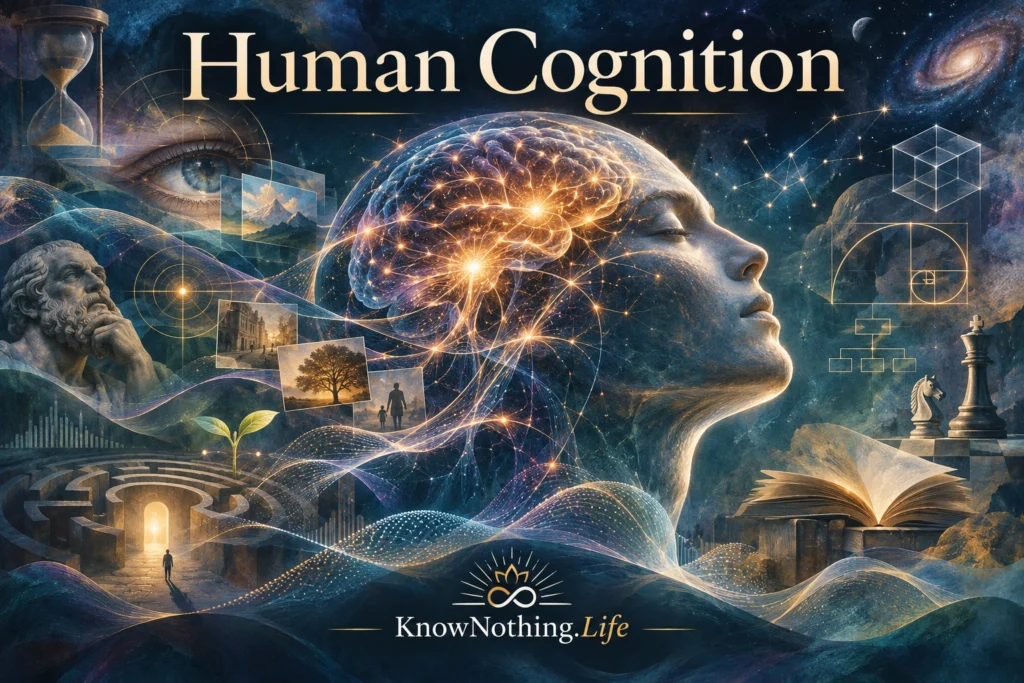
Human cognition refers to the mental processes involved in acquiring, organizing, interpreting, storing, and using information. It encompasses perception, attention, memory, language, learning, reasoning, imagination, problem-solving, and decision-making. Cognitive science investigates these abilities through psychology, neuroscience, philosophy, linguistics, and computer science, seeking to understand how thought emerges from the activities of the brain, body, and environment. Modern research has revealed that human cognition is neither a perfectly rational information-processing system nor a passive reflection of external reality. It is an adaptive, constructive, and sometimes unreliable process through which individuals develop their understanding of the world.
What Is Human Cognition?
Human cognition describes the collection of psychological processes that make knowledge and intelligent behavior possible. When someone reads a sentence, several cognitive systems operate simultaneously. Visual perception identifies letters, attention selects relevant information, memory retrieves word meanings, and language processing mechanisms organize individual words into a coherent message. Reasoning may then connect that message to previous knowledge or evaluate whether its claims are believable. Although researchers often examine these processes separately, ordinary thinking depends on their continuous interaction. Cognition is therefore best understood as a coordinated set of capacities rather than one isolated mental ability.
The modern field of cognitive psychology developed partly as a response to behaviorism, which emphasized observable behavior and environmental influences. In his influential 1967 book Cognitive Psychology, psychologist Ulric Neisser described cognition as involving processes through which sensory information is “transformed, reduced, elaborated, stored, recovered, and used.” This definition helped establish an approach that treated internal mental processes as legitimate subjects of scientific investigation. The cognitive revolution drew additional inspiration from information theory, linguistics, and early computer science, although contemporary researchers increasingly recognize that human thought cannot be explained entirely through a simple computer analogy.
Perception and How the Brain Constructs Reality
Perception is the process through which the nervous system organizes sensory information into meaningful representations of the environment. Although people commonly assume they see the world exactly as it exists, perception is an active interpretation rather than a direct recording. The brain must determine which objects are present, distinguish relevant patterns from background information, and resolve uncertainty within incomplete sensory input. Visual illusions demonstrate this constructive process by revealing circumstances in which perceptual expectations produce experiences that differ from measurable physical properties. These errors are not necessarily evidence of defective perception; they often arise from mechanisms that normally allow individuals to interpret complex environments efficiently.
One influential contemporary explanation involves predictive processing. In his 2013 article Whatever Next? Predictive Brains, Situated Agents, and the Future of Cognitive Science, philosopher and cognitive scientist Andy Clark examined the proposal that the brain continuously generates expectations about incoming sensory information and adjusts them when discrepancies arise. Under this framework, perception emerges partly through interactions between sensory evidence and predictions informed by previous experience. Predictive processing remains an influential theoretical approach rather than a universally accepted complete explanation of cognition. Nevertheless, it illustrates a fundamental discovery: what people perceive depends not only on information entering the senses, but also on what their minds have learned to expect.
Attention and the Limits of Conscious Awareness
The human environment contains far more information than conscious awareness can process simultaneously. Attention allows individuals to prioritize certain objects, thoughts, or activities while filtering competing information. This selective capacity makes concentration possible, but it also creates blind spots. A person reading an absorbing novel may fail to notice background conversations, while someone focusing on a complicated task may overlook an otherwise obvious change in their surroundings. Attention is influenced by personal goals, emotional significance, novelty, and the demands of the current activity. Consequently, consciousness provides only a selective representation of what is happening around us.
Psychologists Daniel Simons and Christopher Chabris demonstrated this limitation in their famous 1999 study, Gorillas in Our Midst: Sustained Inattentional Blindness for Dynamic Events. Participants watched a video of people passing basketballs and counted particular passes. Many failed to notice an unexpected person wearing a gorilla costume walking through the scene. The experiment demonstrated that directing attention toward one task can prevent awareness of other visible events. This phenomenon, known as inattentional blindness, challenges the assumption that people consciously register everything occurring within their visual field. Effective attention necessarily involves selection, and selection means that some potentially important information will be missed.
Memory and the Reconstruction of Experience
Memory allows information acquired through experience to influence future thinking and behavior. Researchers commonly distinguish among working memory, episodic memory, semantic memory, and procedural learning. Working memory temporarily maintains and manipulates information needed for immediate activities, such as remembering a telephone number long enough to enter it or holding several ideas together while solving a problem. In their influential 1974 chapter Working Memory, Alan Baddeley and Graham Hitch proposed a model involving interacting components responsible for maintaining and controlling information. Later refinements expanded the framework, while psychologist Nelson Cowan’s 2001 research suggested that the focus of attention often accommodates approximately four meaningful units under carefully controlled conditions.
Long-term memory provides a different set of capacities. Episodic memory involves personally experienced events, semantic memory concerns general knowledge, and procedural learning supports skills and habits. Psychologist Endel Tulving helped formalize the distinction between episodic and semantic memory in 1972. Importantly, remembering is not equivalent to replaying an exact recording. In their 1974 study, Reconstruction of Automobile Destruction, Elizabeth Loftus and John Palmer demonstrated that the wording of questions could influence participants’ reports about a witnessed event. Their findings helped establish the reconstructive nature of memory. Remembering involves rebuilding an experience from stored information, expectations, and contextual cues, meaning that confidence and accuracy do not always correspond.
Learning and the Development of Knowledge
Learning allows cognition to change through experience. Human beings acquire knowledge through direct observation, practice, social interaction, instruction, and the consequences of their actions. Classical conditioning, investigated by Ivan Pavlov, demonstrates how previously neutral events can acquire significance through association. Operant conditioning, developed extensively through B. F. Skinner‘s research, examines how consequences influence the likelihood of behavior. Yet human learning also involves complex mental representations, goals, interpretation, and understanding. A student learning mathematics does more than associate symbols with rewards; successful comprehension requires recognizing relationships and applying principles to unfamiliar problems.
Modern cognitive research has identified learning strategies that can substantially improve long-term retention. In their 2006 study, Test-Enhanced Learning: Taking Memory Tests Improves Long-Term Retention, Henry Roediger and Jeffrey Karpicke demonstrated that retrieving information through testing can strengthen later memory more effectively than additional studying under certain conditions. This phenomenon, known as the testing effect, challenges the belief that repeatedly reviewing material is always the best way to learn. Learning also depends on meaningful organization, feedback, practice, and opportunities to correct errors. Rather than functioning as passive storage, the mind actively reorganizes knowledge as new information becomes connected to existing understanding.
Language, Concepts, and Cognitive Development
Language dramatically expands the possibilities of human cognition by allowing individuals to represent abstract ideas, communicate knowledge, and organize complex relationships. Words enable people to discuss justice, probability, time, and hypothetical events without requiring the immediate presence of physical objects. Linguist Noam Chomsky challenged strictly behaviorist explanations of language acquisition, arguing that human linguistic competence requires consideration of underlying mental structures. Other researchers emphasize statistical learning, social interaction, and developmental experience. Contemporary theories differ concerning the relative importance of innate capacities and learning, but language clearly interacts with reasoning, memory, categorization, and the transmission of knowledge.
Cognitive development also reveals how the organization of thought changes throughout childhood. Jean Piaget investigated children’s developing understanding of objects, numbers, and logical relationships, while Lev Vygotsky emphasized the importance of social interaction and cultural tools. More recent research has challenged some of Piaget’s proposed developmental timelines. In her 2000 article Core Knowledge, psychologist Elizabeth Spelke examined evidence that infants possess early systems for representing aspects of objects, number, and space. Such findings suggest that human cognition develops through interactions between early capacities and extensive learning. Children are not simply miniature adults possessing less information; their understanding of the world changes as cognitive abilities, experience, and social knowledge develop.
Reasoning, Decision-Making, and Cognitive Biases
Human reasoning allows individuals to draw conclusions, evaluate evidence, imagine consequences, and solve unfamiliar problems. However, people do not always reason through deliberate logical analysis. Everyday decisions frequently depend on mental shortcuts known as heuristics, which simplify complex judgments and reduce cognitive effort. These strategies can be highly useful, particularly when information is incomplete or decisions must be made quickly. Nevertheless, they can also produce systematic errors. Someone might overestimate the danger of an unusual event because dramatic examples are easy to remember, or judge a person according to a familiar stereotype rather than relevant statistical information.
Psychologists Amos Tversky and Daniel Kahneman examined these tendencies in their landmark 1974 Science article, Judgment Under Uncertainty: Heuristics and Biases. They investigated mechanisms including availability, representativeness, and anchoring, demonstrating how apparently intuitive judgments can depart from statistical principles. Kahneman later popularized the distinction between fast, intuitive thinking and slower, more deliberate reasoning in Thinking, Fast and Slow (2011). Although dual-process theories remain influential, researchers Jonathan Evans and Keith Stanovich emphasized in their 2013 paper Dual-Process Theories of Higher Cognition that these processes should not be reduced to two literal, completely separate systems. Human thinking involves multiple interacting mechanisms, and deliberate reasoning is not automatically correct simply because it requires greater effort.
Metacognition and Understanding Our Own Thinking
One of the most distinctive human cognitive abilities is metacognition, commonly described as thinking about thinking. Metacognition allows individuals to evaluate what they know, recognize uncertainty, monitor comprehension, and adjust learning strategies. Someone studying a difficult concept may recognize that they can repeat its definition without understanding how it works. Another person may notice that their confidence in a judgment exceeds the available evidence. Psychologist John Flavell helped establish metacognition as an important research field through his 1979 article Metacognition and Cognitive Monitoring, emphasizing the development of knowledge about one’s own cognitive activities.
Yet metacognitive judgments are themselves vulnerable to error. In their 2002 study, The Misunderstood Limits of Folk Science: An Illusion of Explanatory Depth, Leonid Rozenblit and Frank Keil demonstrated that individuals frequently overestimate their understanding of everyday mechanisms. When participants attempted detailed explanations, they often discovered that their knowledge was substantially less complete than expected. This illustrates an important paradox: the mind must evaluate its own understanding using processes that are themselves imperfect. Intellectual humility, deliberate self-testing, and willingness to revise beliefs can therefore improve the accuracy of metacognitive judgments.
Neuroscience and the Biological Foundations of Cognition
Cognitive neuroscience investigates how mental abilities arise through the coordinated activity of neural systems. Memory, perception, attention, language, and decision-making involve distributed networks rather than isolated brain regions functioning independently. The hippocampus plays an important role in forming certain kinds of memory, while prefrontal systems contribute to cognitive control, planning, and the regulation of goal-directed behavior. Sensory regions process information from the environment, and large-scale interactions among these systems support flexible thinking. Neuroimaging and studies of neurological injury have helped researchers connect cognitive functions with patterns of brain activity, although observing such relationships does not always establish direct causation.
Consciousness presents an especially challenging problem because cognitive processing can occur without conscious awareness. People can learn associations, recognize certain patterns, and prepare responses without being able to describe every operation involved. In their 2011 review, Experimental and Theoretical Approaches to Conscious Processing, neuroscientists Stanislas Dehaene and Jean-Pierre Changeux examined evidence concerning neural activity associated with conscious access. Their global neuronal workspace framework proposes that information becomes consciously accessible when it is made available across distributed brain systems. Other theories offer competing explanations, and the precise mechanisms producing subjective experience remain debated. Understanding how the brain processes information is therefore closely related to, but not identical with, explaining why those processes are accompanied by conscious awareness.
Culture, Technology, and the Extended Mind
Human cognition does not operate independently of social and cultural environments. Education, language, technology, social expectations, and historical circumstances shape how individuals learn, remember, and solve problems. In their influential 2010 article, The Weirdest People in the World?, Joseph Henrich, Steven Heine, and Ara Norenzayan argued that psychological research relied disproportionately on participants from Western, educated, industrialized, rich, and democratic societies. Their analysis challenged researchers to avoid treating findings from narrow populations as universal descriptions of human cognition. Although humans share important biological capacities, cultural practices can influence attention, reasoning, categorization, and social understanding.
Technology also changes the relationship between internal thinking and external information. Writing, diagrams, calculators, search engines, and digital devices allow individuals to perform tasks that would be difficult using unaided memory alone. Philosophers Andy Clark and David Chalmers explored this possibility in their 1998 paper The Extended Mind, arguing that certain external resources can sometimes function as components of cognitive processes. Whether these resources literally constitute parts of the mind remains philosophically contested, but their practical significance is undeniable. Human intelligence depends not only on what individuals store internally, but also on how effectively they interact with tools, environments, and other people.
Final Thoughts on Human Cognition
Human cognition is an extraordinary collection of processes through which the mind transforms information into understanding and action. Perception organizes sensory experience, attention selects what becomes relevant, memory connects the present with the past, and learning modifies knowledge through experience. Language enables abstract thought, reasoning supports judgment, and metacognition allows individuals to examine their own intellectual limitations. Modern psychology and neuroscience demonstrate that these capacities are deeply interconnected, shaped by biological mechanisms, individual development, and social environments.
Perhaps the most important discovery is that human cognition is simultaneously powerful and imperfect. The mind can imagine distant futures, construct scientific theories, and communicate ideas across generations, yet it remains susceptible to illusions, memory distortions, overconfidence, and systematic reasoning errors. These limitations are not simply defects within an otherwise flawless system. Many emerge from the same adaptive processes that allow human beings to function efficiently in a complex world. Understanding cognition therefore requires appreciating both its remarkable abilities and its inherent constraints. By studying how people perceive, remember, think, and decide, cognitive science provides a deeper understanding not only of intelligence, but of the psychological foundations of human experience itself.