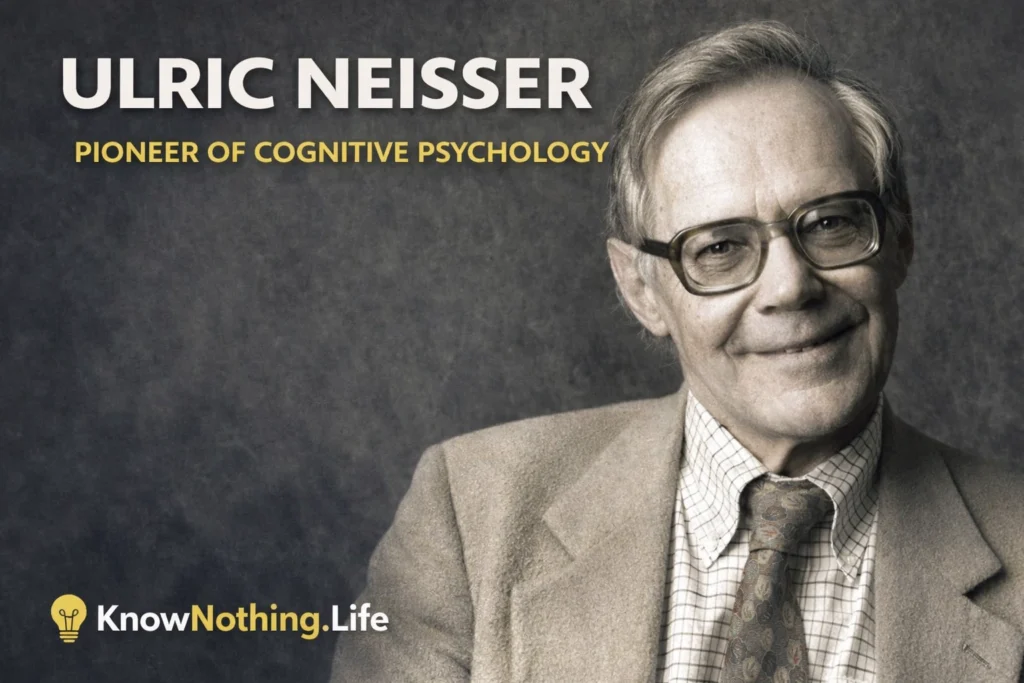
The emergence of cognitive psychology as a dominant force in modern psychological science is inseparable from the work of Ulric Neisser. Often referred to as the “father of cognitive psychology,” Neisser helped redefine the field by shifting attention away from behaviorist explanations of human action and toward the internal processes of the mind. His work provided a framework for understanding how people perceive, remember, think, and interpret the world—functions that had been largely neglected during the behaviorist era.
Neisser’s contributions were not merely theoretical; they represented a methodological and philosophical transformation. By integrating insights from psychology, neuroscience, linguistics, and computer science, he helped establish cognition as a legitimate object of scientific study. His landmark book Cognitive Psychology (1967) did not just summarize a new field—it helped create it. Through his writing and research, Neisser challenged the dominance of behaviorism associated with figures like B. F. Skinner and opened the door to a richer understanding of the human mind.
Early Life and Intellectual Formation
Ulric Gustav Neisser was born on December 8, 1928, in Kiel, Germany, into a Jewish family. With the rise of the Nazi regime, his family emigrated to the United States, a transition that would shape both his personal and intellectual development. Growing up in an environment marked by cultural adaptation and intellectual curiosity, Neisser developed an early interest in understanding how people perceive and interpret their surroundings.
He pursued his undergraduate studies at Harvard University, where he was influenced by leading psychologists of the time, including George A. Miller, whose work on memory and information processing would later intersect with Neisser’s own research. Neisser continued his graduate studies at Swarthmore College, where he was exposed to Gestalt psychology—a perspective that emphasized the holistic nature of perception and the organization of experience.
This combination of influences—behaviorism, Gestalt theory, and emerging information-processing models—provided the intellectual foundation for Neisser’s later work. Rather than aligning himself fully with any single tradition, he sought to synthesize these perspectives into a coherent approach to understanding cognition.
Cognitive Psychology and the Birth of a Field
Neisser’s most significant contribution came with the publication of Cognitive Psychology in 1967, a work that effectively defined and named the field. In this book, he described cognition as “all the processes by which sensory input is transformed, reduced, elaborated, stored, recovered, and used.” This definition provided a comprehensive framework for studying mental processes, encompassing perception, memory, language, and problem-solving.
The timing of this publication was crucial. Psychology was undergoing a paradigm shift, often referred to as the cognitive revolution, as researchers began to question the limitations of behaviorism. Neisser’s book synthesized a wide range of emerging research into a unified perspective, giving coherence and direction to a rapidly evolving field.
Importantly, Neisser did not view cognition as an abstract or purely theoretical construct. He emphasized the importance of studying mental processes in real-world contexts, arguing that laboratory experiments should reflect the complexity of everyday life. This commitment to ecological validity would become a defining feature of his later work.
Perception, Memory, and the Ecological Approach
One of Neisser’s most influential ideas was his emphasis on the ecological study of cognition. He argued that traditional laboratory experiments often oversimplified mental processes, stripping them of the context in which they naturally occur. Instead, he advocated for research that examined how people perceive and remember information in real-world environments.
In his book Cognition and Reality (1976), Neisser critiqued the artificial nature of many cognitive experiments and called for a more naturalistic approach. He wrote, “If X is an interesting or socially important aspect of memory, then psychologists have hardly ever studied X.” This statement reflects his concern that the field had become disconnected from meaningful human experience.
Neisser’s work on memory also challenged prevailing assumptions. He emphasized that memory is not a passive storage system but an active, reconstructive process. Rather than simply retrieving stored information, individuals interpret and reshape memories based on context, expectations, and prior knowledge. This perspective has had lasting influence on research into eyewitness testimony, autobiographical memory, and the reliability of recollection.
Major Works and Intellectual Contributions
In addition to Cognitive Psychology and Cognition and Reality, Neisser made significant contributions through his edited volumes and collaborative research. His work on memory, particularly in relation to real-world events, helped bridge the gap between experimental psychology and everyday experience.
One notable example is his involvement in research on flashbulb memories—vivid recollections of emotionally significant events. Neisser’s studies of memories related to the Challenger Space Shuttle disaster revealed that even highly confident memories can be inaccurate. This finding challenged the assumption that emotional intensity guarantees accuracy, highlighting the complex and fallible nature of human memory.
Neisser’s contributions also extended to the study of self and identity. He proposed a multi-faceted model of the self, encompassing ecological, interpersonal, and conceptual dimensions. This work anticipated later developments in social and developmental psychology, demonstrating the breadth of his intellectual influence.
Criticism and Evolution of His Thought
Neisser’s work was not without criticism, and he himself was often one of his own most vocal critics. While his early contributions helped establish cognitive psychology as a dominant paradigm, he later expressed concern that the field had become too focused on abstract models and computational metaphors. He argued that cognition could not be fully understood through analogies to computers, as human thought is deeply embedded in physical and social contexts.
Some critics also questioned the feasibility of Neisser’s ecological approach, noting the challenges of conducting controlled experiments in real-world settings. Balancing scientific rigor with ecological validity remains an ongoing challenge in psychology.
Despite these critiques, Neisser’s willingness to revise and refine his ideas reflects his commitment to scientific integrity. He did not seek to defend a fixed framework but rather to advance a deeper understanding of cognition. His evolving perspective enriched the field, encouraging researchers to consider both experimental precision and real-world relevance.
Legacy and Lasting Influence
Ulric Neisser’s legacy is profound and far-reaching. By defining and shaping cognitive psychology, he helped transform the study of the mind into a central focus of psychological science. His work laid the foundation for research in areas such as perception, memory, attention, and language, influencing generations of psychologists and cognitive scientists.
His emphasis on real-world cognition has had lasting impact, particularly in applied fields such as education, human-computer interaction, and forensic psychology. The recognition that memory is reconstructive, for example, has informed legal practices and the evaluation of eyewitness testimony.
Neisser once remarked, “We must not be content to describe what people do; we must try to understand how they do it.” This statement captures the essence of his contribution: a commitment to uncovering the processes underlying human thought. His work continues to inspire researchers to explore the complexities of cognition with both rigor and relevance.
Final Thoughts
To study Ulric Neisser is to engage with the intellectual transformation that brought the mind back into psychology. His work challenged the limitations of behaviorism and opened new avenues for understanding perception, memory, and thought. By integrating diverse perspectives and emphasizing real-world relevance, he created a framework that remains central to modern psychology.
Neisser’s legacy is not only in the theories he developed but in the questions he raised. He encouraged psychologists to look beyond simplified models and to consider the richness of human experience. In doing so, he helped shape a field that continues to evolve, grounded in the belief that understanding the mind is essential to understanding ourselves.