Jürgen Habermas was born on June 18, 1929, in Düsseldorf, Germany, into a society marked by the collapse of democratic institutions and the rise of totalitarianism. His early life unfolded during the final years of the Nazi Germany, an experience that profoundly shaped his philosophical concerns. Growing up in the shadow of ideological manipulation and political violence, Habermas developed a deep commitment to understanding how rational discourse could be distorted—and how it might be restored. These formative conditions would later inform his lifelong project of defending democracy through communication and reason.
Habermas studied philosophy, history, and sociology at several German universities, eventually completing his doctorate in Bonn. He became associated with the Frankfurt School, a group of thinkers dedicated to analyzing the social and cultural conditions of modern society. Influenced by figures such as Theodor Adorno and Max Horkheimer, Habermas initially adopted the critical theory tradition but soon sought to revise and expand it. While earlier Frankfurt School theorists emphasized the pervasive domination of reason by instrumental rationality, Habermas aimed to recover a more hopeful vision of rationality grounded in communication and mutual understanding.
The Public Sphere and Democratic Life
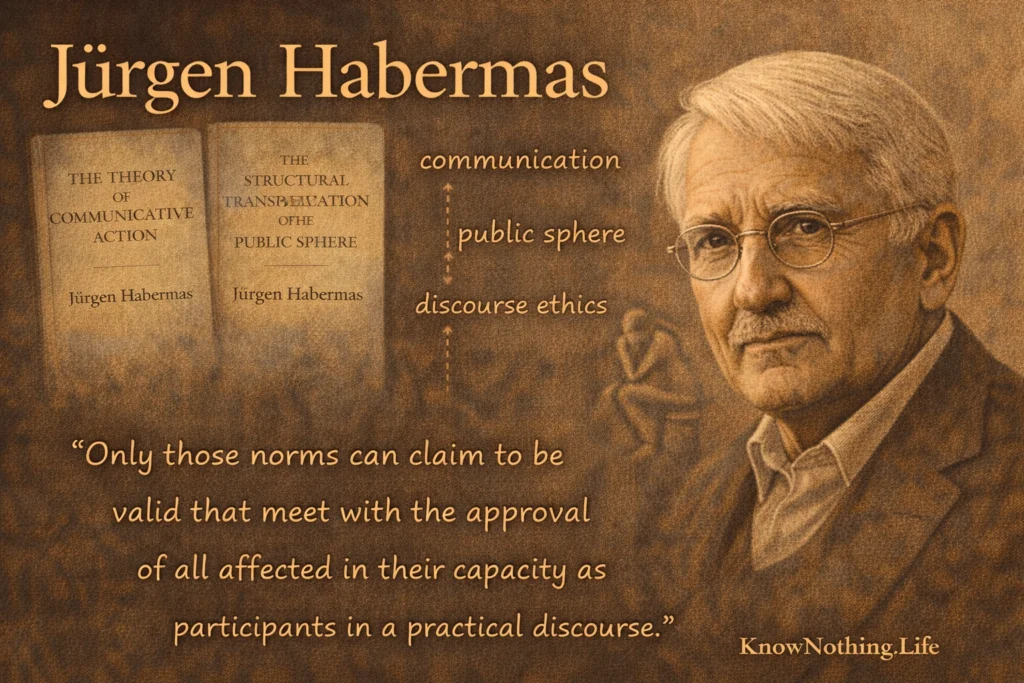
Habermas’s early major work, The Structural Transformation of the Public Sphere, introduced one of his most influential concepts: the public sphere. He traced the emergence of a space in early modern Europe where private individuals could come together to discuss matters of common concern, free from direct state control. This sphere, exemplified by salons, coffeehouses, and print culture, allowed for the formation of public opinion through rational-critical debate.
However, Habermas argued that this ideal of the public sphere had been undermined in modern societies by the rise of mass media, corporate influence, and bureaucratic power. Instead of facilitating open dialogue, these forces often manipulate public opinion, turning citizens into passive consumers rather than active participants. This critique reflects Habermas’s broader concern with the conditions necessary for genuine democratic engagement.
Despite this diagnosis, Habermas did not abandon the ideal of the public sphere. Rather, he sought to reconstruct it as a normative model for democratic life, emphasizing the importance of inclusive, reasoned debate. For Habermas, democracy depends not only on formal institutions but also on the quality of communication among citizens. His work in this area continues to influence political theory, media studies, and democratic practice, offering a framework for understanding both the challenges and possibilities of modern public life.
Communicative Action and Rationality
Habermas’s most ambitious philosophical project is articulated in The Theory of Communicative Action, where he develops a comprehensive account of rationality grounded in communication. Rejecting the narrow focus on instrumental reason—the type of reasoning used to achieve specific goals—Habermas proposed a broader concept of communicative rationality. This form of rationality emerges in dialogue, where participants aim not to dominate but to reach mutual understanding.
Central to this theory is the idea that communication involves implicit claims to validity, including truth, rightness, and sincerity. When individuals engage in discourse, they open these claims to critique and justification, creating the possibility of rational agreement. Habermas argued that this process forms the basis of social coordination and ethical life, providing an alternative to systems driven solely by power or economic exchange. “The unforced force of the better argument,” he wrote, captures his belief in the potential of rational discourse to guide human interaction.
Habermas’s distinction between the “lifeworld” and “system” further elaborates this framework. The lifeworld encompasses the shared cultural and social contexts in which communication takes place, while the system refers to the formal structures of power and economy. He warned that the colonization of the lifeworld by systemic forces—such as market logic and bureaucratic control—threatens the integrity of communication and, by extension, democratic life. This analysis highlights the tension between human interaction and institutional structures, a theme that runs throughout his work.
Ethics, Discourse, and Moral Reasoning
Building on his theory of communicative action, Habermas developed a distinctive approach to ethics known as discourse ethics. This framework seeks to ground moral principles in the conditions of rational communication, rather than in metaphysical or religious foundations. According to Habermas, a norm is valid only if it can be justified in a process of open and inclusive dialogue, where all affected parties have the opportunity to participate.
Discourse ethics emphasizes the importance of fairness, equality, and mutual respect in moral reasoning. It rejects both relativism and authoritarianism, proposing instead a procedural approach to ethics that relies on the quality of communication. In this sense, morality is not imposed from above but emerges through collective deliberation. Habermas’s approach reflects his broader commitment to democratic ideals, extending them into the realm of ethical theory.
His engagement with other philosophical traditions, including debates with thinkers such as Michel Foucault and Jacques Derrida, further illustrates his commitment to dialogue. While he disagreed with aspects of post-structuralist thought, Habermas recognized the importance of engaging with diverse perspectives in the pursuit of understanding. This openness to debate underscores his belief that philosophy itself must embody the principles of communicative rationality.
Religion, Modernity, and Global Society
In his later work, Habermas turned his attention to the role of religion in modern societies and the challenges of globalization. Contrary to earlier secularization theories, he argued that religion continues to play a significant role in public life, offering moral resources that cannot be easily replaced by purely secular reasoning. However, he maintained that religious arguments must be translated into a language accessible to all citizens in order to participate in democratic discourse.
Habermas’s reflections on modernity emphasize the need to balance tradition and innovation, recognizing both the achievements and the limitations of Enlightenment thought. He defended the project of modernity against critics who viewed it as inherently flawed, arguing that its ideals of reason, freedom, and equality remain worth pursuing. At the same time, he acknowledged the need to address the inequalities and exclusions that persist within modern societies.
His work on globalization explores the challenges of creating democratic institutions beyond the nation-state. Habermas advocated for stronger international cooperation and the development of transnational public spheres, where global issues could be addressed through collective deliberation. This vision reflects his belief that the principles of communicative rationality can be extended to the global level, offering a framework for addressing complex, interconnected problems.
Legacy and Enduring Influence
Jürgen Habermas is widely regarded as one of the most important living philosophers, whose work has shaped contemporary debates in philosophy, political theory, sociology, and law. His emphasis on communication, reason, and democracy offers a powerful alternative to both skepticism and authoritarianism, highlighting the potential of dialogue to foster understanding and cooperation.
Habermas’s influence extends beyond academia, informing discussions about media, public policy, and international relations. His ideas about the public sphere and communicative action have been applied to issues ranging from digital communication to global governance, demonstrating their continued relevance in a rapidly changing world. His commitment to clarity and engagement has made his work accessible to a broad audience, reinforcing his role as a public intellectual.
Perhaps Habermas’s most enduring contribution lies in his defense of reason as a shared human capacity, one that enables individuals to transcend differences and work toward common goals. In an era often characterized by polarization and mistrust, his vision of rational discourse offers a hopeful alternative, emphasizing the possibility of understanding through dialogue.
As he once observed, “Only those norms can claim to be valid that meet with the approval of all affected in their capacity as participants in a practical discourse.” This statement encapsulates the core of his philosophy: a belief in the power of communication to ground truth, morality, and democratic life. Through his extensive body of work, Jürgen Habermas has provided a framework for thinking about the challenges of modernity, offering insights that continue to guide and inspire.