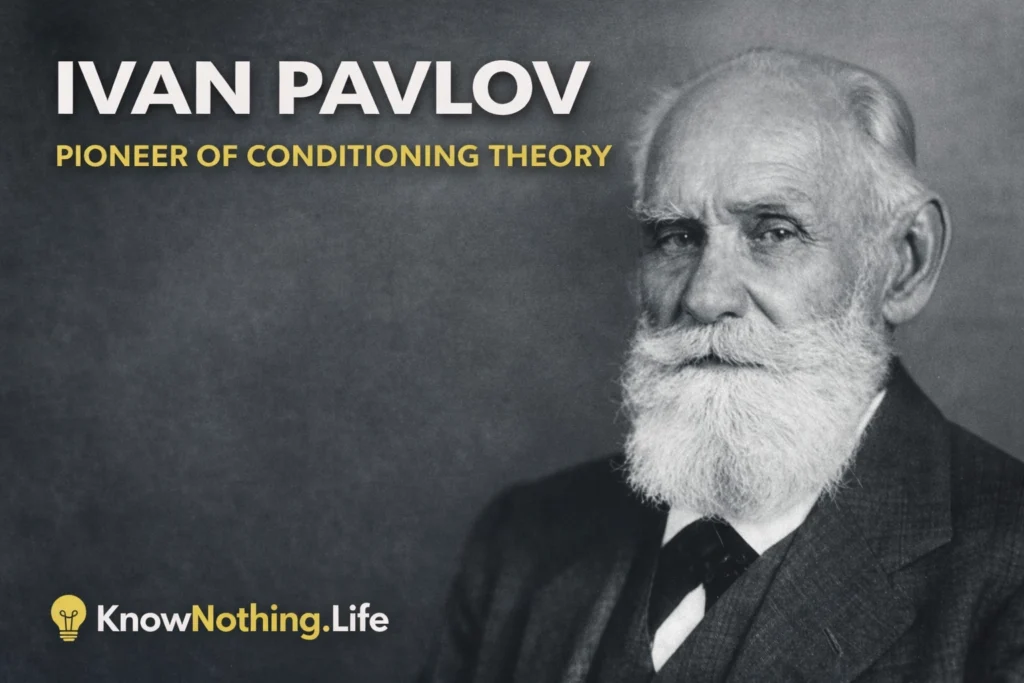
The name Ivan Pavlov is inseparable from the origins of modern behavioral science. Though trained as a physiologist rather than a psychologist, Pavlov’s meticulous experiments on digestion and reflexes led to one of the most influential discoveries in the history of psychology: classical conditioning. His work demonstrated that behavior could be studied scientifically through observable responses to environmental stimuli, laying the groundwork for later developments in behaviorism and experimental psychology.
Pavlov’s legacy extends far beyond the famous image of dogs salivating at the sound of a bell. His research established a rigorous experimental approach that transformed vague philosophical questions about behavior into measurable scientific inquiry. By revealing how organisms learn through association, Pavlov provided a framework that would influence generations of thinkers, including John B. Watson and B. F. Skinner. His work remains foundational in psychology, neuroscience, and even modern therapeutic practices.
Early Life and Intellectual Development
Ivan Petrovich Pavlov was born on September 14, 1849, in Ryazan, Russia, into a deeply religious family. His father was a village priest, and Pavlov initially followed a similar path, enrolling in a theological seminary. However, his intellectual trajectory shifted dramatically after encountering scientific literature, particularly the works of Russian physiologist Ivan Sechenov, whose ideas about reflexes and brain function inspired Pavlov to pursue science instead of theology.
Pavlov left the seminary to study natural sciences at the University of St. Petersburg, where he immersed himself in physiology and chemistry. His early academic work focused on the circulatory and digestive systems, fields that would later provide the foundation for his most famous experiments. He continued his training at the Imperial Medical Academy, where he refined his experimental techniques and developed a reputation for precision and discipline.
Throughout his early career, Pavlov was driven by a commitment to empirical rigor. He rejected speculative explanations of behavior in favor of measurable, observable phenomena. This scientific mindset would define his approach to research and ultimately lead to his groundbreaking discoveries in conditioning.
Research on Digestion and the Path to Conditioning
Pavlov’s initial fame came from his research on the physiology of digestion, for which he was awarded the Nobel Prize in Physiology or Medicine in 1904. His experiments involved surgically preparing dogs to measure salivary and gastric secretions in response to food. These studies required extraordinary precision and control, as Pavlov sought to isolate the mechanisms underlying digestive processes.
During these experiments, Pavlov observed an unexpected phenomenon: the dogs began to salivate not only when food was presented but also when they anticipated it. The mere sight of the lab assistant or the sound of footsteps could trigger salivation. This observation led Pavlov to investigate what he called “psychic secretions,” a term he later replaced with the concept of conditioned reflexes.
This shift marked a pivotal moment in the history of science. Pavlov realized that behavior could be shaped through associations between stimuli. By systematically pairing a neutral stimulus—such as a bell—with food, he demonstrated that the neutral stimulus could eventually elicit the same response as the food itself. This discovery became known as classical conditioning, a principle that would revolutionize the study of learning and behavior.
Classical Conditioning and Experimental Innovation
At the heart of Pavlov’s work is the concept of classical conditioning, a process by which a previously neutral stimulus becomes capable of eliciting a response through repeated association with an unconditioned stimulus. In Pavlov’s experiments, food served as the unconditioned stimulus, naturally producing salivation. The bell, initially neutral, became a conditioned stimulus after being paired with food, eventually triggering salivation on its own.
Pavlov’s experimental design was notable for its precision and repeatability. He introduced key concepts such as the conditioned response, extinction, generalization, and discrimination. These principles allowed researchers to map the dynamics of learning in a systematic way. For example, Pavlov showed that conditioned responses could diminish over time if the association was no longer reinforced, a process known as extinction.
One of Pavlov’s most enduring insights was that learning is fundamentally associative. He wrote, “Do not become a mere recorder of facts, but try to penetrate the mystery of their origin.” This statement reflects his belief that scientific inquiry should go beyond observation to uncover underlying mechanisms. His work transformed the study of behavior into a disciplined science, grounded in experimentation and theory.
Major Works and Scientific Contributions
Pavlov’s ideas were disseminated through a series of influential publications that shaped the development of psychology and physiology. His most important work, Conditioned Reflexes (1927), provided a comprehensive account of his experiments and theoretical framework. In this book, Pavlov detailed the mechanisms of conditioning and outlined the broader implications of his findings for understanding behavior.
Another significant contribution was his research on higher nervous activity, which explored how the brain processes and responds to stimuli. Pavlov sought to bridge the gap between physiology and psychology, arguing that mental processes could be understood in terms of neural activity and reflexes. This approach anticipated later developments in neuroscience and cognitive science.
Pavlov’s work also had practical applications in medicine and psychiatry. He investigated how conditioned reflexes could be used to understand and treat disorders, particularly those involving maladaptive behaviors. His research influenced early behavioral therapies and continues to inform modern approaches to mental health treatment.
Influence on Psychology and Behaviorism
The impact of Pavlov’s work on psychology cannot be overstated. His discovery of classical conditioning provided a scientific basis for the study of learning, influencing the rise of behaviorism in the early 20th century. John B. Watson, often considered the founder of behaviorism, drew heavily on Pavlov’s findings to argue that psychology should focus exclusively on observable behavior.
Later, B. F. Skinner expanded on these ideas with his theory of operant conditioning, which emphasized the role of consequences in shaping behavior. While Pavlov focused on involuntary responses, Skinner explored voluntary actions, creating a complementary framework that further advanced behavioral science.
Pavlov’s influence also extends to fields such as education, advertising, and neuroscience. The principles of conditioning are used to understand how habits form, how preferences are shaped, and how behaviors can be modified. His work remains a cornerstone of psychological theory and practice, demonstrating the enduring relevance of his discoveries.
Criticism and Limitations
Despite his groundbreaking contributions, Pavlov’s work has been subject to criticism. Some scholars argue that classical conditioning provides an incomplete account of human behavior, as it does not fully address the role of cognition, emotion, and individual differences. The rise of cognitive psychology in the mid-20th century challenged the behaviorist emphasis on observable behavior, highlighting the importance of mental processes.
Critics have also pointed out that Pavlov’s experiments, conducted primarily on animals, may not fully generalize to human behavior. While the basic principles of conditioning apply across species, human learning is influenced by complex cognitive and social factors that extend beyond simple associations.
Nevertheless, these criticisms do not diminish the significance of Pavlov’s work. Instead, they highlight the evolving nature of scientific inquiry, in which new perspectives build upon and refine earlier theories. Pavlov’s contributions remain foundational, even as the field continues to expand.
Legacy and Lasting Impact
Ivan Pavlov’s legacy is one of scientific rigor, intellectual curiosity, and transformative insight. His work established a new paradigm for understanding behavior, one that continues to shape research and practice across multiple disciplines. From the laboratory to the classroom, the principles of classical conditioning remain deeply embedded in the study of learning.
Pavlov once stated, “Science demands from a man all his life.” This sentiment captures the dedication that defined his career. He approached his work with relentless discipline, driven by a desire to uncover the fundamental laws of behavior. His experiments, though simple in design, revealed profound truths about how organisms interact with their environment.
Today, Pavlov is remembered not only as a pioneer of conditioning but also as a symbol of scientific inquiry at its most disciplined and impactful. His discoveries continue to inform our understanding of behavior, reminding us that even the most complex phenomena can be explored through careful observation and experimentation.
Final Thoughts
To study Ivan Pavlov is to encounter the origins of a scientific revolution in understanding behavior. His work transformed abstract questions into empirical investigations, providing tools that remain essential to psychology and neuroscience. By uncovering the mechanisms of learning through association, Pavlov opened the door to a deeper understanding of how behavior is shaped.
His influence endures in both theory and practice, from behavioral therapies to educational systems. While subsequent developments have expanded and refined his ideas, the core principles he established remain as relevant as ever. Pavlov’s legacy is a testament to the power of disciplined inquiry and the enduring value of scientific exploration.