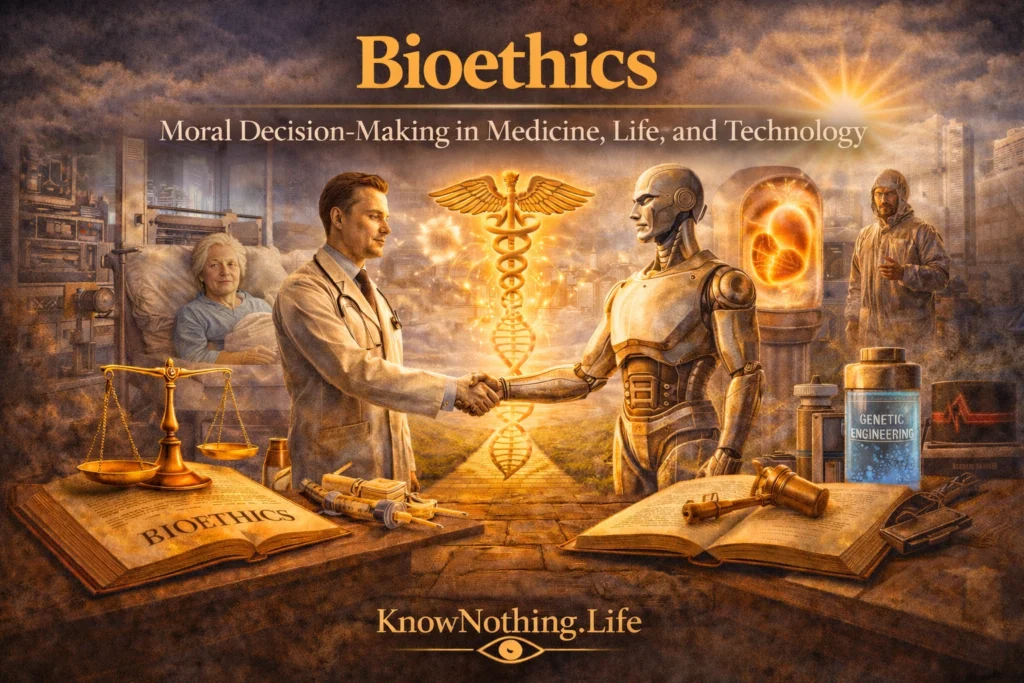
Bioethics is the field of applied ethics that examines the moral dimensions of healthcare, medicine, and the life sciences. It addresses some of the most profound and sensitive questions humans face: when life begins and ends, how suffering should be alleviated, who should receive scarce medical resources, and how far scientific intervention into human biology should go. At its core, bioethics seeks to guide decision-making in contexts where values such as autonomy, dignity, justice, and well-being intersect—often in tension.
The emergence of bioethics as a distinct discipline in the 20th century was driven by rapid advances in medical technology and growing awareness of ethical failures in research and practice. From organ transplantation and life-support systems to genetic engineering and artificial reproduction, new capabilities created situations that traditional moral frameworks were not fully equipped to address. Bioethics arose as a response, bringing philosophical analysis into direct conversation with clinical practice and scientific innovation.
Unlike purely theoretical ethics, bioethics operates at the boundary between principle and practice. It must account for real-world complexities, including uncertainty, emotional stakes, and institutional constraints. As a result, bioethics is inherently interdisciplinary, drawing on philosophy, medicine, law, and social science to navigate dilemmas that are as practical as they are philosophical.
Historical Development and Foundational Events
The roots of bioethics lie in both philosophical traditions and historical events that exposed the need for ethical oversight in medicine. While ancient medical ethics can be traced to the Hippocratic Oath, modern bioethics was shaped by 20th-century developments, particularly in response to abuses in medical research. The revelations of unethical experimentation during World War II led to the establishment of the Nuremberg Code, which emphasized the necessity of voluntary consent and the protection of human subjects.
Subsequent cases, such as the Tuskegee syphilis study in the United States, further highlighted the dangers of unregulated research. These events prompted the development of formal ethical guidelines and institutions dedicated to overseeing medical practice and research. Bioethics emerged not only as a philosophical discipline but also as a practical framework for preventing harm and ensuring accountability.
Philosophers and ethicists began to articulate systematic approaches to medical ethics. Tom Beauchamp and James Childress played a central role in this development with their influential work Principles of Biomedical Ethics. They proposed four guiding principles—autonomy, beneficence, nonmaleficence, and justice—that have become foundational in bioethical analysis. These principles provide a structured yet flexible approach to navigating complex ethical situations in healthcare.
Core Principles of Bioethics
The four principles articulated by Tom Beauchamp and James Childress form the cornerstone of modern bioethics. Autonomy refers to the right of individuals to make informed decisions about their own bodies and medical treatment. This principle is rooted in respect for persons and has led to practices such as informed consent, where patients must be given sufficient information to make voluntary and knowledgeable choices.
Beneficence and nonmaleficence focus on the responsibilities of healthcare providers. Beneficence requires acting in the best interests of the patient, promoting well-being and providing care. Nonmaleficence, often summarized as “do no harm,” emphasizes the obligation to avoid causing unnecessary suffering or injury. These principles are closely related but can come into tension, particularly in cases where treatment carries risks or uncertain outcomes.
Justice addresses the fair distribution of healthcare resources and the equitable treatment of individuals. It raises questions about who should receive medical care, how to allocate limited resources, and how to address disparities in access to treatment. In contexts such as organ transplantation or pandemic response, the principle of justice becomes especially critical, requiring careful balancing of competing needs and values.
Autonomy and Informed Consent
Autonomy is one of the most influential and widely discussed principles in bioethics. It reflects the idea that individuals have the right to control their own bodies and make decisions about their healthcare based on their values and preferences. This principle has transformed medical practice, shifting it away from paternalism—where doctors made decisions on behalf of patients—toward a model of shared decision-making.
Informed consent is the practical expression of autonomy. It requires that patients be provided with clear, accurate, and comprehensive information about their condition, treatment options, risks, and benefits. Only with this information can individuals make decisions that align with their values. This process is not merely a formality but a fundamental ethical requirement that respects the dignity and agency of patients.
However, autonomy is not absolute. Situations involving diminished capacity, such as severe mental illness or unconsciousness, raise questions about how decisions should be made. In such cases, surrogate decision-makers or advance directives may be used to guide care. These complexities highlight the need for careful ethical judgment in applying the principle of autonomy.
End-of-Life Ethics and the Value of Life
One of the most challenging areas of bioethics concerns end-of-life decision-making. Advances in medical technology have made it possible to prolong life in ways that were previously unimaginable, raising questions about the quality of life, the limits of treatment, and the meaning of death. Issues such as euthanasia, assisted suicide, and the withdrawal of life-sustaining treatment are central to this domain.
Philosophers such as Peter Singer have argued for a more flexible approach to end-of-life ethics, emphasizing considerations of suffering and quality of life. In Practical Ethics, Singer suggests that in some cases, allowing or even assisting death may be ethically permissible if it reduces suffering. This perspective challenges traditional views that prioritize the preservation of life above all else.
At the same time, many ethicists and religious traditions emphasize the intrinsic value of human life, arguing that it must be protected regardless of circumstances. This tension between quality of life and sanctity of life reflects broader philosophical disagreements about the nature of moral value. Bioethics must navigate these competing perspectives, balancing compassion with respect for deeply held beliefs.
Biotechnology and Emerging Ethical Challenges
The rapid advancement of biotechnology has introduced new ethical questions that extend beyond traditional medical concerns. Techniques such as genetic engineering, cloning, and stem cell research raise issues about the limits of human intervention in natural processes. These developments challenge existing ethical frameworks and require careful consideration of both potential benefits and risks.
Hans Jonas, in The Imperative of Responsibility, argued that modern technology demands a new ethical approach that accounts for long-term consequences and the vulnerability of future generations. “Act so that the effects of your action are compatible with the permanence of genuine human life,” he wrote, emphasizing the importance of foresight and responsibility in technological innovation.
Debates about biotechnology often center on questions of identity, autonomy, and justice. For example, genetic enhancement raises concerns about inequality and the potential for creating new forms of discrimination. Similarly, advances in reproductive technology challenge traditional concepts of family and parenthood. Bioethics provides a framework for addressing these issues, ensuring that technological progress is guided by ethical reflection.
Conclusion
Bioethics represents a vital and evolving field that addresses some of the most profound questions at the intersection of life, health, and technology. By applying ethical principles to real-world dilemmas, it provides guidance for navigating situations where the stakes are often deeply personal and socially significant. Through its emphasis on autonomy, beneficence, nonmaleficence, and justice, bioethics offers a structured approach to moral decision-making in complex contexts.
The contributions of thinkers such as Tom Beauchamp, James Childress, Peter Singer, and Hans Jonas have shaped the field, providing diverse perspectives on how to address ethical challenges in medicine and science. Their work underscores the importance of balancing theoretical insight with practical application.
Ultimately, bioethics is not about finding simple answers but about engaging thoughtfully with the complexities of human life. It challenges individuals and societies to consider not only what can be done, but what should be done, fostering a deeper understanding of responsibility, dignity, and care in an increasingly technological world.