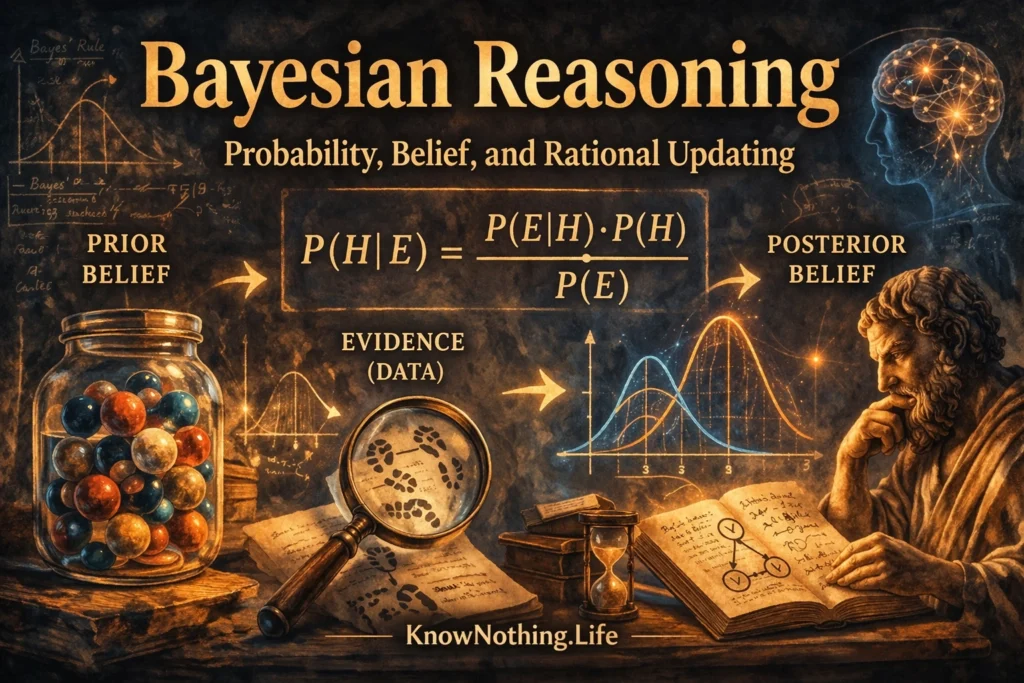
Bayesian reasoning is a framework for thinking under uncertainty, grounded in probability theory and centered on the idea that beliefs should be updated as new evidence emerges. Rather than treating knowledge as fixed or certain, Bayesian reasoning views it as dynamic—constantly revised in light of incoming information. At its core lies a simple yet powerful principle: rational belief is not static but evolves through the systematic integration of prior expectations and new data.
The foundations of Bayesian reasoning trace back to Thomas Bayes, whose posthumously published essay introduced what is now known as Bayes’ theorem. This work was later expanded and popularized by Pierre-Simon Laplace, who applied Bayesian ideas to a wide range of scientific problems. In modern times, Bayesian reasoning has become central to fields such as statistics, artificial intelligence, and cognitive science, offering a unifying approach to inference and decision-making.
Bayes’ Theorem and Its Meaning
At the heart of Bayesian reasoning is Bayes’ theorem, a mathematical formula that describes how to update probabilities in light of new evidence. It provides a way to calculate the probability of a hypothesis given observed data, based on prior beliefs and the likelihood of the evidence under that hypothesis. In essence, it formalizes the intuitive idea that our confidence in a belief should change when we encounter new information.
Bayes’ theorem can be understood as a rule for revising beliefs. It begins with a prior probability, representing our initial degree of belief in a hypothesis, and adjusts it based on the likelihood of the observed evidence. The result is a posterior probability, reflecting our updated belief after considering the evidence. This process captures the dynamic nature of reasoning under uncertainty, where conclusions are not fixed but continually refined.
Pierre-Simon Laplace recognized the broader significance of this approach, applying Bayesian reasoning to problems ranging from astronomy to social statistics. He famously stated, “Probability theory is nothing but common sense reduced to calculation,” highlighting the idea that Bayesian reasoning formalizes intuitive processes of belief revision. This perspective underscores the practical and philosophical importance of Bayes’ theorem as a tool for rational inference.
Priors, Likelihoods, and Posteriors
Bayesian reasoning revolves around three key components: prior probabilities, likelihoods, and posterior probabilities. The prior represents our initial belief about a hypothesis before observing new data. The likelihood measures how probable the observed evidence is under the hypothesis. The posterior combines these elements to produce an updated belief.
The role of priors is one of the most debated aspects of Bayesian reasoning. Critics argue that priors introduce subjectivity, as different individuals may begin with different initial beliefs. However, proponents contend that priors reflect existing knowledge and can be updated objectively through evidence. Over time, as more data is incorporated, the influence of the prior diminishes, and the posterior becomes increasingly driven by the evidence.
Harold Jeffreys, a key figure in the development of Bayesian statistics, defended the use of priors as an essential component of scientific reasoning. In Theory of Probability, he argued that priors are necessary for making sense of data, writing, “We must regard the prior probability as representing the state of knowledge before the data are taken into account.” This view emphasizes that Bayesian reasoning is not purely subjective but integrates both prior knowledge and empirical evidence.
Bayesian Reasoning and Scientific Inference
Bayesian reasoning offers a powerful framework for scientific inference, where hypotheses are evaluated and updated based on evidence. Unlike traditional approaches that focus on hypothesis testing and p-values, Bayesian methods provide a continuous measure of belief, allowing for more nuanced conclusions. This makes Bayesian reasoning particularly well-suited for complex and uncertain domains.
In scientific practice, Bayesian reasoning enables researchers to incorporate prior knowledge into their analyses, improving the interpretation of data. For example, in medical research, prior information about disease prevalence can be combined with test results to estimate the probability of a condition. This approach reflects the real-world process of decision-making, where evidence is rarely interpreted in isolation.
The Bayesian perspective also aligns with philosophical views of science as a process of belief revision. Karl Popper famously criticized probabilistic confirmation, arguing that scientific theories cannot be proven but only falsified. While Popper rejected Bayesianism, modern philosophers have sought to reconcile his insights with Bayesian reasoning, viewing scientific progress as a process of updating probabilities rather than achieving certainty.
Applications in Artificial Intelligence and Decision Theory
Bayesian reasoning has become a cornerstone of artificial intelligence, where it is used for tasks such as pattern recognition, machine learning, and decision-making under uncertainty. Bayesian networks, for example, model probabilistic relationships between variables, allowing systems to make predictions and update beliefs based on new data.
In decision theory, Bayesian reasoning provides a framework for making rational choices in uncertain environments. By combining probabilities with utilities (measures of value), it enables the evaluation of different options based on their expected outcomes. This approach is widely used in economics, risk analysis, and policy-making, where decisions must be made with incomplete information.
Judea Pearl played a crucial role in advancing the application of Bayesian reasoning in AI. His work on probabilistic graphical models demonstrated how complex systems of uncertainty could be represented and analyzed. Pearl emphasized the importance of causal reasoning, arguing that “Bayesian networks provide a language for expressing causal relationships,” bridging the gap between probability and explanation.
Bayesian Cognition and Human Reasoning
Beyond formal systems, Bayesian reasoning has been proposed as a model of human cognition. Some psychologists argue that the brain operates in a Bayesian manner, continuously updating beliefs based on sensory input and prior expectations. This perspective suggests that Bayesian reasoning is not merely a mathematical tool but a fundamental aspect of how humans perceive and understand the world.
Daniel Kahneman, however, highlighted the limitations of human reasoning, showing that people often deviate from Bayesian principles due to cognitive biases. In Thinking, Fast and Slow, he demonstrated that intuitive judgments are frequently influenced by heuristics that lead to systematic errors. For example, individuals often neglect base rates (prior probabilities) when evaluating evidence, resulting in flawed reasoning.
This tension between normative models and actual behavior raises important questions about the nature of rationality. While Bayesian reasoning provides a standard for how beliefs should be updated, human reasoning often falls short of this ideal. Understanding these discrepancies can help improve decision-making and critical thinking, bridging the gap between theory and practice.
Critiques and Challenges
Despite its strengths, Bayesian reasoning faces several challenges and criticisms. One major concern is the subjectivity of priors, which can influence the outcome of analyses. Critics argue that different choices of priors can lead to different conclusions, raising questions about the objectivity of Bayesian methods.
Another challenge lies in the computational complexity of Bayesian inference, particularly in high-dimensional problems. While advances in computing have made Bayesian methods more practical, they can still be difficult to implement in certain contexts. This has led to the development of approximation techniques and alternative approaches.
Philosophically, Bayesian reasoning raises questions about the nature of probability and belief. Is probability an objective feature of the world, or a subjective measure of belief? Bayesianism typically adopts the latter view, treating probability as a degree of belief rather than a frequency. This perspective has been both influential and controversial, reflecting broader debates in the philosophy of probability.
Conclusion
Bayesian reasoning represents a powerful and flexible approach to understanding uncertainty, offering a systematic method for updating beliefs in light of evidence. From its origins in the work of Thomas Bayes to its modern applications in science and technology, it has transformed how we think about probability, inference, and decision-making.
By integrating prior knowledge with new data, Bayesian reasoning provides a dynamic framework for navigating an uncertain world. It captures the essence of rational belief as something that evolves over time, shaped by experience and evidence. At the same time, its challenges remind us that reasoning is complex, involving both mathematical principles and human judgment.
Ultimately, Bayesian reasoning bridges the gap between logic and life, offering a model of thought that is both rigorous and adaptable. It shows that certainty is rare, but that through careful updating of beliefs, we can move closer to understanding—even in the face of uncertainty.