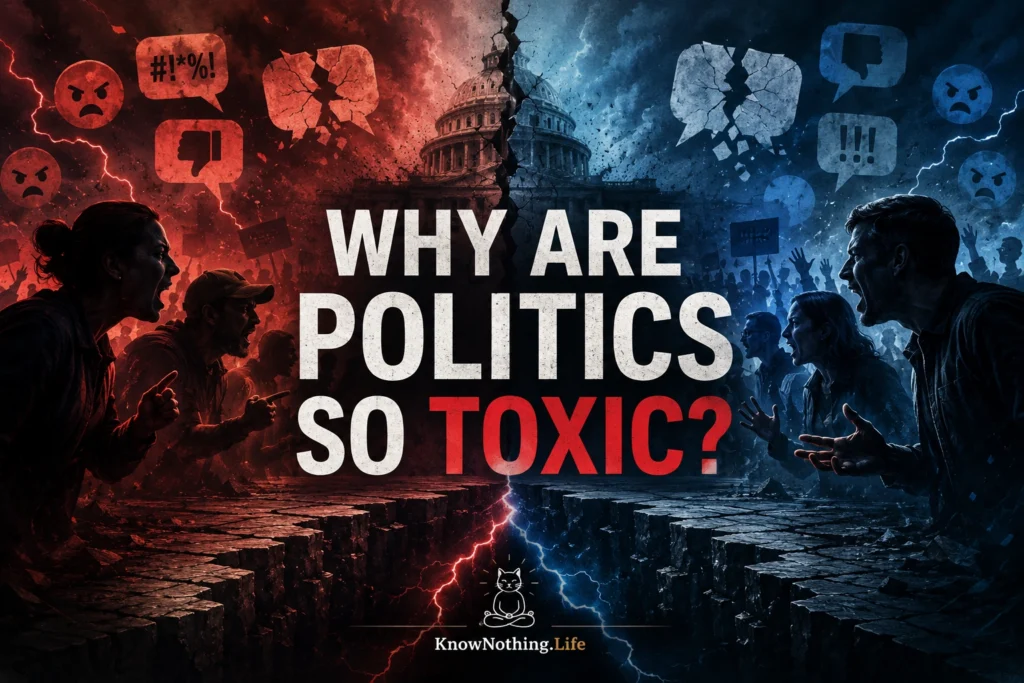
Politics has always involved conflict because it determines who receives power, which values become law, and how a society distributes rights, risks, and resources. Yet ordinary disagreement does not fully explain why modern political life so often feels personal, humiliating, and morally contaminated. People do not merely argue over taxes, immigration, public health, education, or foreign policy. They increasingly interpret political opponents as dishonest, dangerous, unintelligent, or fundamentally unworthy of trust. A policy dispute can therefore become a judgment about someone’s character, family, community, or right to belong.
Researchers describe much of this hostility as affective polarization: the tendency to feel warmth and loyalty toward one’s political group while expressing dislike, suspicion, or contempt toward the opposing group. Shanto Iyengar, Gaurav Sood, and Yphtach Lelkes argued in their influential 2012 study “Affect, Not Ideology” that partisan hostility cannot be understood simply by measuring the distance between policy preferences. Their research showed that Americans increasingly disliked opposing partisans as people, even when the connection between those feelings and specific policy positions was inconsistent. Politics becomes toxic when it stops functioning primarily as a debate over public choices and begins operating as a struggle between rival social identities.
Political Belonging Has Become a Social Identity
Political parties once served largely as coalitions that organized interests, candidates, and elections. They still perform those functions, but for many people party membership now carries a much broader cultural meaning. Political affiliation can signal attitudes about religion, race, education, gender, geography, media, lifestyle, and national identity. When these characteristics align, political identity becomes what political scientist Lilliana Mason calls a “mega-identity” in Uncivil Agreement: How Politics Became Our Identity. A person may no longer experience an election as a choice between competing governing programs. Instead, the election feels like a contest between “people like us” and a threatening coalition of outsiders.
This fusion of identities makes compromise psychologically difficult. Social identity research suggests that people naturally favor groups to which they belong, but intense polarization adds something more corrosive: hostility toward the out-group. Eli Finkel and his colleagues describe this condition as political sectarianism, built from three elements—othering, aversion, and moralization. Opponents are seen as essentially different, emotionally repellent, and morally corrupt. Once political conflict reaches that stage, losing an election can feel less like accepting a temporary policy setback and more like surrendering one’s country, status, or way of life to an illegitimate enemy.
Moral Conviction Turns Disagreement Into Condemnation
Political issues frequently concern genuine moral questions. Debates about abortion, policing, war, inequality, discrimination, climate change, and freedom involve competing beliefs about harm, justice, duty, authority, and human dignity. Moral conviction can inspire courage and reform, but it can also make negotiation appear shameful. When a position is experienced as morally sacred, concession may look like complicity with evil. The opposing side is no longer merely mistaken; it becomes vicious, corrupt, or dangerous. This helps explain why people can interpret compromise not as a democratic achievement but as a betrayal of their deepest principles.
Digital communication intensifies this moralization because emotionally charged language travels farther than careful qualification. In a 2017 analysis of more than half a million social-media messages, William Brady and his colleagues found that moral-emotional words increased the diffusion of political content within ideological networks. A later study by Steve Rathje, Jay Van Bavel, and Sander van der Linden found that references to the political out-group were especially powerful drivers of online engagement. These findings help explain why political feeds become saturated with accusation and outrage: platforms reward material that provokes immediate reactions, while calm explanations and partial agreements attract less attention.
Media and Political Elites Benefit From Conflict
Toxic politics is not produced by technology alone. Politicians, commentators, activists, and media organizations operate within systems that often reward confrontation. Candidates can motivate supporters by presenting elections as emergencies. Partisan media can retain audiences by repeatedly confirming that the other side is reckless or malicious. Advocacy organizations can attract attention and contributions when supporters believe catastrophe is imminent. Conflict is therefore not merely reported. It is packaged, personalized, and continually renewed, creating an environment in which political calm may be less profitable than permanent crisis.
The result is a feedback loop between elites and citizens. Political leaders provide cues about which groups, events, and ideas deserve fear or outrage. Supporters repeat those messages, media organizations measure the response, and successful frames receive even more attention. Researchers have also found that people misperceive the composition and extremity of opposing parties. Douglas Ahler and Gaurav Sood showed that Americans often exaggerate the prevalence of groups stereotypically associated with each party, and these distorted images are linked to greater social distance and hostility. Matthew Levendusky and Neil Malhotra similarly found that Americans perceive more policy polarization than actually exists. People may therefore be reacting not to the average opponent but to a frightening caricature constructed from the loudest politicians, activists, and viral examples.
Social Media Makes Political Performance Constant
Social media transforms political identity into a public performance. Users do not simply receive information; they display loyalty, signal moral character, punish deviance, and compete for recognition. A political post can communicate, “I understand what is happening, I know who is responsible, and I stand with the right people.” Because approval comes from an audience, political expression can become more absolute than private belief. Nuance risks looking weak, uncertainty can be interpreted as disloyalty, and certainty becomes a visible demonstration of commitment.
It is tempting to assume that exposing people to opposing views will automatically make them more tolerant. Evidence suggests that the process is more complicated. In a 2018 field experiment, Christopher Bail and his colleagues paid Democrats and Republicans to follow automated accounts sharing messages from the opposing political side. Republicans exposed to liberal messages became more conservative, while the researchers did not find an equivalent statistically significant shift among Democrats. Unstructured exposure can trigger defensiveness when people experience opposing content as hostile, alien, or threatening to their identity. The problem is therefore not simply that people live in informational bubbles. Online encounters also frequently lack trust, context, shared purpose, and the social cues that make disagreement feel human rather than menacing.
Fear, Uncertainty, and Status Raise the Stakes
Politics becomes especially toxic when people believe that their safety, status, or future is slipping away. Economic insecurity, demographic change, cultural displacement, institutional distrust, and rapid technological disruption can make political narratives emotionally potent. Leaders who identify an enemy and promise restoration offer psychological clarity: complex problems become intentional attacks, while uncertainty becomes a struggle between heroes and villains. This style of politics is persuasive because it organizes anxiety into a story containing blame, belonging, purpose, and action.
Negative partisanship also means that citizens may support their side less from admiration than from fear of the alternative. Under these conditions, almost any behavior can be rationalized as necessary to prevent the opposing party from taking power. Finkel and his colleagues warn that political sectarianism can weaken democratic accountability because voters may tolerate misconduct by their own representatives rather than risk helping the enemy. When every election is presented as the last chance to save the country, restraint begins to look naïve, compromise appears dangerous, and institutional rules are treated as obstacles rather than shared protections.
Toxicity Is Reinforced by False Images of the Opposition
One of the most damaging features of political hostility is that people frequently misunderstand what their opponents actually believe. Citizens tend to remember the most shocking examples they encounter, particularly when those examples confirm existing stereotypes. An outrageous statement from an activist, commentator, or anonymous account can gradually become a mental representation of millions of ordinary voters. The political out-group consequently appears more extreme, more unified, and more hostile than it really is.
These misperceptions can become self-reinforcing. When people believe the opposition despises them, rejects democratic rules, or supports political violence, they may conclude that their own side must become more aggressive. The other party then interprets that aggression as evidence confirming its own fears. Political conflict escalates even when the original beliefs were exaggerated. Research summarized by Iyengar and his colleagues indicates that partisan animosity affects behavior beyond elections, including social relationships and judgments about people in otherwise nonpolitical settings. Politics becomes culturally pervasive because party labels begin to influence whom people trust, date, hire, befriend, or welcome into their families.
Can Political Culture Become Less Toxic?
Reducing toxicity does not require eliminating disagreement, suppressing moral conviction, or pretending that every position is equally reasonable. Democracy depends on conflict, criticism, organized opposition, and the ability to identify genuine abuses of power. The goal is to prevent disagreement from becoming dehumanization. Research suggests that correcting exaggerated beliefs about opponents, emphasizing identities that cross party lines, and directing attention toward factual accuracy can reduce some forms of hostility. Gordon Pennycook and his colleagues found that prompting people to consider accuracy improved the quality of news they subsequently shared, while Matthew Levendusky’s experiments suggest that emphasizing a shared American identity can reduce affective polarization under some conditions.
No single intervention will repair a political culture whose incentives repeatedly reward outrage. Healthier politics requires institutions and habits that make cooperation visible, distinguish ordinary citizens from extreme stereotypes, and impose reputational costs on deliberate dehumanization. It also requires accepting that an opponent can be wrong, self-interested, or even harmful without every supporter of that opponent being identical. Politics becomes toxic when identity, morality, fear, false perceptions, and media incentives combine to turn fellow citizens into enemies. It becomes more democratic when disagreement remains serious but opponents remain recognizable as human beings who must continue living together after the election ends.