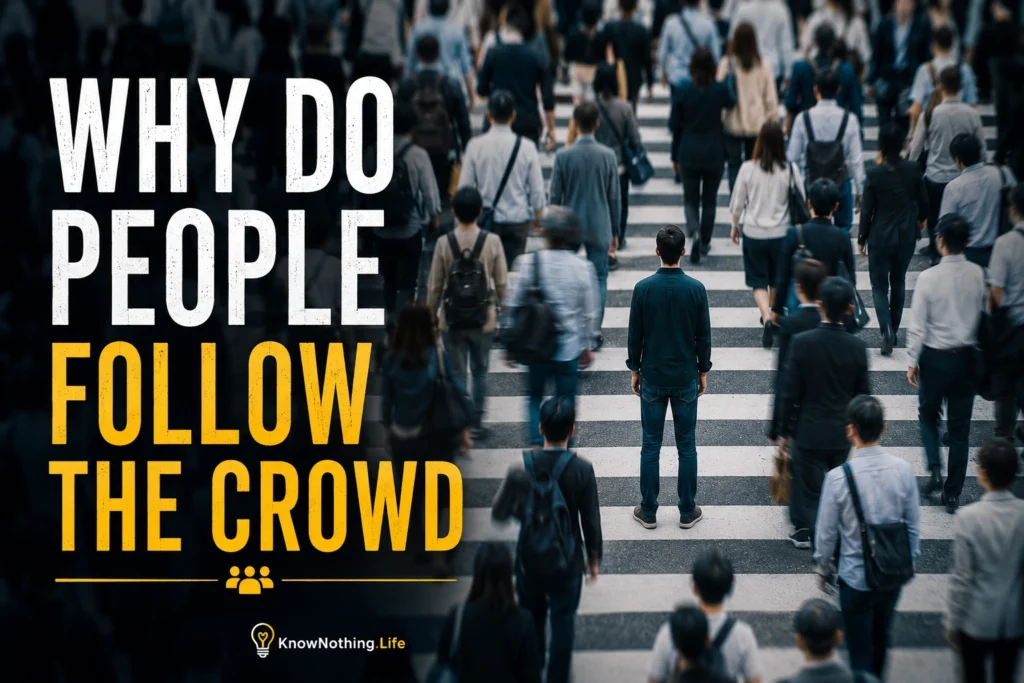
People often imagine themselves as independent thinkers who make decisions from evidence and personal conviction. Yet clothing styles, political opinions, workplace habits, consumer choices, and judgments about obvious facts are influenced by what other people appear to believe. Psychology calls this tendency conformity: a change in judgment or behavior that brings someone closer to a group’s position. It is not simply weakness. Social life depends on shared expectations, and watching others is often an efficient way to learn how to behave in situations we do not fully understand.
Robert Cialdini and Noah Goldstein’s review of social influence describes conformity as serving recurring goals such as accuracy, social connection, and the maintenance of a favorable self-concept. Groups can provide information, protection, belonging, and a ready-made interpretation of events. The same mechanism that helps a newcomer understand an unfamiliar culture can also persuade someone to repeat a rumor or remain silent when a group is mistaken. Conformity is neither automatically rational nor irrational; its value depends on the quality of the group and how its agreement formed.
When Other People Seem to Know More
One major reason people follow the crowd is informational social influence. When a situation is confusing or unfamiliar, the behavior of others becomes evidence. A traveler who sees everyone moving toward one airport gate assumes they may know about a change. A restaurant with a long line appears more trustworthy than an empty one. In such cases, imitation can save time and reduce risk. The individual is using other people as sources of information rather than simply surrendering independent judgment.
Muzafer Sherif demonstrated this process in experiments involving the autokinetic illusion, in which a stationary point of light in darkness appears to move. Because the stimulus was ambiguous, participants’ estimates gradually converged when they made judgments together, producing shared norms that could persist afterward. Morton Deutsch and Harold Gerard later distinguished this informational pressure from normative pressure, arguing that people sometimes conform because they believe the group is correct and at other times because they want acceptance. Sherif’s The Psychology of Social Norms showed how uncertainty allows collective judgments to shape private perception.
The Need to Belong
People also follow crowds because disagreement can carry social costs. Human beings depend on relationships, cooperation, reputation, and group membership. Rejecting a group’s judgment may risk embarrassment, conflict, ridicule, or exclusion. Normative social influence occurs when people align publicly with others to gain approval or avoid rejection, even when they privately remain unconvinced. The crowd’s power comes not only from the number of people involved but from the value of belonging to them.
This pressure is strongest when the group matters to a person’s identity. Friends, families, professions, political movements, and online communities communicate ideas about what a “real” member should believe or do. Research on peer conformity suggests that adapting to others can increase compatibility and reduce the danger of isolation. Studies of social anxiety likewise indicate that people who are especially concerned about acceptance may be more inclined to follow favorable group judgments. Conformity can therefore be an attempt to preserve relationships rather than a genuine change of mind.
What the Asch Experiments Revealed
Solomon Asch’s conformity experiments made the conflict between personal perception and group agreement dramatically visible. Participants compared a target line with three possible matches while sitting among people instructed to give the same incorrect answer on selected trials. The task was simple, yet the unanimous majority caused many participants to repeat answers that contradicted what they could plainly see. Some doubted their own judgment, while others knew the group was wrong but did not want to stand apart.
Asch’s findings do not mean that people mindlessly obey majorities. Many responses remained independent, and his variations showed that unanimity mattered greatly. When even one person broke with the majority, conformity fell sharply, even when the dissenter was not consistently correct. The participant was no longer completely alone. Asch’s 1956 “Studies of Independence and Conformity” therefore demonstrated both the pressure created by consensus and the liberating effect of a dissenting voice.
Identity and Culture Shape the Crowd
Crowds influence people most strongly when they are perceived as “us.” Self-categorization theory, developed by John Turner and colleagues, proposes that individuals sometimes understand themselves as unique persons and at other times as members of a group. When group identity becomes prominent, people look to group norms to determine appropriate attitudes and conduct. Conformity in this sense is not merely submission to outside pressure. It can be an expression of identity because the group’s values feel like one’s own.
Culture also shapes how agreement, independence, and obligation are interpreted. Rod Bond and Peter Smith’s meta-analysis of Asch-type studies found cross-cultural variation associated with individualism and collectivism. This does not divide the world into independent and passive cultures. Every society rewards conformity in some domains and distinctiveness in others. A person may resist one crowd while strongly following another, depending on which group represents morality, expertise, status, or belonging in that context.
The Brain Treats Agreement as Feedback
Neuroscience suggests that agreement and disagreement with groups engage systems involved in learning, emotion, and valuation. Gregory Berns and colleagues used brain imaging during a mental-rotation task involving incorrect group judgments. Their findings suggested that social information could influence perceptual processing, while resisting the group was associated with activity in regions linked to emotional salience. Standing alone may therefore feel uncomfortable even when a person believes the evidence is clear.
Vasily Klucharev and colleagues found that conflict between a participant’s judgment and a group norm produced activity resembling a learning signal in the rostral cingulate zone and ventral striatum. Participants later adjusted some ratings toward the group’s position. Other research has linked neural responses during social exclusion with later susceptibility to peer norms in a driving task. These studies do not prove that the brain is built for blind obedience. They show that social agreement is treated as consequential feedback involving error, reward, and threat.
Information Cascades and Digital Crowds
Crowd behavior can grow even when most individuals possess little reliable information. Economists Sushil Bikhchandani, David Hirshleifer, and Ivo Welch developed informational-cascade theory to explain how people may imitate earlier decisions while discounting their own private signals. Once several people make the same choice, later observers may assume those choices reflect knowledge. Their imitation becomes additional apparent evidence, producing a chain that can support fashions, market enthusiasm, reputational panics, and sudden shifts in public behavior.
Digital platforms intensify this process by making popularity visible. View counts, ratings, reposts, trending labels, and comment totals suggest what deserves attention before a person evaluates the content. Yet visible consensus can mislead because users observe actions without knowing the reasons behind them. A post may be shared to criticize it, and an opinion may appear dominant because dissenters remain quiet. When everyone relies on everyone else, the crowd can look informed even though little independent evaluation has occurred.
When Agreement Becomes Groupthink
In Victims of Groupthink, Irving Janis described how cohesive decision-making groups may suppress objections, rationalize warnings, and mistake silence for genuine agreement. Members censor doubts because they assume everyone else is committed, while apparent consensus makes further dissent difficult. Expertise offers limited protection when leaders announce preferences too early, status hierarchies punish disagreement, or loyalty becomes confused with obedience. A crowd becomes wiser when judgments are formed independently and then combined; it becomes less reliable when people copy one another before evaluating the evidence.
Following the crowd is often sensible. Shared norms coordinate language, traffic, cooperation, safety, and everyday courtesy, while expert communities can pool knowledge that no isolated person possesses. The alternative is not automatic contrarianism, which still allows the majority to determine one’s behavior. Independent judgment means deciding when social information deserves weight and when evidence or ethical principles should take priority. The central lesson of conformity research is not that crowds are always wrong, but that agreement has psychological force beyond its evidential value. Healthy groups preserve belonging while making disagreement safe.