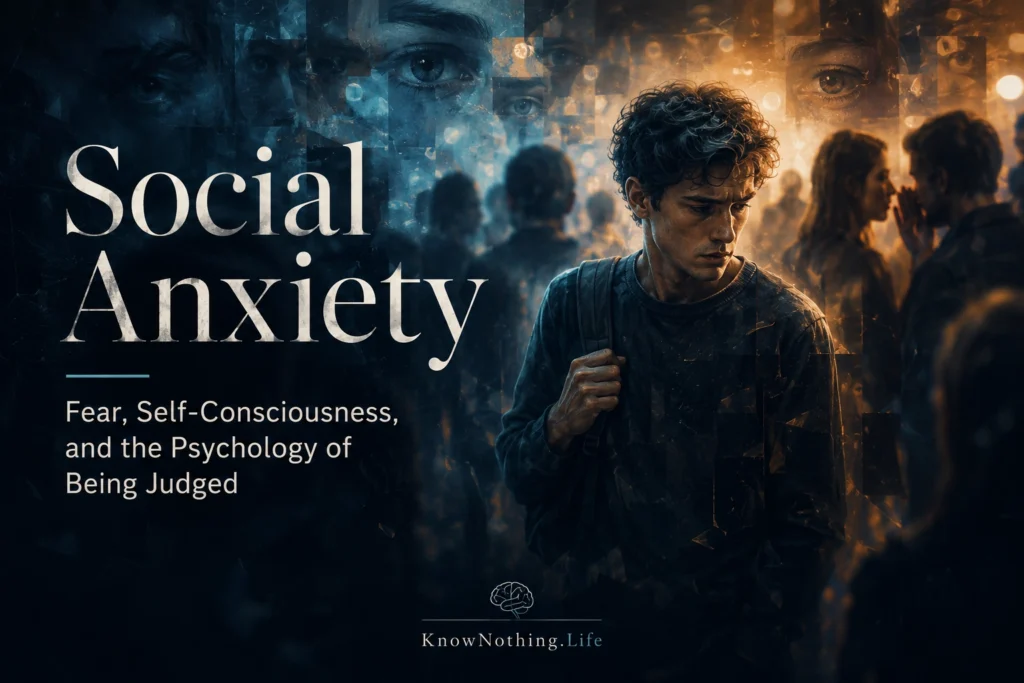
Social anxiety is more than ordinary nervousness, shyness, or discomfort in public. Nearly everyone feels uneasy before a speech, job interview, first date, performance, or difficult conversation. Social anxiety becomes a disorder when fear of scrutiny, embarrassment, rejection, or negative judgment becomes intense, persistent, and limiting. The National Institute of Mental Health describes social anxiety disorder as anxiety or fear in situations where a person may be “scrutinized, evaluated, or judged by others,” including public speaking, meeting new people, dating, interviews, asking for help, or ordinary transactions.
At its core, social anxiety is the fear of the self being exposed. The socially anxious person does not simply fear people; they fear how they appear to people. They may worry that their face looks strange, their voice sounds weak, their hands are shaking, their silence seems awkward, or their words will be misunderstood. This makes social life feel like a stage, even when no one else sees it that way. The person becomes both actor and critic, trying to participate while also watching themselves from the imagined viewpoint of others. The result is exhaustion, avoidance, and a painful gap between the life one wants and the life one feels safe enough to live.
What Social Anxiety Means
Social anxiety disorder, historically called social phobia, involves fear of social or performance situations in which a person believes they may be judged negatively, embarrassed, humiliated, rejected, or seen as inadequate. The American Psychiatric Association explains that the fear is out of proportion to the actual situation, lasts at least six months, and leads the person to avoid the feared situation or endure it with intense anxiety. This distinction matters because occasional self-consciousness is normal. Social anxiety disorder is not a personality preference; it is a pattern of fear that interferes with work, school, relationships, and ordinary independence.
Social anxiety can appear in obvious and subtle ways. Some people avoid parties, meetings, phone calls, classrooms, public speaking, eating in front of others, using public restrooms, or dating. Others appear socially functional but suffer privately through intense anticipatory worry, careful scripting, rumination, and post-event self-criticism. They may replay conversations for hours, searching for proof that they sounded foolish or offended someone. Social anxiety is therefore not always visible from the outside. A person may seem calm while internally fighting panic, shame, and the desire to escape.
Symptoms and Everyday Experience
The symptoms of social anxiety include mental, physical, and behavioral patterns. Mentally, the person may fear embarrassment, rejection, criticism, or being noticed as anxious. Physically, they may experience blushing, sweating, trembling, nausea, rapid heartbeat, shortness of breath, dry mouth, or a shaky voice. Mayo Clinic lists fear of negative judgment, worry about humiliation, intense fear of talking with strangers, and fear that others will notice anxiety symptoms such as blushing or trembling as common signs. Behaviorally, the person may avoid eye contact, speak softly, leave early, overprepare, stay silent, use alcohol to cope, or avoid situations entirely.
The emotional pain of social anxiety often comes from the belief that one wrong move will reveal something shameful. A minor pause in conversation may feel like failure. A neutral facial expression may be read as disapproval. A small mistake may seem unforgettable. This is why reassurance often gives only temporary relief. The anxious mind is not merely asking, “Did I do okay?” It is asking, “Am I acceptable?” When self-worth becomes tied to perfect social performance, ordinary human awkwardness becomes threatening.
Cognitive Models of Social Anxiety
Modern cognitive-behavioral theories have been especially influential in explaining why social anxiety persists. David Clark and Adrian Wells proposed a major cognitive model of social phobia in 1995, emphasizing self-focused attention, negative self-imagery, safety behaviors, and post-event rumination. Later research summarizes their view by noting that self-focused attention can maintain social anxiety because it increases access to negative thoughts and self-impressions. In simple terms, the person turns attention inward at the very moment they most need to engage outwardly.
Ronald Rapee and Richard Heimberg developed another influential model in their 1997 paper “A cognitive-behavioral model of anxiety in social phobia.” Their model describes how socially anxious people process information related to possible evaluation and compare their imagined self-presentation with what they believe the audience expects. This helps explain a central feature of social anxiety: the feared audience is often partly internal. The person is not responding only to real observers, but to an imagined observer who is critical, demanding, and alert to every flaw.
Self-Focused Attention and Safety Behaviors
Self-focused attention turns the body into an alarm system. The person monitors their voice, face, posture, heartbeat, breathing, sweating, hands, and words. This internal monitoring makes anxiety feel more obvious than it actually is. Because the person feels shaky, they assume they look shaky. Because they notice a racing heart, they assume others can see panic. The result is a loop: anxiety increases self-monitoring, self-monitoring increases perceived danger, and perceived danger increases anxiety.
Safety behaviors are actions meant to prevent embarrassment but often keep the fear alive. A person may avoid speaking, rehearse every sentence, hide their hands, wear heavy makeup to cover blushing, avoid asking questions, look at the floor, or keep conversations extremely brief. These behaviors can reduce anxiety in the short term, but they prevent corrective learning. If a person survives a meeting only by saying nothing, they may conclude that silence saved them. They never learn that speaking imperfectly would probably have been acceptable.
Shyness, Introversion, and Social Anxiety
Social anxiety is often confused with shyness or introversion, but they are not the same. Introversion is a preference for lower stimulation and inward processing. Shyness is discomfort or inhibition in social situations, especially with unfamiliar people. Social anxiety disorder is stronger and more impairing: it involves persistent fear of being judged, embarrassed, or rejected. An introvert may enjoy solitude without fearing people. A shy person may warm up gradually. A socially anxious person may want connection but feel blocked by threat.
This distinction is important because social anxiety can affect extroverts as well as introverts. A person may be talkative with close friends but terrified in formal settings. Another may crave relationships but avoid them because the risk of humiliation feels too high. Mark Leary’s self-presentation theory is useful here. Leary argued that social anxiety arises when people are motivated to make a desired impression but doubt their ability to do so. In that sense, social anxiety is not a lack of social interest. It is the painful collision between wanting acceptance and fearing exposure.
Causes and Risk Factors
Social anxiety does not have one single cause. It usually develops through an interaction of temperament, genetics, learning, family patterns, peer experiences, culture, and cognitive style. Some people are behaviorally inhibited from early childhood, meaning they are cautious, sensitive, and slow to approach unfamiliar people or situations. Others develop social anxiety after bullying, humiliation, criticism, rejection, or repeated experiences of being watched harshly. A person who was laughed at while speaking in class may later feel dread before any public performance.
Culture also shapes social anxiety. In environments that emphasize performance, beauty, status, popularity, constant visibility, and social comparison, fear of judgment can become stronger. Social media adds another layer because it turns self-presentation into a daily public activity. Likes, comments, silence, and comparison can become social signals that anxious people interpret as evidence of worth or failure. Still, social anxiety is not caused simply by modern life. It reflects an older human concern: the fear of exclusion from the group.
Treatment and Recovery
Social anxiety disorder is treatable. Cognitive-behavioral therapy is one of the best-supported treatments, especially when it includes exposure, cognitive restructuring, attention training, reduction of safety behaviors, and work with post-event rumination. Mayo Clinic describes diagnosis and treatment as focusing on persistent fear or anxiety about social situations, avoidance, distress, and interference in daily life. Treatment helps people test feared predictions rather than simply argue with them. The person learns, through experience, that anxiety can rise and fall, mistakes can be survived, and other people are usually less focused on them than they imagine.
Exposure is often misunderstood. It is not simply forcing someone into fear. Good exposure is gradual, purposeful, and designed for learning. A person might practice asking a small question, making brief eye contact, speaking in a group, making a minor intentional mistake, or allowing silence without rushing to fix it. The goal is not perfect confidence, but freedom. Medication, including certain antidepressants, may also help some people, especially when symptoms are severe or combined with depression or panic. The strongest recovery usually involves both courage and strategy: entering feared situations while changing the habits that keep fear convincing.
Final Thoughts on Social Anxiety
Social anxiety is a disorder of fear, attention, imagination, and self-evaluation. It turns ordinary social life into a test of acceptability and makes the person feel constantly visible, even when others are barely paying attention. Its suffering is not always dramatic from the outside, but it can quietly narrow a life through avoidance, loneliness, underachievement, and shame. The person may decline invitations, hide talents, avoid relationships, or stay silent not because they lack ability, but because the cost of being seen feels too high.
The work of Clark and Wells, Rapee and Heimberg, Leary, Barlow, and many later researchers has shown that social anxiety is not simply weakness or awkwardness. It is a learned and maintained pattern of threat perception, self-focused attention, avoidance, and fear of negative evaluation. The hopeful part is that patterns can change. With treatment, practice, and self-compassion, people can learn to shift attention outward, tolerate imperfection, reduce avoidance, and discover that social life does not require flawless performance. The goal is not to become fearless or endlessly outgoing. The goal is to become free enough to speak, connect, participate, and be seen without living under the constant rule of imagined judgment.