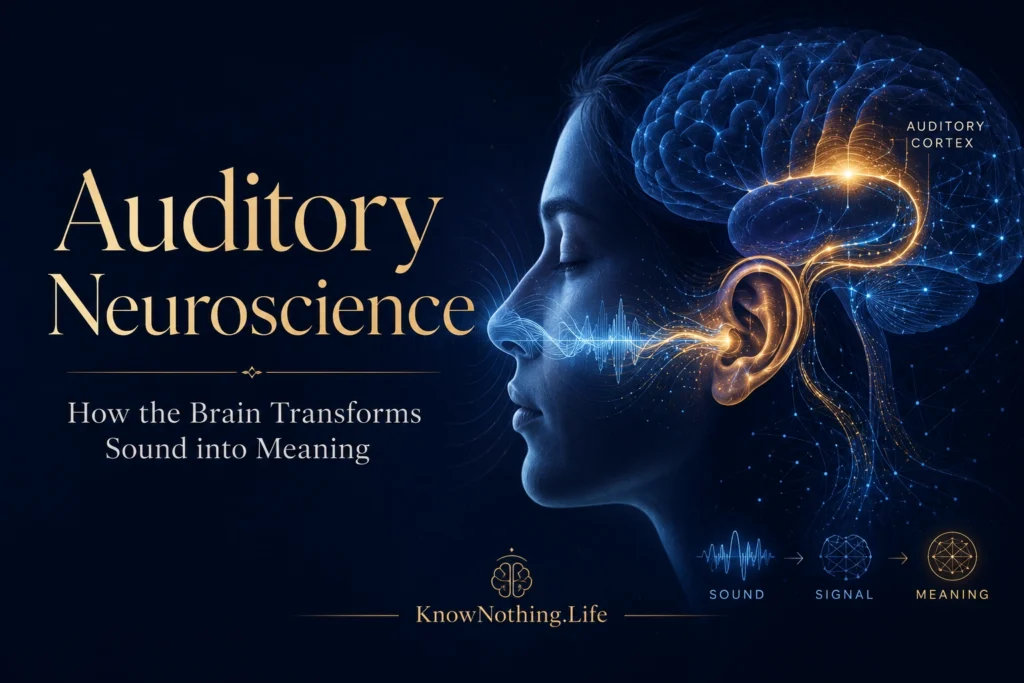
Auditory neuroscience studies how the nervous system detects vibrations, converts them into electrical signals, and organizes those signals into experiences such as speech, music, voices, environmental sounds, and spatial awareness. Hearing begins with pressure fluctuations traveling through air or another medium, but the brain does not receive sound waves directly. Instead, the ear and auditory pathways divide acoustic energy into frequency, intensity, timing, and location-related information. Neural circuits then combine these features with attention, memory, movement, and expectation to determine what produced a sound and why it matters.
Sound perception is not a passive recording of the environment. A conversation, melody, or approaching vehicle produces a rapidly changing mixture of frequencies that often overlaps with background noise. The auditory system must separate simultaneous sources, follow meaningful patterns across time, compensate for changes in volume or location, and recognize familiar sounds despite enormous acoustic variation. Auditory neuroscience therefore investigates the entire path from cochlear mechanics to conscious listening, including the cellular mechanisms of hearing and the distributed cortical networks that transform vibration into meaning.
The Cochlea and the Mechanical Analysis of Sound
Sound waves enter the outer ear, vibrate the eardrum, and move the small bones of the middle ear. These bones transmit mechanical energy into the fluid-filled cochlea, a spiral structure within the inner ear. Motion of the cochlear fluids produces a traveling wave along the basilar membrane. High-frequency sounds generate their greatest displacement near the cochlear base, while progressively lower frequencies reach peak displacement closer to the apex. This spatial arrangement creates a frequency map before auditory information has been converted into neural impulses.
The cochlea is not merely a passive frequency analyzer. Outer hair cells generate mechanical forces that increase the sensitivity and frequency selectivity of cochlear motion, particularly for quiet sounds. Experiments that selectively disrupted prestin, a motor protein central to outer-hair-cell movement, showed that these cells provide powerful local amplification to traveling waves. This active cochlear process helps explain the ear’s wide operating range, sharp tuning, and ability to detect extremely weak vibrations while still responding to much louder sounds.
Hair Cells and Mechanoelectrical Transduction
Inside the organ of Corti, inner and outer hair cells possess bundles of microscopic projections known as stereocilia. Movement of the cochlear partition bends these bundles and mechanically opens ion channels. The resulting ion flow changes the hair cell’s electrical potential and regulates neurotransmitter release. A. James Hudspeth’s influential work on hair-cell biophysics demonstrated that mechanical displacement can open transduction channels extremely rapidly, allowing auditory receptors to preserve the precise timing required for hearing.
Inner hair cells provide most of the sensory input transmitted to the brain, whereas outer hair cells contribute strongly to cochlear amplification and tuning. Auditory-nerve fibers connected to inner hair cells differ in threshold, spontaneous activity, dynamic range, and frequency preference. Fibers with high spontaneous firing rates tend to respond readily to quiet sounds, while lower-rate fibers often have higher thresholds and broader useful intensity ranges. Together, these varied fibers allow the auditory nerve to represent sounds across a much wider range of levels than one neuron could encode alone.
Frequency, Timing, and Neural Coding
Each auditory-nerve fiber responds most strongly to a characteristic frequency determined largely by its position along the cochlea. This tonotopic organization continues through the brainstem, midbrain, thalamus, and auditory cortex. Frequency is therefore represented partly through place: activity in different neural populations indicates which frequency components are present. Tonotopy does not mean that every auditory neuron responds to only one pure tone. Natural sounds activate distributed populations whose combined responses represent complex spectra, harmonics, intensity changes, and temporal envelopes.
Timing provides another essential auditory code. At lower frequencies, auditory-nerve spikes can become synchronized with particular phases of a sound waveform, a phenomenon called phase locking. Neural populations also follow slower changes in amplitude, helping represent rhythm, speech envelopes, and modulation patterns. Studies of mammalian auditory-nerve fibers have documented both sharp frequency tuning and frequency-dependent phase locking, showing that the nerve carries complementary rate, place, and temporal information. These signals provide the raw material from which later circuits calculate pitch, location, and auditory identity.
How the Brain Locates Sound
The nervous system estimates horizontal sound location largely by comparing signals arriving at the two ears. A sound located to one side usually reaches the nearer ear slightly earlier and at a greater intensity. Interaural time differences are especially useful for lower-frequency sounds, while interaural level differences become increasingly informative at higher frequencies because the head creates an acoustic shadow. The shape of the outer ear adds frequency-dependent changes that help distinguish elevation and determine whether a sound originated in front of or behind the listener.
Research on barn owls has provided some of the clearest evidence for neural coincidence detection. Neurons within the owl’s auditory brainstem respond selectively when signals from the two ears arrive with particular timing relationships, allowing extremely precise calculation of interaural delays. Mammalian systems do not follow one identical mechanism in every frequency range, but they also contain specialized brainstem circuits for comparing binaural timing and intensity. By the level of auditory cortex, neural populations can represent perceived source location across different combinations of spatial cues rather than encoding only one physical cue in isolation.
Auditory Cortex and Tonotopic Maps
Auditory signals pass through the cochlear nuclei, superior olivary complex, inferior colliculus, and medial geniculate nucleus before reaching auditory cortex. Primary auditory cortex lies mainly on Heschl’s gyrus within the temporal lobe. In 1982, Gian Luca Romani, Samuel Williamson, and Lloyd Kaufman used neuromagnetic recordings to demonstrate an orderly relationship between sound frequency and the estimated location of cortical activity. Later high-resolution imaging identified multiple frequency gradients, suggesting that human auditory cortex contains adjoining tonotopic fields rather than one simple map.
Tonotopy provides an organizing framework, but cortical neurons are influenced by far more than frequency. Their responses can depend on intensity, modulation, spectral complexity, behavioral relevance, and recent acoustic context. Auditory cortex also communicates extensively with frontal, parietal, motor, memory, and multisensory regions. Attention can selectively enhance cortical activity associated with an expected frequency, showing that auditory representations are modified by a listener’s goals. Hearing is therefore shaped by interactions between incoming acoustic evidence and top-down signals related to task, prediction, and experience.
Sound Recognition, Space, and Auditory Streams
Auditory cortical processing can be divided broadly into interacting pathways. An anterior or ventral pathway contributes strongly to identifying sound sources, voices, words, and other auditory objects. A posterior or dorsal pathway contributes more strongly to sound location, spatial attention, movement, and the transformation of auditory information into action. Human imaging studies have reported different activation patterns during pitch-identification and sound-location tasks, while experiments using transcranial magnetic stimulation have produced a double dissociation between anterior regions involved in identity judgments and posterior regions involved in spatial judgments.
These pathways are not completely independent. Recognizing a speaker may require combining vocal identity with location, and following a moving source requires continuous interaction between object and spatial representations. Auditory perception is better described as distributed processing with regional preferences than as a collection of isolated modules. Experiments in animals show that cortical populations can preserve sound identity despite changes in pitch, level, and position, allowing the brain to recognize the same source under varying acoustic conditions.
Speech, Pitch, and Complex Sound
Speech perception requires the auditory system to track rapid changes in frequency, timing, amplitude, and harmonic structure. Neural populations across the superior temporal cortex respond to combinations of acoustic and phonetic features rather than assigning every sound category to a single location. Intracranial recordings have shown that speech information is encoded across distributed cortical sites, with primary areas responding strongly to acoustic structure and higher regions representing increasingly complex combinations related to phonemes, words, and linguistic meaning.
Pitch is equally important for speech prosody, voice recognition, and music. It can remain stable even when the individual frequencies producing it vary, requiring the brain to derive a perceptual regularity from complex acoustic patterns. Recordings from primate auditory cortex have identified neurons responsive to the fundamental pitch of harmonic sounds, while human imaging has located pitch-sensitive responses near low-frequency regions of anterior auditory cortex. These findings suggest that pitch emerges through population activity spanning primary and nonprimary auditory areas rather than from a perfect one-to-one representation of acoustic frequency.
Plasticity, Hearing Loss, and Auditory Technology
Auditory circuits change through development, learning, and experience. Musical training, language exposure, perceptual practice, and attention can alter neural sensitivity to behaviorally important sound features. In a study of temporal perceptual learning, Shaowen Bao and colleagues found that training improved temporal discrimination and modified response dynamics in primary auditory cortex. Other experiments have shown that the strategy used during learning affects how cortical representations change, indicating that plasticity reflects behavioral relevance rather than simple exposure alone.
Hearing loss can disrupt communication throughout the auditory system, but prosthetic devices may restore part of the missing input. Cochlear implants bypass damaged hair cells and electrically stimulate auditory-nerve fibers according to the frequency and intensity structure of sound. Outcomes vary because speech understanding depends not only on the implant but also on nerve survival, age, auditory experience, and cortical adaptation. Neuroimaging research has found relationships between auditory-cortical activation and speech perception after implantation, highlighting the brain’s continuing role in learning how to interpret an altered sensory code.
The Continuing Challenge of Auditory Neuroscience
Auditory neuroscience reveals a system that performs extraordinary computations with speed and precision. The cochlea decomposes sound mechanically, hair cells transform movement into electrical activity, auditory nerves preserve frequency and timing, brainstem circuits compare the ears, and cortical networks identify sources and connect sound with language, memory, emotion, and action. At each stage, information is transformed rather than merely relayed.
Future research will increasingly combine cellular recording, advanced imaging, genetics, computational modeling, artificial intelligence, and neural prosthetics. These approaches may improve hearing restoration, speech-processing technology, tinnitus treatment, and understanding of communication disorders. Yet the field’s deepest question remains open: how distributed electrochemical activity becomes the unified experience of a voice, melody, warning sound, or meaningful spoken sentence. Auditory neuroscience shows that hearing begins with vibration, but listening is an achievement of the entire brain.