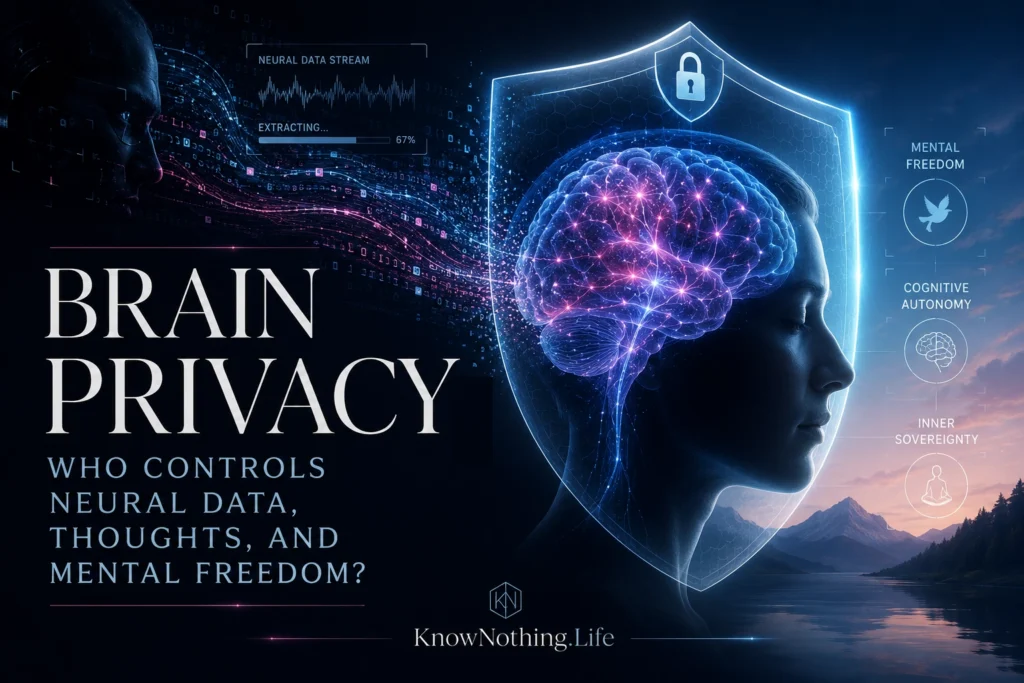
Brain privacy is the principle that people should control access to information produced by their nervous systems and the conclusions drawn from that information. It includes raw neural recordings, processed data, algorithmic predictions, and records generated by technologies such as electroencephalography, functional magnetic resonance imaging, implanted electrodes, and brain–computer interfaces. The idea overlaps with medical confidentiality and digital privacy, but it addresses a more intimate concern: technology may reveal information about attention, perception, intention, emotion, health, or identity that a person did not knowingly communicate.
Researchers often distinguish brain privacy from the broader concept of mental privacy. Brain privacy focuses primarily on data derived from neural structures or activity, while mental privacy includes protection against unwanted access to thoughts, preferences, intentions, and emotional states regardless of how those states are inferred. Marcello Ienca and colleagues have argued that privacy should be evaluated according to context, because the appropriate use of neural data in a hospital may be unacceptable in advertising, employment, education, insurance, or criminal justice. Rafael Yuste and colleagues similarly identified privacy, identity, agency, and equality as fundamental priorities for neurotechnology.
Why Neural Data Is Different
All personal information can be misused, but neural data has unusual characteristics. It is generated by the biological systems involved in sensation, movement, memory, attention, and thought. A recording collected for one purpose may contain signals unrelated to that purpose, and improved algorithms may extract information that could not be interpreted when the data was originally collected. A consumer might agree to use a headset for meditation or gaming without realizing that the stored signal could later be analyzed for identification, health-related patterns, or responses to carefully selected images.
Brain recordings can also contain stable individual signatures. Emily Finn and colleagues demonstrated that patterns of functional brain connectivity measured with fMRI could identify individuals across separate scanning sessions and even across rest and task conditions. A later electroencephalography study by Yao-Yuan Yang and colleagues found person-identifying EEG patterns that persisted across tasks and weeks and could distinguish even identical twins. Neural data cannot therefore always be treated as anonymous simply because obvious identifiers such as names or email addresses have been removed.
What Brain Decoding Can and Cannot Reveal
Brain-decoding research has advanced rapidly, but current systems are not universal machines that freely read private thoughts. Most successful decoders require controlled conditions, extensive individual training data, specialized equipment, and cooperation from the participant. In 2023, Jerry Tang and colleagues used fMRI to reconstruct the general meaning of perceived and imagined language. The output usually paraphrased ideas rather than reproducing an exact internal transcript. The researchers also found that successful training and application required cooperation from the participant, who could interfere with decoding by deliberately directing attention elsewhere.
Invasive speech neuroprostheses have achieved greater speed and accuracy because electrodes record closer to the neurons involved in attempted speech. Frank Willett and colleagues decoded attempted speech from a participant with amyotrophic lateral sclerosis at 62 words per minute, while Sean Metzger and colleagues produced text, synthesized speech, and facial-avatar movements from cortical activity in a participant with severe paralysis. These systems offer extraordinary clinical promise, but they were trained for specific individuals who intentionally attempted to communicate. Their achievements should not be described as evidence that strangers can remotely extract anyone’s unspoken thoughts.
Medical Promise and Informed Consent
Neural data can restore communication, operate prosthetic devices, monitor seizures, guide surgery, and improve treatment for neurological disorders. Brain privacy should not be framed as opposition to these benefits. For a person who has lost speech or movement, sharing neural activity with a medical system may increase autonomy rather than threaten it. The ethical challenge is ensuring that the person retains meaningful control over how the recording is collected, interpreted, stored, and reused.
Ordinary consent forms may be inadequate when future uses are difficult to predict. A participant may understand that data will control a communication device but not anticipate that the same recording could help train a commercial artificial-intelligence model. Consent should distinguish treatment from research, necessary processing from optional analysis, and device operation from secondary commercial use. It should also address how long recordings will be retained, who can access them, whether they can be transferred during a corporate acquisition, and what happens when a participant withdraws or an implanted device is no longer supported.
Consumer Neurotechnology and Commercial Use
Brain privacy becomes especially uncertain when neurotechnology leaves hospitals and research laboratories. Consumer devices may be marketed for relaxation, attention tracking, gaming, sleep, education, or workplace performance. Data from these products may not receive the same protections as medical records, particularly when companies operate outside traditional healthcare relationships. Privacy policies may permit broad data collection, internal product development, sharing with service providers, or changes in data practices that users are unlikely to read or fully understand.
In 2024, Jared Genser, Stephen Damianos, and Yuste analyzed the privacy policies and user agreements of 30 companies selling consumer neurotechnology products. Their report identified broad gaps between industry practices and established international data-protection principles, including unclear collection and retention rules, insufficient restrictions on secondary use, and inconsistent security protections. The report did not prove that every company was intentionally exploiting users, but it showed that commercial neural data can enter complicated information ecosystems without protections proportionate to its sensitivity.
Security, Reidentification, and Function Creep
Brain privacy is not protected merely by removing a person’s name. Neural patterns can sometimes function as biometric identifiers, and combining them with health records, device accounts, location histories, or behavioral data can increase the possibility of reidentification. Machine-learning models may also generate sensitive inferences without storing a recognizable thought or image. A system might estimate fatigue, cognitive workload, familiarity, or emotional response, and those predictions could influence decisions even when their accuracy is uncertain.
Security researchers have demonstrated how neural interfaces could be manipulated to expose unintended information. Ivan Martinovic and colleagues designed experiments in which carefully selected visual stimuli and EEG responses were used to infer private facts, including whether participants recognized particular people, locations, or financial information. The study did not show that consumer headsets routinely steal secrets, but it demonstrated that a system designed for one task can become a side channel for another. Brain privacy must therefore protect against function creep—the gradual expansion of data use beyond the purpose for which it was originally collected.
Employment, Education, and Unequal Power
Consent becomes less meaningful when refusing a device carries a penalty. An employee asked to wear a neural monitor may technically agree while fearing the loss of a job or promotion. A student may accept attention tracking because participation is presented as necessary for learning. Even inaccurate predictions can cause harm if employers, schools, insurers, or governments treat them as objective measurements of motivation, honesty, ability, or mental health. Neural data should not receive greater authority merely because it originates in the brain.
These concerns are partly about power rather than technological accuracy. A weak system can still be harmful when used to rank, discipline, exclude, or stigmatize people. Predictions may also perform unevenly across age groups, disabilities, cultural contexts, or populations underrepresented in training datasets. UNESCO’s 2025 Recommendation on the Ethics of Neurotechnology calls for informed consent, independent oversight, protections in education and employment, and safeguards against discrimination and coercion. It recognizes that brain technologies must be governed across their entire life cycle rather than evaluated only at the moment of data collection.
Laws, Neurorights, and Emerging Protections
Traditional medical, biometric, and consumer-privacy laws cover some neural information, but important gaps remain. Health privacy rules may apply when a hospital collects brain data for treatment, yet the same physiological signal may receive different protection when gathered by an entertainment or wellness company. Conventional privacy frameworks also tend to focus on stored information, while neurotechnology raises questions about real-time interpretation, algorithmic inference, manipulation, and the right not to be measured.
Colorado expanded its Privacy Act in 2024 to include biological and neural data, defining neural data as information generated by measuring activity in the central or peripheral nervous system. California enacted Senate Bill 1223 later that year, adding neural data to the sensitive personal information covered by the California Consumer Privacy Act. At the international level, the OECD adopted its Recommendation on Responsible Innovation in Neurotechnology in 2019, and UNESCO adopted the first global Recommendation on the Ethics of Neurotechnology on November 11, 2025. These measures represent meaningful progress, although their definitions, enforcement powers, exemptions, and geographic reach differ.
Building a Privacy-Respecting Future
Strong brain privacy requires more than asking users to click “agree.” Devices should collect only the signals necessary for their stated purpose, process information locally when possible, encrypt recordings, limit retention, prevent unauthorized model training, and provide genuine deletion and portability rights. Users should be able to understand what is measured, what conclusions are produced, who receives them, and whether decisions are made from raw signals or uncertain inferences. Independent auditing is necessary because people cannot evaluate complex neural algorithms from a privacy policy alone.
The central principle should be that access to the nervous system does not transfer ownership of the person. Neural data can support medicine, communication, creativity, and independence, but those benefits depend on trust. Brain privacy protects more than secrecy; it safeguards the freedom to think, hesitate, imagine, and change without every neural fluctuation becoming a permanent record or commercial prediction. The future of neurotechnology should therefore be measured not only by how accurately systems decode the brain, but by how reliably they preserve human dignity, mental freedom, and control over the most intimate forms of personal information.