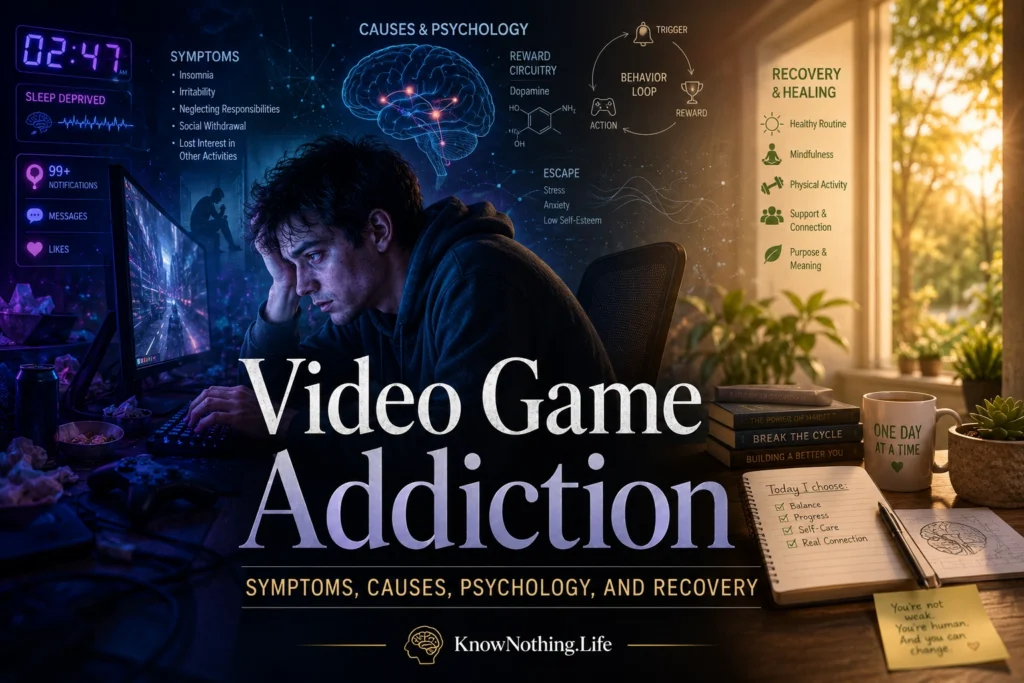
Video game addiction refers to a pattern of gaming behavior in which play becomes difficult to control, increasingly central to daily life, and continued despite harmful consequences. It is not the same as enjoying games, playing competitively, building online friendships, or spending many hours on a meaningful hobby. The psychological issue begins when gaming repeatedly overrides sleep, school, work, health, relationships, emotional stability, or real-world responsibilities. In that sense, the problem is not gaming itself, but the loss of balance and control around gaming.
Modern psychology treats video game addiction as part of the wider field of behavioral addiction. The World Health Organization includes “gaming disorder” in ICD-11, defining it by impaired control, increased priority given to gaming, and continuation or escalation despite negative consequences. The American Psychiatric Association lists Internet Gaming Disorder in the DSM-5-TR section for conditions needing further study, rather than as a fully formal DSM diagnosis. This distinction matters because video game addiction is real for some people, but the label must be used carefully to avoid pathologizing ordinary enthusiasm.
Gaming, Reward, and Reinforcement
Video games are powerful because they are built around reward. They offer goals, feedback, achievement, progress, mastery, competition, exploration, identity, and social recognition. B. F. Skinner’s work on reinforcement helps explain why games can become compelling. Skinner wrote in Science and Human Behavior that “the consequences of behavior determine the probability that the behavior will occur again.” Games provide consequences quickly: points, levels, loot, rankings, victories, unlocks, praise, and visual feedback. The brain learns that play produces reward.
Many games also use intermittent reinforcement, where rewards are unpredictable rather than guaranteed. This can be especially motivating because the next match, drop, achievement, or victory might be the rewarding one. Gambling machines operate through similar principles, though gaming and gambling are not identical. The psychological pattern is clear: uncertainty can sustain behavior. A player may keep going not because every moment is enjoyable, but because the next moment could deliver success, status, relief, or emotional escape.
Escapism and Emotional Regulation
Video game addiction often develops when gaming becomes a primary tool for emotional regulation. A person may play to escape anxiety, loneliness, depression, boredom, family conflict, school stress, trauma, social rejection, or low self-worth. In moderation, games can provide relaxation, creativity, competence, and social contact. In addiction, however, the game becomes less like recreation and more like refuge. The player does not simply want to play; they feel they need to play in order to feel okay.
Gabor Maté’s work on addiction emphasizes the emotional pain beneath compulsive behavior. His well-known question is not “Why the addiction?” but “Why the pain?” This perspective is important for gaming addiction because excessive gaming is often a symptom as well as a problem. A teenager who spends all night online may be avoiding social humiliation. An adult who cannot stop gaming may be escaping failure, grief, or emptiness. The screen becomes a place where the self feels competent, seen, or safe when offline life feels threatening.
Motivation, Identity, and Online Worlds
Games are not passive entertainment. They are interactive worlds in which players can become skilled, recognized, and socially meaningful. Self-determination theory, developed by Edward Deci and Richard Ryan, argues that human motivation is shaped by needs for autonomy, competence, and relatedness. Games often satisfy all three. They allow players to choose strategies, improve skills, and connect with others. This is why gaming can be genuinely enriching. The same features that make games meaningful can also make them difficult to leave.
For some players, the gaming identity becomes stronger than the offline identity. The person may feel more respected as a guild leader, ranked competitor, streamer, builder, or teammate than as a student, employee, sibling, or partner. This does not make the identity fake. Online identities can be real and socially significant. The problem begins when the game identity crowds out broader development. A healthy life can include gaming; an addicted life increasingly narrows around it.
Symptoms and Diagnosis
Mark Griffiths’s components model of behavioral addiction is useful for understanding video game addiction. He describes addiction through components such as salience, mood modification, tolerance, withdrawal, conflict, and relapse. Salience means gaming dominates thought and behavior. Mood modification means gaming changes emotional state. Tolerance means needing more gaming to achieve the same effect. Withdrawal may involve irritability, restlessness, or distress when unable to play. Conflict appears in damaged relationships, school, work, or health. Relapse occurs when attempts to cut down repeatedly fail.
The WHO definition of gaming disorder similarly emphasizes impaired control, gaming taking priority over other activities, and continued gaming despite harm. These criteria help separate addiction from passion. A person can play many hours and not be addicted if gaming fits within a balanced life. Addiction is defined by impairment, distress, and loss of control, not by time alone. The key question is not only “How much do you play?” but “What is gaming replacing, damaging, or controlling?”
Brain, Dopamine, and Habit
Video games engage reward and motivation systems, including dopamine-related pathways involved in learning, wanting, attention, and reinforcement. Dopamine should not be reduced to a “pleasure chemical.” Researchers such as Kent Berridge and Terry Robinson have shown that wanting and liking are not the same. A person can strongly want a behavior even after it stops producing much pleasure. This distinction helps explain why some players keep gaming long after they feel exhausted, angry, or empty.
Habit also matters. Charles Duhigg’s The Power of Habit popularized the cue-routine-reward loop. In gaming addiction, the cue may be boredom, loneliness, stress, a notification, a friend invitation, or the time of day. The routine is gaming. The reward is relief, stimulation, status, or connection. Over time, the loop becomes automatic. The player may open the game before consciously deciding to play. Recovery often requires changing cues, adding friction, and creating alternative routines that meet the same emotional needs.
Social Connection and Isolation
Many games are social environments. Multiplayer games, voice chat, guilds, clans, and online communities can provide belonging and friendship. For isolated people, gaming may be the one place where they feel competent and connected. This is why simplistic advice like “just stop playing” can fail. If gaming is the person’s main source of social life, removing it without replacing connection can deepen loneliness.
At the same time, gaming can become isolating when online life replaces sleep, exercise, education, family interaction, work, or face-to-face relationships. Sherry Turkle’s Alone Together warns that digital connection can sometimes offer the feeling of companionship while leaving deeper needs unmet. Video game addiction often contains this paradox: the player may be socially connected in the game but increasingly disconnected from the rest of life. Recovery should not destroy connection; it should widen it.
Controversy and Overdiagnosis
Video game addiction remains controversial because researchers and clinicians worry about overdiagnosis, moral panic, and stigmatizing healthy gaming. Many people play intensely without meeting criteria for addiction. Esports players, streamers, developers, hobbyists, and socially active gamers may spend many hours gaming in ways that are disciplined, meaningful, and compatible with life goals. The ICD-11 inclusion of gaming disorder reflects clinical concern, but the APA’s DSM placement as a condition for further study shows that debate remains.
This debate is healthy. A good diagnosis should identify real suffering without turning normal behavior into illness. The most responsible view is balanced: video game addiction can be serious, but it is not common simply because gaming is popular. The question is impairment. Does gaming repeatedly damage health, relationships, school, work, money, sleep, or emotional control? Has the person tried to stop or cut down and failed? Does gaming continue despite clear harm? Those questions matter more than cultural discomfort with games.
Treatment and Recovery
Treatment for video game addiction often involves cognitive behavioral therapy, motivational interviewing, family work, sleep repair, digital boundaries, and treatment of underlying anxiety, depression, ADHD, trauma, or loneliness. Cognitive behavioral therapy helps players identify triggers, distorted thoughts, and avoidance patterns. Motivational interviewing, developed by William Miller and Stephen Rollnick, helps people explore ambivalence without shame. Many players both want to change and fear losing the only activity that gives them competence or belonging.
Recovery does not always require permanent abstinence, though some people may need a period away from gaming. Others may work toward controlled use. A good plan includes practical limits, device boundaries, scheduled offline activities, social replacement, exercise, sleep routines, and accountability. Most importantly, recovery must replace the function gaming served. If games provided achievement, the person needs real-world mastery. If games provided friendship, they need connection. If games provided escape, they need safer ways to face distress.
Conclusion
Video game addiction is a behavioral addiction pattern in which gaming becomes compulsive, prioritized, and harmful despite negative consequences. It grows from reinforcement, reward design, emotional regulation, habit, identity, and social connection. Games themselves are not the enemy. They can be creative, social, educational, and meaningful. The problem begins when gaming narrows life rather than enriching it.
A mature psychology of video game addiction avoids both denial and panic. It recognizes that some people suffer real impairment, while many others game heavily without addiction. Understanding the difference requires attention to control, consequences, distress, and life balance. Recovery is not simply about turning off a screen. It is about rebuilding a life where play has a place, but no longer controls the whole world.