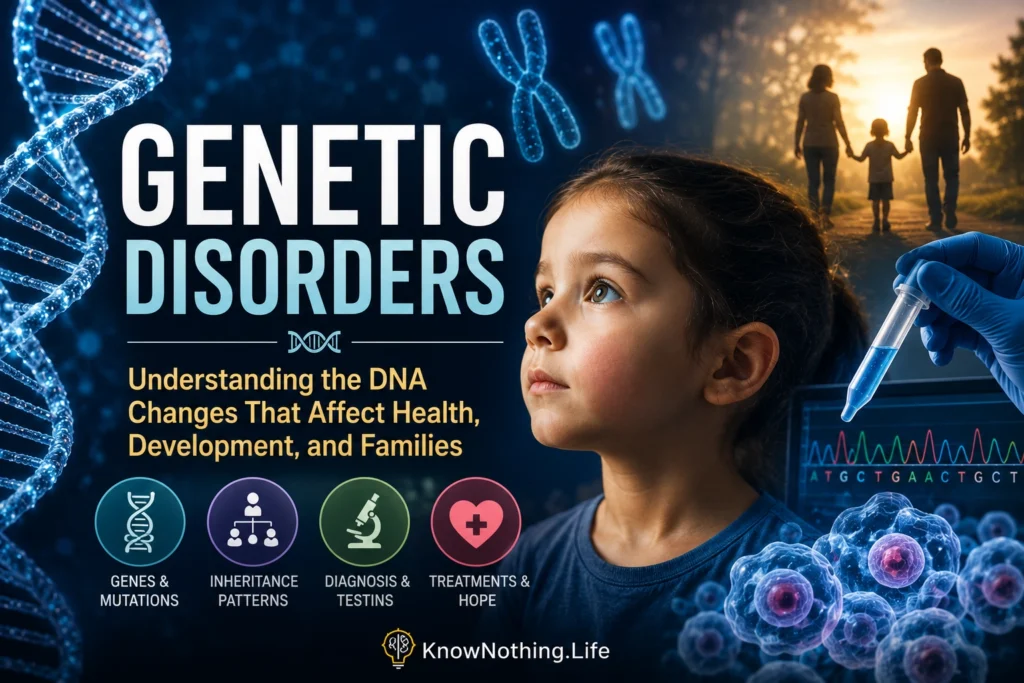
Genetic disorders are health conditions caused wholly or partly by changes in DNA. These changes may alter a single nucleotide, remove or duplicate part of a gene, affect the number or structure of chromosomes, or disrupt the mitochondrial genome. Some pathogenic variants are inherited from one or both parents, while others arise spontaneously in an egg, sperm, or developing embryo. A genetic condition may be evident at birth, emerge during childhood, or remain unnoticed until adulthood. The timing depends on the biological pathway involved, the severity of the variant, and the influence of other genes and environmental conditions.
The relationship between a genetic change and disease is rarely as simple as a damaged gene automatically producing one predictable outcome. Genes provide instructions for making proteins and functional RNA molecules, but those products operate inside complicated cellular networks. A pathogenic variant may prevent a protein from being produced, alter its shape, reduce its activity, or cause it to function in a harmful way. The resulting effects may be limited to one organ or may influence several systems. Clinical genome and exome sequencing have revealed that patients with similar symptoms can carry variants in different genes, while people with changes in the same gene can experience substantially different symptoms.
Single-Gene and Chromosomal Disorders
Single-gene disorders result primarily from pathogenic variants in one gene and may follow recognizable inheritance patterns. In autosomal dominant disorders, one altered copy can be sufficient to cause disease. Huntington’s disease is a well-known example: research published by the Huntington’s Disease Collaborative Research Group in 1993 identified an expanded CAG repeat in the HTT gene. Later work showed that repeat length is associated with important differences in clinical presentation and age at onset, although it does not explain every difference among patients.
Autosomal recessive disorders generally develop when a person inherits pathogenic variants in both copies of a gene. Cystic fibrosis, for example, results from variants affecting CFTR, a protein involved in ion transport across epithelial cells. Experiments showed that introducing functional CFTR into affected airway cells corrected defective chloride-channel regulation, strengthening the evidence that CFTR dysfunction directly causes the characteristic cellular problem. Other conditions involve sex chromosomes or mitochondrial DNA. Mitochondrial disorders are particularly complex because they may result from variants in either mitochondrial or nuclear genes, and the proportion of altered mitochondrial DNA can vary among cells and tissues.
Chromosomal disorders involve larger changes than those usually found in a single gene. A person may have an extra chromosome, a missing chromosome, or a segment that has been deleted, duplicated, inverted, or moved. Down syndrome is caused by an additional complete or partial copy of chromosome 21. Because chromosome 21 contains many genes and regulatory elements, the condition reflects an imbalance in gene dosage rather than disruption of one isolated pathway. Research has shown that trisomy 21 can influence gene expression throughout the genome, helping explain why its effects can involve cognition, heart development, immune function, metabolism, and other systems.
Inheritance Is More Complicated Than a Family Tree
Traditional inheritance diagrams are useful, but they cannot capture every feature of genetic disease. Penetrance refers to the proportion of people carrying a disease-associated genotype who develop the related condition. A variant with incomplete penetrance may cause symptoms in some carriers but not others. Variable expressivity means that individuals with the same pathogenic variant can develop different symptoms or levels of severity. Age, sex, modifier genes, lifestyle, environmental exposures, medical care, and chance events during development can all influence the final outcome.
New genetic changes can also arise without being detected in either parent’s blood. These de novo variants help explain why a child may have a dominant disorder despite having no known family history. Mosaicism creates another layer of complexity. A post-conception genetic change may appear in only a subset of the body’s cells, meaning that its effects depend partly on when the change occurred and which tissues carry it. A parent may also have germline mosaicism, in which some egg or sperm cells carry a variant that is absent or difficult to detect elsewhere in the body. Genetic risk therefore cannot always be inferred from an ordinary family history alone.
How Genetic Disorders Are Diagnosed
Diagnosis usually begins with medical history, physical examination, family history, laboratory results, imaging, and evaluation of characteristic symptoms. Genetic testing may then focus on one suspected variant, analyze a panel of related genes, examine chromosome number and structure, or sequence the protein-coding exome or complete genome. Chromosomal microarrays can identify many deletions and duplications, while exome and genome sequencing are especially useful when symptoms do not point clearly to one disorder. In a landmark 2013 study, Yaping Yang and colleagues used clinical whole-exome sequencing to diagnose 62 of 250 patients with suspected Mendelian conditions, producing a molecular diagnosis in 25 percent of cases.
Sequencing does not automatically produce a clear answer. Every person carries a large number of genetic differences, most of which are harmless. Laboratories must determine whether a detected variant is pathogenic, likely pathogenic, of uncertain significance, likely benign, or benign. The 2015 standards developed by Sue Richards and colleagues for the American College of Medical Genetics and Genomics and the Association for Molecular Pathology established a structured framework that weighs population frequency, functional evidence, family segregation, computational findings, and other forms of evidence. A variant of uncertain significance should not be treated as proof of disease, and its classification may change as new information becomes available.
Even advanced testing leaves many patients without a definitive result. Disease-causing changes may occur in regions that are difficult to sequence, affect gene regulation rather than protein structure, or involve repeat expansions, structural rearrangements, mosaicism, and mechanisms that scientists do not yet understand. A 2024 New England Journal of Medicine study examining families with suspected rare monogenic diseases showed that genome sequencing can identify diagnoses missed by previous testing, although its incremental benefit depends on the technologies and analyses already performed. Reanalysis is therefore valuable because newly discovered disease genes and improved computational methods can turn an earlier negative result into a diagnosis.
Treatment in the Genomic Era
For many years, genetic diagnosis mainly helped families understand prognosis and recurrence risk. Today, some treatments act directly on the molecular consequences of genetic disease. Medicines may replace a missing enzyme, stabilize a faulty protein, alter RNA processing, introduce a functional gene, or modify a patient’s own cells. These therapies do not erase every consequence of a disorder, but they demonstrate that inherited does not mean untreatable. Supportive care also remains essential, including physical therapy, nutritional support, surgery, medication, respiratory care, psychological services, and educational accommodations.
Spinal muscular atrophy illustrates the transition from genetic discovery to targeted therapy. The disorder is usually caused by loss of functional SMN1, resulting in inadequate production of survival motor neuron protein. Nusinersen is an antisense oligonucleotide designed to modify the splicing of the related SMN2 gene so that it produces more full-length protein. In the 2017 ENDEAR trial led by Richard Finkel, infants receiving nusinersen were more likely than those undergoing a sham procedure to achieve motor milestones and survive without permanent assisted ventilation. The results also indicated that earlier treatment produced greater benefit, reinforcing the importance of prompt genetic diagnosis.
Gene editing has expanded the therapeutic possibilities further. In a 2021 study, Haydar Frangoul and colleagues used CRISPR-Cas9 to edit blood-forming stem cells from patients with sickle cell disease and transfusion-dependent β-thalassemia. The edited cells were designed to increase fetal hemoglobin by disrupting regulation involving BCL11A. Early participants experienced substantial clinical improvement, providing proof that editing a patient’s cells could counteract the effects of an inherited blood disorder. Such treatments remain medically intensive and may involve chemotherapy, transplantation risks, long-term monitoring, and considerable cost.
Genetic Counseling, Ethics, and the Future
Genetic information can affect an entire family rather than only the person being tested. A diagnosis may reveal that siblings, parents, or children also carry a variant or face an increased risk. Genetic counselors help individuals understand inheritance, testing choices, reproductive options, uncertain results, and the emotional consequences of learning about future disease risk. Counseling is especially important for conditions that have no preventive treatment or that vary greatly among carriers. The goal should be informed decision-making, not pressure to pursue or reject testing.
Genetic medicine also raises concerns about privacy, discrimination, unequal access, embryo selection, incidental findings, and the social treatment of disability. A molecular diagnosis can provide relief and useful guidance, but it should never be used to reduce a person to a sequence of DNA. Genetic disorders develop through biological pathways that interact with medical care, social conditions, relationships, and individual experience. As sequencing and gene-based treatments improve, the central challenge will be ensuring that scientific progress is accompanied by careful interpretation, ethical safeguards, and fair access to diagnosis and treatment.