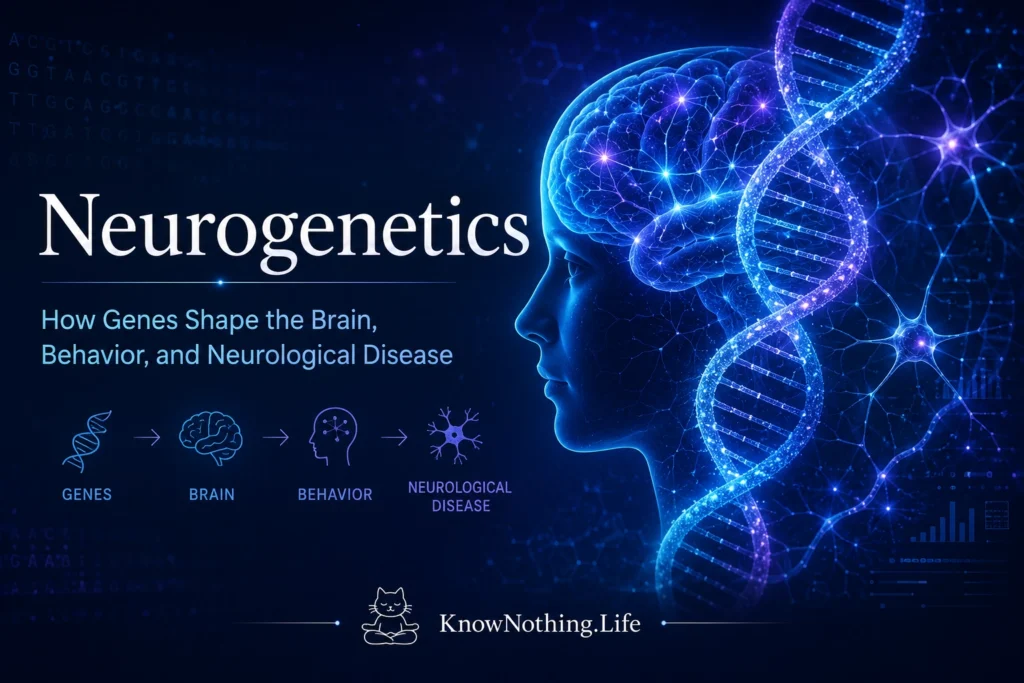
Neurogenetics is the study of how genetic variation influences the development, structure, function, and vulnerability of the nervous system. It joins neuroscience with genetics to investigate questions ranging from why certain neurons form particular circuits to why some people inherit neurological disorders or carry increased susceptibility to psychiatric illness. The field examines DNA variants, gene expression, chromosome structure, RNA processing, epigenetic regulation, and the molecular pathways through which inherited or newly arising changes alter brain cells. Because the brain contains many specialized cell types that change across development and aging, neurogenetics is not simply a search for “brain genes.” It seeks to understand when, where, and in which cells genes become biologically important.
Early neurogenetic research often focused on families in which a neurological condition followed a recognizable inheritance pattern. A landmark example came in 1993, when the Huntington’s Disease Collaborative Research Group identified an expanded CAG repeat in the gene now called HTT. The mutation provided a direct molecular explanation for Huntington’s disease and showed how an unstable repeat could be inherited across generations. In the same year, E. H. Corder and colleagues showed that the APOE ε4 allele substantially increased risk for late-onset Alzheimer’s disease, illustrating a different relationship: APOE ε4 raises probability but does not determine an individual’s fate. Together, these discoveries helped establish the distinction between highly penetrant disease-causing mutations and risk variants whose effects depend on additional biological and environmental factors.
From Single-Gene Disorders to Polygenic Risk
Some neurological disorders are strongly associated with changes in one gene. Huntington’s disease, many forms of muscular dystrophy, Rett syndrome, and particular inherited epilepsies can be traced to variants with relatively large effects. Even in these conditions, however, the clinical picture is rarely produced by one mutation acting in isolation. Modifier genes, developmental history, cellular stress, age, and environmental exposure can influence when symptoms emerge and how severe they become. Neurogenetics therefore asks not only which gene is altered, but how that alteration affects protein production, synaptic signaling, neuronal survival, myelination, metabolism, or communication among neural circuits.
Most common psychiatric and neurological conditions have a more complex architecture. They reflect combinations of many common variants with small effects, rarer variants with larger effects, and non-genetic influences. Schizophrenia provides a clear example. A 2022 genome-wide association study led by Vassily Trubetskoy identified associations at 287 genomic loci in a sample including more than 76,000 people with schizophrenia and more than 243,000 controls. The implicated regions were enriched near genes expressed in excitatory and inhibitory neurons and pointed toward synaptic biology. A companion exome-sequencing study led by Tarjinder Singh found ultra-rare coding variants in ten genes that conferred substantially elevated risk. These findings show why the idea of a single “schizophrenia gene” is misleading: common and rare variants can converge on related cellular systems while contributing different degrees of risk in different people.
Genes, Brain Development, and Behavior
Genes influence the brain by directing developmental processes such as cell division, neuronal migration, axon guidance, synapse formation, and the maturation of neural networks. Their effects depend heavily on timing. A gene active in a fetal neural progenitor may serve a different function from the same gene expressed in an adult neuron or glial cell. Research on the human brain transcriptome has shown that gene-expression patterns shift across prenatal development, childhood, adulthood, and aging. The PsychENCODE Consortium extended this work by integrating transcriptomic, epigenetic, and genetic data, helping researchers connect disease-associated variants—many of which lie outside protein-coding regions—to changes in gene regulation within the developing and adult brain.
The discovery of FOXP2 illustrates both the power and danger of simplifying gene–behavior relationships. In 2001, Cecilia Lai and colleagues identified a FOXP2 mutation in members of a family with a severe inherited speech and language disorder. FOXP2 encodes a transcription factor that helps regulate other genes involved in neural development and function. The finding did not reveal a single “language gene.” Instead, it showed that disruption of one regulatory gene could alter the motor and neural systems needed for fluent speech. Similarly, a large 2020 exome-sequencing study led by F. Kyle Satterstrom identified more than 100 genes associated with autism, with results pointing to both early developmental regulation and later neuronal communication. Complex behaviors emerge from networks of genes acting through networks of cells, not from isolated genetic instructions for personality, intelligence, empathy, or language.
How Neurogenetic Research Works
Modern neurogenetics uses several complementary methods. Family studies and linkage analysis remain useful for rare inherited disorders, while whole-exome sequencing focuses on protein-coding regions and whole-genome sequencing can identify variants across coding and noncoding DNA. Genome-wide association studies compare genetic markers across large populations to find variants statistically associated with a trait or disorder. Researchers then use transcriptomics to determine which genes are active, epigenomics to examine regulatory modifications, and proteomics to measure the proteins produced by cells. Single-cell technologies add another level of precision by revealing that a variant may influence one neuronal or glial subtype while having little effect in another.
Finding an association is only the beginning. Scientists must determine whether a variant changes gene expression, protein structure, RNA splicing, cellular physiology, or circuit activity. This requires experiments in cultured neurons, induced pluripotent stem cells, brain organoids, animal models, and postmortem human tissue. Epigenetic research further complicates the picture in a productive way. A major 2013 study by Ryan Lister and colleagues documented extensive reconfiguration of DNA methylation during mammalian brain development, demonstrating that the genome’s functional state changes as neurons mature. These regulatory layers help explain how cells containing essentially the same DNA can become cortical neurons, interneurons, astrocytes, oligodendrocytes, or microglia with very different roles.
Clinical Promise and Ethical Limits
Neurogenetics has already changed diagnosis and treatment. Genetic testing can end long diagnostic searches, identify relatives who may be at risk, guide reproductive counseling, and distinguish conditions that appear clinically similar but arise from different molecular causes. Spinal muscular atrophy became a defining example of genetically informed therapy. In 2017, Richard Finkel and colleagues reported that nusinersen, an antisense oligonucleotide designed to alter SMN2 RNA splicing, improved outcomes in infants with the disorder. That same year, Jerry Mendell and colleagues reported early results from an AAV-based gene-replacement treatment delivering functional SMN genetic material. A 2019 report by Jinkuk Kim and colleagues went further by describing a customized oligonucleotide developed for a single child with a uniquely rare mutation, suggesting a possible path toward individualized genomic medicines.
The field also carries serious limitations. A genetic association is not a diagnosis, and a polygenic risk score is not a prediction of destiny. Scores may perform unevenly across populations when discovery datasets lack ancestral diversity, and uncertain variants can create anxiety without providing clear guidance. Questions of consent, genetic privacy, disability rights, embryo selection, data ownership, and unequal access become especially sensitive when research concerns cognition, behavior, or mental illness. Responsible neurogenetics must resist biological determinism. Genes influence probabilities and developmental pathways, but their effects unfold within cells, bodies, families, cultures, and environments. The future of the field lies not in reducing the mind to DNA, but in explaining how genetic variation interacts with molecular regulation, neural circuits, experience, and time to produce the diversity of human brains.