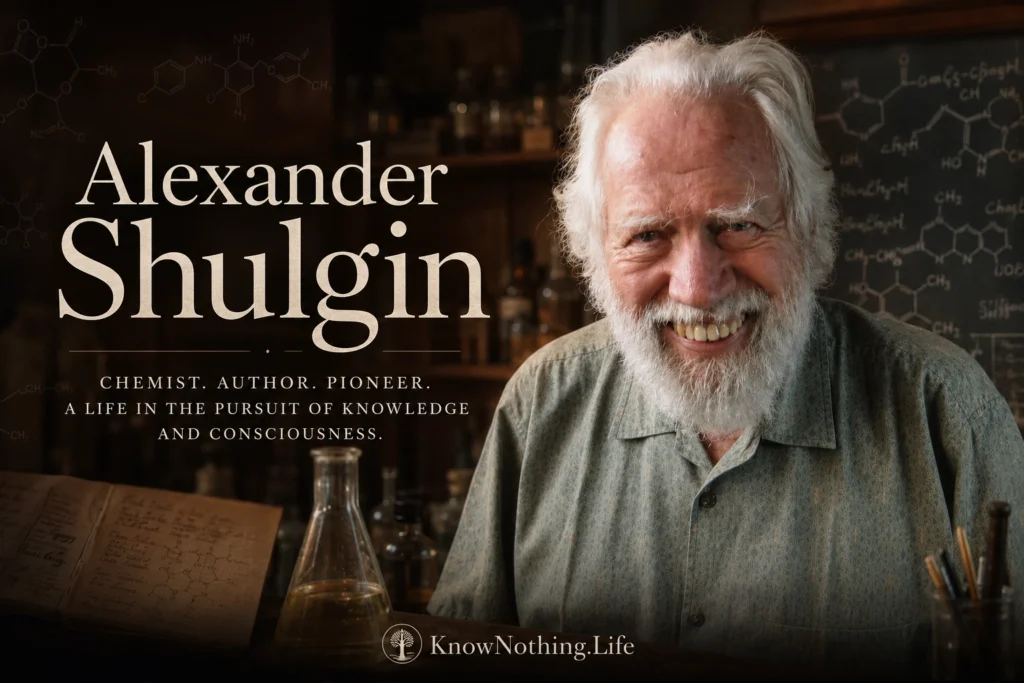
Alexander “Sasha” Shulgin was an American chemist, pharmacologist, and author whose work made him one of the most consequential and controversial figures in psychedelic science. Over several decades, he synthesized, investigated, and documented a large family of psychoactive compounds, treating altered consciousness as a phenomenon that could be explored through chemistry and disciplined observation. He is most closely associated with the modern rediscovery of MDMA. Although Merck chemists first synthesized the substance decades earlier, Shulgin recognized its unusual psychological effects, introduced it to psychotherapists, and helped bring it into a small therapeutic community before it became widely associated with nightlife and recreational drug use.
His wider legacy rests on far more than one substance. Working from a home laboratory in Lafayette, California, Shulgin explored relationships between molecular structure and subjective experience, particularly among phenethylamines and tryptamines. With his wife, Ann Shulgin, he documented much of this work in PiHKAL: A Chemical Love Story and TiHKAL: The Continuation, books that combine autobiography, cultural argument, chemical documentation, and descriptions of altered states. Admirers regard him as a pioneer who preserved valuable knowledge during an era of prohibition; critics question the controls, ethics, and risks of his self-experimental methods.
Early Life and Scientific Education
Alexander Theodore Shulgin was born on June 17, 1925, in Berkeley, California, to parents who worked as public-school teachers. Gifted in music, languages, and science, he entered Harvard University on scholarship at sixteen but left during the Second World War to serve in the United States Navy. One formative experience involved his losing consciousness after assuming that sugar crystals in a glass of juice were a sedative. Discovering that expectation rather than medication had produced the reaction impressed upon him how powerfully belief could influence bodily experience.
After leaving the Navy, Shulgin returned to California and studied chemistry at the University of California, Berkeley, earning a doctorate in biochemistry in 1954. He later completed postdoctoral work involving psychiatry and pharmacology at the University of California, San Francisco. Following a period as research director at Bio-Rad Laboratories, he joined Dow Chemical as a senior research chemist. This training gave him an unusual combination of synthetic expertise, biological curiosity, and interest in subjective mental life.
Dow Chemical and the Mescaline Turning Point
At Dow, Shulgin developed Zectran, a commercially successful insecticide described by the Alexander Shulgin Research Institute as the first biodegradable pesticide. The patent’s profitability earned him considerable freedom to pursue research of his own choosing. His professional reputation rested on conventional industrial chemistry, but a personal encounter with mescaline redirected his ambitions toward psychopharmacology. Recalling the experience, Shulgin said, “I learned there was a great deal inside me.”
The insight became central to his philosophy. Shulgin reasoned that the molecule had not placed a complete experience inside his mind; instead, it had somehow made internal possibilities more accessible. He began modifying known psychoactive structures to investigate how relatively small chemical changes affected potency, duration, physical sensations, and the emotional character of an experience. As public concern about illicit drugs increased during the 1960s, Dow became uncomfortable with the reputational risks surrounding his publications. Shulgin left the company and continued as an independent researcher, lecturer, consultant, and expert witness.
MDMA and the Therapeutic Underground
MDMA remained largely obscure until Shulgin prepared and tested it in 1976 after learning of its possible effects. He did not invent the molecule, but his work gave it a new scientific and cultural life. Through gradual testing and careful observation, he identified a state characterized less by the visual distortions associated with classical psychedelics than by emotional openness, reduced defensiveness, and easier communication. He introduced MDMA to psychotherapist Leo Zeff, who shared it with a network of therapists using it as an adjunct to structured sessions.
Shulgin viewed MDMA as a tool rather than a guaranteed cure. Its effects depended on health, intention, relationships, surroundings, and responsible administration. During the 1980s, the substance spread beyond therapeutic circles and became known as Ecstasy. The Drug Enforcement Administration eventually placed it in Schedule I, sharply restricting its clinical availability. Shulgin opposed the loss of scientific access but distinguished careful investigation from indiscriminate consumption. Psychoactive compounds, in his view, might enable change, but they could not determine whether that change would be beneficial.
Self-Experimentation and the Shulgin Method
Shulgin’s most unusual contribution was his systematic use of personal bioassay. After synthesizing a compound, he generally began with a very small amount and increased his exposure cautiously over time. Only after evaluating it personally would he sometimes invite Ann and a trusted circle of experienced participants to join structured sessions. They recorded onset, duration, bodily reactions, emotional tone, imagery, communication, and aftereffects. Shulgin also created a rating scale ranging from barely detectable threshold effects to experiences that decisively transformed awareness.
This method produced qualitative observations that animal studies could not supply, but it did not meet modern standards for controlled clinical research. The sessions were not randomized or blinded, participants were self-selected, expectations were strong, and the groups were small. Unknown compounds also carried toxicological risks that careful observation could not eliminate. Shulgin acknowledged the danger, warning that uninformed experimentation was “irresponsibly and immorally” conducted, whether or not it was technically legal. His research is therefore best understood as exploratory human pharmacology rather than evidence that the compounds were safe or therapeutically effective.
PiHKAL, TiHKAL, and Major Works
In 1991, Alexander and Ann Shulgin published PiHKAL: A Chemical Love Story, whose title abbreviates “Phenethylamines I Have Known and Loved.” The first portion presents a partly fictionalized account of their lives, relationship, and intellectual community, while the second documents phenethylamine compounds and reported effects. TiHKAL: The Continuation, published in 1997, uses a similar structure to examine tryptamines, a chemical family related to serotonin, psilocin, and DMT. Both volumes function as scientific references, autobiographies, love stories, and deliberate attempts to preserve information that restrictive laws might otherwise erase.
Shulgin’s other important works include Controlled Substances: Chemical and Legal Guide to Federal Drug Laws, The Simple Plant Isoquinolines, written with Wendy Perry, and The Shulgin Index, Volume One: Psychedelic Phenethylamines and Related Compounds, created with Tania Manning and Paul Daley. His notebooks reveal an investigator interested not merely in producing intense effects but in mapping structure–activity relationships: the ways modifications to a molecule might alter its psychological and physiological profile.
Conflict, Controversy, and Responsibility
Shulgin maintained a complicated relationship with law enforcement. He possessed a DEA Schedule I research license, performed chemical analyses, served as an expert witness, and wrote a respected legal guide to controlled substances. In 1994, however, federal agents raided his laboratory. The DEA fined him for conducting analyses outside the terms of his license, and he surrendered the license rather than continue his scheduled-substance research under restrictions he regarded as unreasonable.
Publishing detailed chemical information preserved scientific knowledge, but it also made novel substances more accessible to underground manufacturers and inexperienced users. Some compounds connected with Shulgin’s research later entered unregulated markets and were associated with medical emergencies. It would be misleading to blame him alone for those consequences, just as it would be misleading to treat his detailed notes as proof of safety. His legacy raises a difficult question: how should potentially valuable but hazardous knowledge be shared when suppression, misuse, commercial exploitation, and scientific stagnation are all genuine risks?
Philosophy, Final Years, and Legacy
Shulgin regarded psychedelics as instruments for investigating consciousness rather than as containers filled with automatic wisdom. In PiHKAL, he wrote that “our entire universe is contained in the mind and the spirit,” adding that certain chemicals can catalyze access to what is already present. This view joined material chemistry with a conviction that subjective life was vast, structured, and worthy of direct investigation. He did not claim that every drug experience was meaningful or beneficial; his interest was whether carefully studied compounds could help reveal dimensions of memory, identity, emotion, creativity, and spiritual experience.
Shulgin experienced serious health problems during his final years, including strokes and dementia, and died at his Northern California home on June 2, 2014, at the age of eighty-eight. His work continues to influence medicinal chemistry, neuroscience, drug-policy scholarship, and research into psychedelic-assisted therapies. His methods remain historically distinctive rather than a model to reproduce uncritically. Alexander Shulgin’s enduring achievement was to demonstrate that a small alteration in molecular structure could produce a dramatically different human experience—while leaving later generations to investigate those discoveries with greater safety, rigor, and ethical accountability.
ALEXANDER SHULGIN BOOKS
PiHKAL: A Chemical Love Story (1991)
TiHKAL: The Continuation (1997)
The Simple Plant Isoquinolines (2002)
The Shulgin Index: Psychedelic Phenethylamines and Related Compounds (2011)
The Nature of Drugs: History, Pharmacology, and Social Impact (vol.1 2021, vol.2 2023)