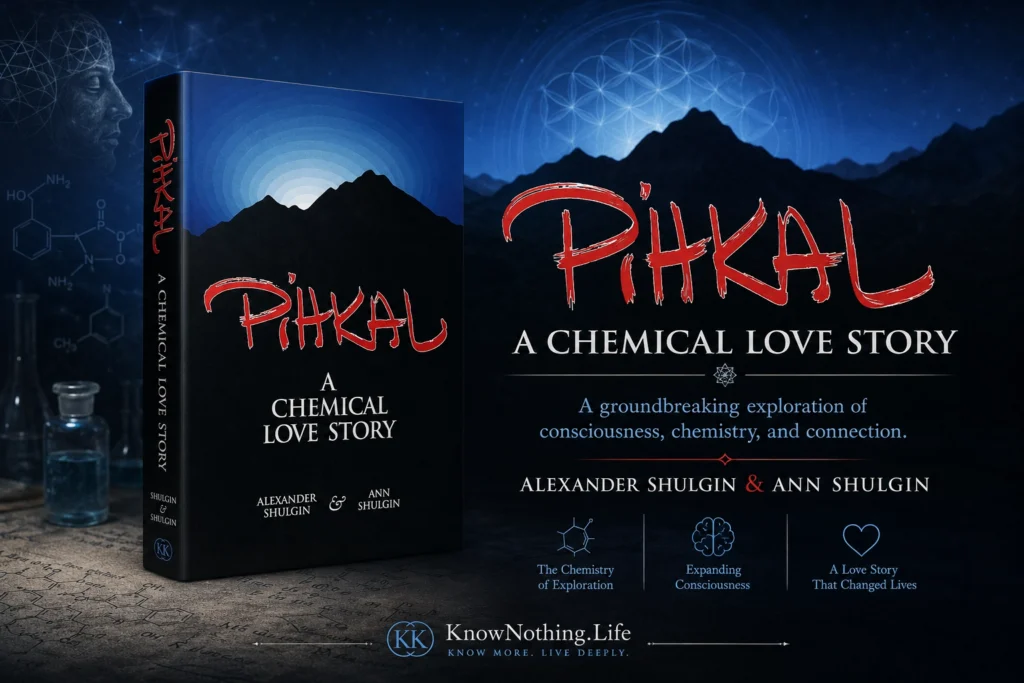
Published in 1991, PiHKAL: A Chemical Love Story is one of the strangest and most influential books to emerge from twentieth-century psychedelic culture. Although commonly associated with chemist Alexander “Sasha” Shulgin, it was written with his wife, Ann Shulgin, and its title is an acronym for Phenethylamines I Have Known and Loved. The book deliberately refuses to belong to a single genre. It is partly autobiographical romance, partly memoir of scientific discovery, partly philosophical investigation of altered consciousness, and partly technical record of psychoactive phenethylamines. Purdue University’s Alexander Shulgin archive describes its first half as an autobiographical story told through fictionalized characters and its second half as a record of the couple’s extensive exploration of phenethylamine compounds.
That unusual structure is essential to understanding the book. PiHKAL is not simply a catalogue of psychoactive substances, nor is it merely a memoir about unconventional researchers. The “chemical” and “love” stories are inseparable because the Shulgins are interested in chemistry largely as a means of investigating human experience. Their deeper subject is consciousness: how small alterations in molecular structure can correspond with radically different changes in perception, emotion, introspection, intimacy, and meaning. Modern pharmacology confirms the remarkable diversity of psychedelic compounds and their effects on perception, mood, and cognition, although contemporary science approaches their risks and mechanisms more systematically than the informal research culture depicted in PiHKAL.
Alexander Shulgin and the Experimental Exploration of Mind
Alexander Shulgin approaches psychopharmacology with the mentality of both chemist and phenomenologist. Chemistry provides him with the ability to create variations within a family of molecules, while subjective experience becomes another domain requiring careful observation. He is interested not merely in whether a compound is “active,” but in the texture of consciousness that follows: changes in emotion, sensory perception, imagination, social connection, introspection, or awareness. The second half of PiHKAL consequently documents 179 phenethylamines, forming a historical record of an unusually broad program of psychedelic investigation.
There is a philosophical parallel with William James, whose The Varieties of Religious Experience argued that unusual states of consciousness cannot simply be dismissed because they differ from ordinary waking awareness. James famously treated consciousness as plural in its possibilities, suggesting that normal rational awareness may represent only one form of mental life. Shulgin’s project operates in a comparable spirit, although through chemistry rather than philosophy or comparative religion. His underlying question is whether altered states can reveal dimensions of emotion and cognition that ordinarily remain inaccessible. Later controlled research has shown that psychedelic experiences can indeed produce enduring changes in reported meaning and spiritual significance under carefully supervised conditions, although such findings do not imply that every altered state is insightful or beneficial.
Phenethylamines as a Map of Consciousness
The phenethylamine family gives PiHKAL its scientific center. Some members of this broad chemical class can produce psychedelic effects, while others have stimulant, empathogenic, or substantially different psychological profiles. David Nichols’ major review of psychedelic pharmacology describes serotonergic psychedelics as substances capable of altering perception, mood, cognition, and numerous other psychological processes, while emphasizing that differences in molecular structure and receptor activity can produce meaningful differences in subjective effects.
For Shulgin, those differences turn medicinal chemistry into something resembling cartography. If changing part of a molecule changes subjective consciousness, then chemical structure becomes one way of exploring the architecture of mind. This does not mean that a particular emotional state can be reduced to a molecule. On the contrary, one of PiHKAL’s recurring lessons is that pharmacology interacts with personality, expectation, environment, relationships, and circumstances. Modern research refers to these influences through the concept of set and setting: psychological expectations and environmental context can substantially influence psychedelic experience. Contemporary scholarship continues to treat these contextual factors as important both for interpreting psychedelic research and for reducing harm.
Ann Shulgin and the Psychological Side of the Story
Ann Shulgin gives PiHKAL much of its psychological depth. Where Alexander frequently approaches altered consciousness through chemistry, Ann is interested in what such states might reveal about the inner life. Her sections explore intimacy, vulnerability, self-examination, relationships, sexuality, emotional conflict, and psychological growth. The result is a book in which molecules repeatedly lead back to questions about personality. What does a person discover when ordinary defenses temporarily change? What happens when fear decreases or emotional material becomes unusually accessible? And does unusual insight have lasting value if it cannot be incorporated into ordinary life?
Her perspective has affinities with depth psychology, particularly Carl Jung’s emphasis on integrating aspects of the psyche that remain outside habitual awareness. Jung’s concept of individuation involved confronting disowned or insufficiently recognized parts of oneself rather than simply maximizing pleasant emotions. Abraham Maslow’s writings on “peak experiences” provide another useful comparison. Maslow regarded certain intense experiences of unity, meaning, beauty, and self-transcendence as psychologically significant, while insisting that human development ultimately depends upon what becomes integrated into everyday personality. PiHKAL repeatedly approaches altered consciousness in a similar way: the experience itself may be extraordinary, but its significance depends upon what the individual does with it afterward.
MDMA and the Possibility of Emotional Openness
One substance occupies an especially important position in the Shulgins’ story: MDMA. Shulgin did not originally discover MDMA, but he played a major role in its modern reintroduction and introduced it to psychotherapist Leo Zeff during the 1970s. From there it circulated among a relatively small network of therapists who believed that its unusual emotional effects might facilitate psychotherapy. Historical reviews describe this period as crucial to MDMA’s emergence as an experimental therapeutic substance.
MDMA is usually distinguished from classical psychedelics such as LSD or psilocybin and is often described as an entactogen, referring broadly to effects involving emotional openness, introspection, empathy, and interpersonal connection. Decades after the events described in PiHKAL, randomized clinical trials investigated MDMA-assisted therapy for PTSD and reported significant reductions in symptoms in controlled research settings. Those findings should not be read as retrospective proof of every therapeutic claim surrounding MDMA—the research has also generated methodological, safety, and bias concerns, and a 2024 systematic review emphasized that adverse events and study quality require careful consideration. Nevertheless, modern research makes this part of PiHKAL historically striking: questions explored informally within Shulgin’s circle eventually became subjects of serious clinical investigation.
Subjective Experience as a Form of Evidence
Perhaps the book’s most controversial intellectual commitment is its reliance on subjective experience. Shulgin treats first-person reports as meaningful observations rather than meaningless noise. Participants describe how consciousness changes, compare experiences, and attempt to identify recurring qualities. This resembles phenomenology, the philosophical tradition associated with Edmund Husserl and later Maurice Merleau-Ponty, which insists that experience should be carefully described as it appears before being reduced entirely to external explanation.
Yet PiHKAL also reveals the limitations of such an approach. Self-experimentation lacks many safeguards that modern clinical research considers essential: randomized assignment, controlled comparison conditions, blinding, standardized assessment, statistical analysis, and independent replication. Expectation can substantially alter reported psychedelic effects, making placebo effects and set-and-setting variables particularly important. The Shulgins’ observations therefore function better as exploratory phenomenology than as definitive clinical evidence. Their reports can generate hypotheses about consciousness, but they cannot by themselves establish efficacy or safety. This tension between subjective richness and scientific control is one of the most intellectually interesting features of the book.
Freedom, Risk, and the Ethics of Self-Experimentation
Behind the chemistry lies a political and ethical argument about cognitive liberty. The Shulgins treat exploration of consciousness as something adults should, under appropriate circumstances, possess considerable freedom to pursue. This places PiHKAL within a broader philosophical debate about autonomy. John Stuart Mill’s On Liberty argues that individuals should generally possess freedom over actions primarily affecting themselves, while simultaneously acknowledging that liberty becomes more complicated when actions create substantial risks for others.
PiHKAL pushes that principle into unusually difficult territory because psychoactive substances involve genuine uncertainty. Personal autonomy does not eliminate pharmacological risk, psychological vulnerability, or social consequences. Nor does curiosity guarantee wisdom. Modern psychedelic research illustrates why controlled environments, screening, professional oversight, informed consent, and careful monitoring matter. The contemporary scientific revival of psychedelic research is consequently both an extension of the curiosity represented by Shulgin and a correction to its limitations: subjective exploration is being placed within more rigorous systems of evidence, ethics, and safety. Nichols’ review similarly emphasizes that psychedelics should be understood pharmacologically rather than through either romanticization or indiscriminate fear.
Love as More Than a Metaphor
The phrase “chemical love story” refers partly to Alexander and Ann’s relationship, but it also describes their shared fascination with knowledge. Their romance develops alongside intellectual collaboration, and their experiments become part of a larger attempt to understand intimacy, individuality, trust, and consciousness. The book therefore makes a subtle argument that scientific curiosity need not be emotionally sterile. Chemistry and love appear together because human beings remain the subject even when molecules are being studied.
This gives PiHKAL a quality rarely found in scientific writing. The Shulgins are simultaneously investigators and participants. They are interested in the chemistry of altered states, but also in friendship, jealousy, mortality, erotic connection, spirituality, and personal transformation. That combination sometimes makes the book scientifically uncomfortable, because the distance between observer and observed nearly disappears. Yet it is also why PiHKAL remains culturally significant. Rather than portraying consciousness as merely a neurological machine, it asks what changes in brain chemistry actually mean within a lived human life.
The Legacy and Limits of PiHKAL
The influence of PiHKAL extends far beyond the Shulgins’ private laboratory. Shulgin became an important figure in the modern history of psychedelic medicinal chemistry, and later pharmacological literature has continued to cite his work while developing far more sophisticated accounts of psychedelic receptor activity and neurobiology. The renewed scientific interest in psychedelics has also made many of the questions raised by the book newly relevant: how altered states affect emotion, whether some experiences produce lasting psychological change, how context shapes drug effects, and whether unusual states can sometimes be therapeutically useful.
Yet PiHKAL should not be mistaken for a contemporary medical guide. Its self-experimental culture, technical orientation, and sometimes optimistic attitude toward psychoactive exploration belong to a particular historical context. Modern controlled research provides a much stronger basis for evaluating therapeutic claims and risks. The most productive way to read PiHKAL today is therefore as a historical, psychological, and philosophical document: an extraordinary record of an era when one chemist and his closest collaborators attempted to map an enormous region of psychoactive possibility largely outside conventional institutions.
What PiHKAL Ultimately Teaches
At its deepest level, PiHKAL is about the relationship between matter and mind. A seemingly small molecular alteration can correspond with dramatic changes in perception, emotion, identity, or interpersonal experience. That fact raises questions reaching far beyond pharmacology. How dependent is personality upon neurochemistry? Are unusual states merely distortions, or can some reveal psychologically meaningful perspectives? How should society balance individual freedom with genuine risk? And what kind of evidence should count when the phenomenon being studied is consciousness itself?
The Shulgins never completely resolve these questions, which is partly why the book remains interesting. PiHKAL occupies the uneasy territory between laboratory science and lived experience, objective chemistry and subjective meaning, disciplined curiosity and personal risk. Modern psychedelic science has become considerably more rigorous, yet research showing that carefully controlled altered states can sometimes produce enduring psychological significance demonstrates that the fundamental questions explored by the Shulgins have not disappeared.
Ultimately, PiHKAL: A Chemical Love Story argues for curiosity about consciousness itself. Its enduring contribution is not any particular compound, formula, or experience, but the proposition that the mind remains an enormous territory worthy of careful investigation. Alexander and Ann Shulgin approached that territory through chemistry, psychology, intimacy, and self-observation. Their methods remain controversial and their conclusions require scientific scrutiny, but the question driving the book remains profound: if consciousness can change so dramatically, what can those changes teach us about the ordinary mind we usually take for granted?