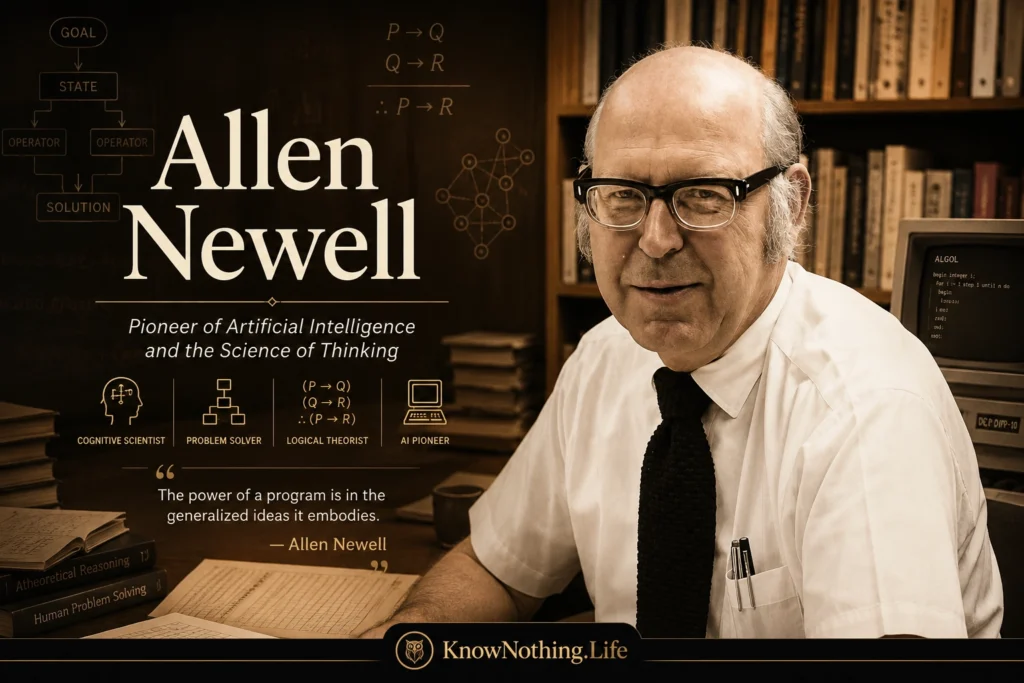
Allen Newell was born on March 19, 1927, in San Francisco, California, into a family that valued science, research, and broad intellectual curiosity. His father, Robert R. Newell, was a distinguished radiologist at Stanford Medical School, and the younger Newell grew up with a strong model of disciplined inquiry. Yet he did not begin life with a fixed plan to become a scientist. As a boy, he loved the Sierra Nevada mountains, sports, and practical activity as much as formal academics. The combination mattered: Newell’s later work would always join abstract theory to concrete systems that could actually run, test, fail, and improve.
After graduating from high school near the end of the Second World War, Newell worked briefly in a shipyard and served in the U.S. Navy. His scientific vocation sharpened when he was assigned to work connected with the Bikini nuclear tests, making maps of radiation distribution. The experience exposed him to large-scale scientific work and showed him that research was not merely classroom knowledge. After military service, he enrolled at Stanford University, studied physics, and encountered George Pólya’s ideas about problem solving and heuristics. This helped plant one of Newell’s lifelong questions: can the process of discovery itself be analyzed?
RAND, Information Processing, and the Mind
Newell spent a year in graduate study in mathematics at Princeton, where game theory and formal modeling attracted him but did not fully satisfy him. He wanted theory joined to empirical reality. He then joined the RAND Corporation, where he worked on logistics, organizational decision-making, and simulations of complex human systems. RAND gave him contact with computers at a moment when most people still saw them mainly as calculating devices. Newell saw something larger: a machine might manipulate symbols, represent situations, and model intelligent behavior.
At as calculating devices. Newell saw something larger: a machine might manipulate symbols, RAND, Newell met J. C. Shaw, a systems programmer, and began collaborating closely with Herbert A. Simon. Their shared interest was not merely computing but human thinking. Newell came to believe that intelligence could be studied by building working information-processing systems and comparing them with human problem solving. This was a decisive shift. Instead of asking only what intelligence is in the abstract, Newell asked what mechanisms could produce it. His science became constructive: to understand the mind, build a system that tries to do what minds do.
Logic Theorist and the Birth of AI
In the mid-1950s, Newell, Simon, and Shaw created the Logic Theory Machine, often called Logic Theorist. It was designed to discover proofs in symbolic logic, and it became one of the first major programs in artificial intelligence. The achievement was radical because it showed that a computer could do more than arithmetic. It could search through symbolic possibilities, use heuristics, and produce results that resembled a form of reasoning. AI did not begin as magic; it began as controlled symbolic search.
Logic Theorist also helped establish the research strategy Newell would pursue for the rest of his life. Intelligence, on this view, could be explored through programs that represented goals, operators, rules, and problem spaces. Newell and Simon later described computer science as “the study of the phenomena surrounding computers,” a line that helped defend computer science as an empirical discipline rather than a mere branch of mathematics or engineering. For Newell, programs were not only tools. They were scientific theories expressed in executable form.
General Problem Solver and Human Problem Solving
After Logic Theorist, Newell, Simon, and Shaw developed the General Problem Solver, or GPS. GPS used means-ends analysis, a method in which a system compares its current state with a goal state, identifies differences, and selects operators that may reduce those differences. This approach gave early AI a powerful model of problem solving as search through a space of possibilities. GPS was not a universal intelligence in the modern sense, but it supplied a vocabulary that shaped both artificial intelligence and cognitive psychology.
Newell and Simon’s 1972 book Human Problem Solving became one of the great works of cognitive science. It combined laboratory experiments, verbal protocols, computer simulation, and theory. The book treated human thought as a process that could be studied in detail, not merely inferred from final answers. Newell’s commitment to thinking-aloud protocols showed his empirical seriousness. He wanted to know not only whether people solved problems, but what sequence of mental steps they appeared to take while doing so.
Symbols, Search, and the Physical Symbol System
Newell’s most famous theoretical statement came through the physical symbol system hypothesis, developed with Simon. In their Turing Award lecture, they wrote: “A physical symbol system has the necessary and sufficient means for general intelligent action.” This became one of the defining claims of classical artificial intelligence. It proposed that intelligence depends on systems capable of creating, modifying, combining, and interpreting symbolic structures. To think, on this view, is largely to manipulate symbols in search of solutions.
The hypothesis became enormously influential and later deeply contested. Critics argued that intelligence also requires embodiment, perception, emotion, neural learning, social context, or statistical pattern recognition. Yet even criticism of symbolic AI often begins from the framework Newell helped build. His work forced the question into the open: what kind of system must a mind be? Whether one accepts or rejects the physical symbol system hypothesis, it remains one of the central ideas in the history of AI and cognitive science.
“You Can’t Play 20 Questions With Nature”
Newell was impatient with narrow experimental programs that tested isolated variables without building broader theories. In his 1973 paper “You Can’t Play 20 Questions With Nature and Win,” he argued that cognitive science needed larger, integrated models. The title became one of his most quoted warnings. Nature, he suggested, will not yield the structure of mind if researchers only ask one small question after another without a unifying architecture.
This concern led him toward cognitive architectures: integrated systems meant to model the structure that supports many kinds of intelligent behavior. Newell believed that a theory of mind should not explain one laboratory task while ignoring memory, learning, language, perception, skill, and action. A genuine cognitive theory had to be broad enough to model intelligence as a whole. This made him one of the central figures in the movement from isolated AI programs toward unified theories of cognition.
Soar and Unified Theories of Cognition
In the 1980s, Newell worked with John Laird, Paul Rosenbloom, and others on Soar, a cognitive architecture designed to model general intelligence through problem spaces, goals, production rules, learning, and chunking. Soar was not merely another AI program. It was Newell’s attempt to build an architecture that could support many tasks within one framework. He increasingly saw architecture as the key to understanding mind: a fixed set of mechanisms that allows knowledge to be acquired and used in pursuit of goals.
His 1990 book Unified Theories of Cognition gave mature form to this ambition. Based on his William James Lectures at Harvard, the book argued that cognitive science needed theories large enough to explain the full range of human cognition. Newell did not deny the value of specialized models, but he thought the field would remain fragmented without architectural unification. His project was bold because it refused to accept a small theory of the mind. Intelligence had to be studied as an integrated system.
Institutions, Honors, and Lasting Legacy
Newell moved from RAND to the Carnegie Institute of Technology, later Carnegie Mellon University, in 1961. There he became a central figure in building one of the world’s great centers for computer science, artificial intelligence, and cognitive psychology. He helped shape CMU’s early computer science program, contributed to list-processing languages, worked on computer structures with Gordon Bell, supported speech-understanding research, and helped open the path to human-computer interaction through work connected to the model human processor and GOMS.
In 1975, Newell and Herbert Simon received the A. M. Turing Award for basic contributions to artificial intelligence, human cognition, and list processing. Newell also received many other honors, including the National Medal of Science shortly before his death. He died of cancer on July 19, 1992, in Pittsburgh. His legacy remains immense because he helped create AI not as fantasy, but as a research program: build systems, test mechanisms, compare them with human performance, and search for the architecture of mind. Allen Newell remains essential because he showed that intelligence could be studied as computation, cognition, and organized action all at once.