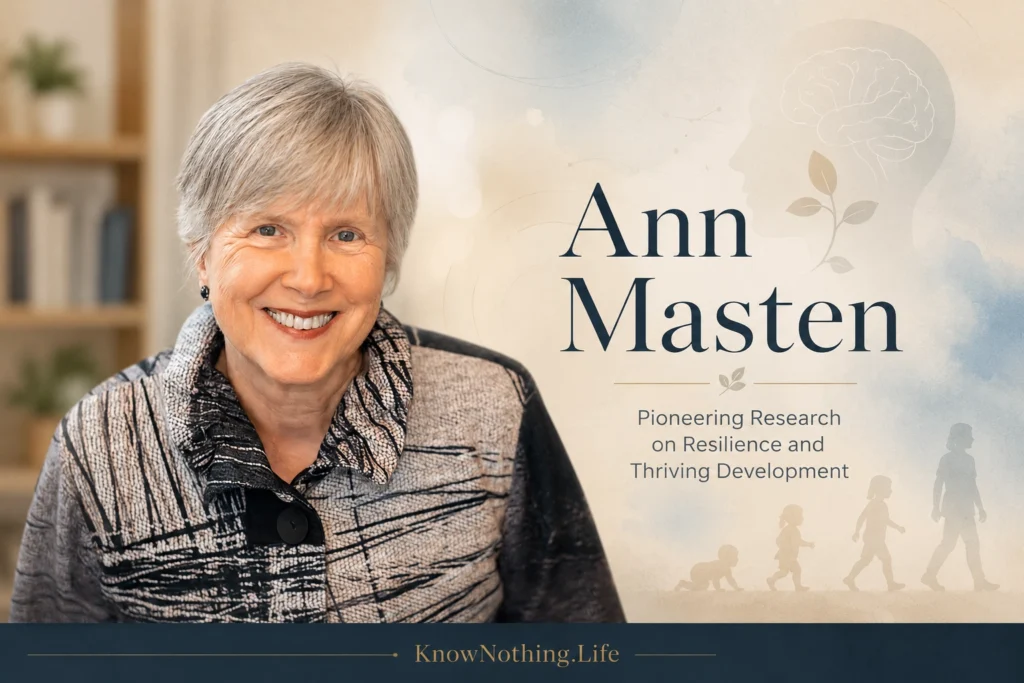
Ann S. Masten is an American developmental psychologist whose research transformed how scholars understand resilience in children, families, and communities. Earlier accounts sometimes described resilient young people as unusually tough, invulnerable, or naturally gifted. Masten challenged that image. Her studies showed that positive adaptation after adversity often depends on familiar developmental systems: caring relationships, effective schools, problem-solving abilities, self-regulation, cultural traditions, and supportive communities. Resilience is therefore not a mysterious quality possessed by a heroic few. It emerges through interactions among people and the environments in which they develop.
Masten’s most influential phrase, “ordinary magic,” captures this hopeful but demanding perspective. The magic is ordinary because the systems supporting adaptation are widespread and recognizable; it is remarkable because their coordinated operation can help children withstand poverty, homelessness, displacement, disaster, violence, and war. Her major works include the landmark article “Ordinary Magic: Resilience Processes in Development,” the book Ordinary Magic: Resilience in Development, and extensive research on competence, developmental cascades, protective factors, family resilience, migration, and multisystem adaptation.
Early Life and Education
Masten grew up in a military family that moved frequently, exposing her early to the challenges of adjustment, separation, and changing social environments. Her father’s military service and the experiences of other families affected by war contributed to her enduring interest in how people respond to disruption. She later recalled, “I think I’ve always been interested in how you adapt to challenges.” Rather than treating adaptation as a narrow clinical issue, she came to see it as a basic developmental process visible whenever children must manage change while continuing to learn, form relationships, and build a coherent identity.
She studied psychology at Smith College in Massachusetts and afterward worked as a research assistant at the National Institute of Mental Health with David Shakow, a prominent researcher in psychopathology. Through Shakow, she met Norman Garmezy, one of the founders of developmental resilience research. Garmezy was studying children who succeeded despite serious risks and recruited Masten to the University of Minnesota’s clinical psychology program. She earned her doctorate there in 1982, completed a clinical internship at UCLA, and joined the University of Minnesota’s Institute of Child Development faculty in 1986.
From Invulnerability to Resilience
Early researchers sometimes referred to children who functioned well under difficult conditions as “invulnerable.” Masten and her colleagues helped replace that misleading label with a more dynamic understanding. No child is immune to adversity, and the same person may adapt well in one period or domain while struggling in another. A child might succeed academically while experiencing emotional distress, or function well during one crisis but become overwhelmed when several risks accumulate. Resilience must therefore be evaluated in relation to specific challenges, developmental tasks, resources, and periods of life.
Masten defines resilience as the capacity of a dynamic system to adapt successfully to disturbances that threaten its function, survival, or development. The word system is crucial. A child is supported by interacting biological, psychological, relational, cultural, educational, and social systems. Resilience may increase when these systems work together and decline when several are damaged at once. As Masten has emphasized, “Resilience is a capacity that’s generated by many, many factors,” not a fixed personality trait that someone simply has or lacks.
Project Competence and Developmental Research
Masten became a leading researcher in the Project Competence Longitudinal Study, an influential investigation initiated by Norman Garmezy. The project followed 205 children and their families across development, examining competence, adversity, symptoms, relationships, academic progress, and adaptation. Its longitudinal design allowed researchers to move beyond snapshots of children’s lives. They could examine how early strengths influenced later opportunities, how difficulties spread across domains, and how changes in relationships or circumstances redirected developmental pathways over time.
The study helped clarify several foundational concepts in developmental psychopathology, including risk, promotive factors, protective processes, developmental tasks, and competence. It also supported the idea of developmental cascades, in which functioning in one domain influences another across time. Strong self-regulation may support classroom learning, which improves academic confidence and peer relationships; disruptive behavior may generate school problems that produce further social and emotional difficulties. Development is not a sequence of isolated outcomes but a network of transactions whose consequences can accumulate in helpful or harmful directions.
The Meaning of “Ordinary Magic”
Masten’s 2001 article “Ordinary Magic: Resilience Processes in Development” became one of the most influential publications in resilience science. Reviewing decades of evidence, she concluded that successful adaptation usually arose from normal human capabilities rather than extraordinary psychological powers. The commonly observed protective factors included supportive adults, cognitive abilities, self-regulation, motivation, effective schools, community resources, and opportunities to develop competence. She described the field’s great surprise as “the ordinariness of the phenomena,” redirecting attention from exceptional children toward the everyday systems surrounding them.
This perspective does not imply that overcoming adversity is easy or guaranteed. Ordinary adaptive systems can be damaged, unavailable, or overwhelmed. A caring parent may be struggling with illness or economic insecurity; a capable child may attend an unsafe school; an effective community program may lack stable funding. Masten’s framework shifts responsibility away from asking why an individual was not strong enough and toward examining whether families and societies protected the systems children need. Resilience becomes both a scientific question and a public responsibility.
Ordinary Magic and a Multisystem Theory
Masten expanded her research into Ordinary Magic: Resilience in Development, a major synthesis of evidence on children and adolescents facing adversity. The book examines resilience across biological, psychological, family, school, cultural, and community levels. It also considers timing: resources that are protective in early childhood may differ from those needed during adolescence or the transition to adulthood. The second edition, published in 2025, incorporates newer research on neurobiology, migration, pandemics, climate-related disasters, systemic inequality, and the growing multisystem perspective in resilience science.
The multisystem approach recognizes that resilience may depend on coordination among systems operating at different scales. During a disaster, for example, a child’s coping may be affected by family communication, school continuity, healthcare access, emergency policy, cultural rituals, and community trust. Masten’s work therefore extends beyond individual psychology. It asks how societies preserve adaptive capacity before crises occur, mobilize resources during disruption, and restore conditions that allow development to continue afterward. This framework has made her research relevant to humanitarian aid, education, public health, disaster planning, and child policy.
Homelessness, War, Migration, and Disaster
Masten has applied resilience science to children and families affected by homelessness, poverty, mobility, war, disaster, and migration. Her Minnesota research has investigated school achievement among homeless and highly mobile children, with particular attention to parenting, executive function, self-regulation, housing stability, sleep, and school support. She has collaborated with public schools, community organizations, state agencies, and interdisciplinary research teams, seeking protective processes that can be changed through intervention rather than merely documenting disadvantages after they occur.
Her international collaborations have examined immigrant youth, children exposed to political violence, and families navigating large-scale emergencies. This work emphasizes that adversity rarely affects one system alone. War can disrupt homes, schools, healthcare, cultural routines, and community networks simultaneously. Migration may offer safety while introducing discrimination, language barriers, separation, and uncertainty. Effective interventions must therefore restore multiple forms of stability and belonging rather than expecting individual children to compensate psychologically for every failure surrounding them.
Protective Factors and Practical Intervention
Across studies and cultures, Masten has identified a recurring “short list” of protective influences. These include caring relationships, problem-solving and self-control skills, hope, purpose, motivation, agency, positive identity, effective education, safe communities, and meaningful cultural routines. Their effects are not identical for every child, nor do they function independently. A supportive teacher may strengthen motivation, while predictable family rituals may increase security and improve self-regulation. The practical value of the list lies in showing where families, schools, clinicians, and policymakers can reinforce adaptive capacity.
Masten’s approach also warns against waiting until a crisis has produced severe damage. Building resilience includes investing in ordinary developmental conditions before disaster occurs: stable housing, competent caregiving, good schools, healthcare, social connection, and opportunities for mastery. When those systems are protected, they can mobilize during adversity. When they are chronically weakened, even highly capable individuals may struggle. Resilience policy is therefore not simply teaching children to cope; it is strengthening the social infrastructure that makes successful coping possible.
Major Works and Lasting Influence
Masten has published more than 300 scholarly works and has served as president of both the Society for Research in Child Development and the developmental psychology division of the American Psychological Association. Her honors include lifetime-contribution and mentoring awards, election to the American Academy of Arts and Sciences, honorary degrees, and the 2024 Grawemeyer Award in Psychology for her work on ordinary magic. She retired from the University of Minnesota’s Institute of Child Development in May 2025 after nearly four decades on its faculty.
Her legacy extends through the students, researchers, clinicians, educators, and policymakers influenced by her work. Masten has said of teaching and mentorship, “Your real legacy is the work that they do.” Scientifically, her greatest contribution is a model of resilience that is hopeful without being simplistic. Children do not succeed because adversity is harmless or because suffering automatically makes them stronger. They succeed when adaptable human capacities are supported by dependable relationships and functioning communities. Ann Masten made resilience less mythical and more actionable by locating its power in the ordinary systems through which human development is sustained.