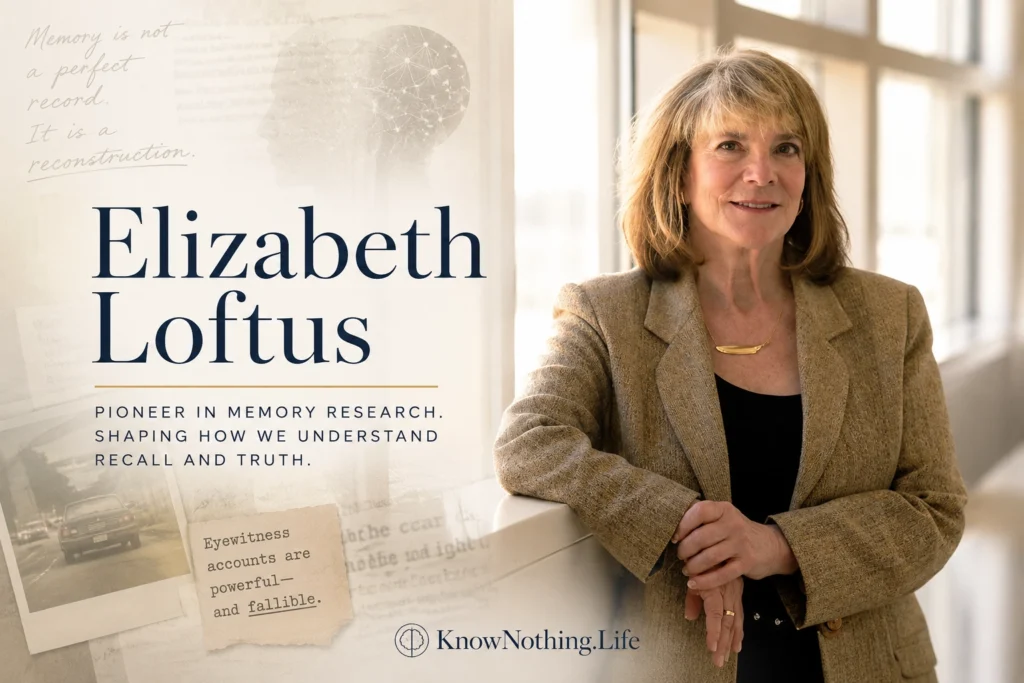
Elizabeth F. Loftus is an American cognitive psychologist whose research transformed the scientific understanding of memory and its role in justice. For more than five decades, she has demonstrated that remembering is not a literal replay of the past. New information, suggestive questions, conversations, photographs, expectations, and repeated imagination can alter what people later report. Her findings forced courts, police departments, therapists, and the public to confront an uncomfortable possibility: a person can describe an event sincerely, vividly, and confidently while being mistaken about important details.
Loftus is best known for research on the misinformation effect, eyewitness testimony, and false autobiographical memories. Her major books include Human Memory: The Processing of Information, Eyewitness Testimony, Witness for the Defense, The Myth of Repressed Memory, and multiple editions of Eyewitness Testimony: Civil and Criminal. Her work does not imply that memory is useless or that every witness is wrong. It shows that memory is a reconstructive system whose flexibility supports ordinary thought but creates serious vulnerabilities when recollection is treated as unquestionable proof.
Early Life and Academic Formation
Elizabeth Fishman was born in Los Angeles on October 16, 1944. Her father was a physician, and her mother was a librarian who drowned when Loftus was fourteen. Decades later, a relative incorrectly told Loftus that she had discovered her mother’s body. She began forming vivid images of the scene, only to learn that another relative had actually made the discovery. The episode became a personal illustration of the process she studied professionally: an authoritative suggestion can supply a framework around which details, feelings, and apparent recollections begin to gather.
Loftus studied mathematics and psychology at the University of California, Los Angeles, graduating with highest honors in 1966. She earned a master’s degree in 1967 and a doctorate from Stanford University in 1970, training in mathematical psychology before turning toward long-term memory and real-world judgment. She taught at the New School in New York and joined the University of Washington in 1973. In 2002, she became a Distinguished Professor at the University of California, Irvine, with appointments spanning psychological science, criminology, law, cognitive science, and the School of Law.
Leading Questions and the Misinformation Effect
Loftus’s landmark work with John Palmer began with films of automobile accidents. Participants estimated vehicle speeds after receiving questions that used different verbs, including “hit,” “collided,” and “smashed.” The wording changed their estimates. Participants who heard “smashed” also became more likely to report seeing broken glass one week later, although no broken glass appeared in the film. The study concluded that “questions asked subsequent to an event can cause a reconstruction” of memory. A single word had not merely changed an opinion; it influenced what participants later believed they had witnessed.
This research developed into the misinformation-effect paradigm. A person first observes an event, later encounters misleading information, and eventually incorporates some of that material into a report of the original experience. The source may be a police question, another witness, a lawyer, a news story, or an image presented afterward. Loftus uses a modern analogy to explain the result: memory is “more like a Wikipedia page—you can go change it, but so can other people.” Memories remain editable, but the editor is not always the rememberer.
Eyewitness Testimony and the Courtroom
Loftus turned her laboratory findings into a sustained examination of eyewitness evidence. In Eyewitness Testimony, published in 1979, she considered perception under stress, identification procedures, leading questions, delay, and the persuasive force of confident witnesses. She later coauthored Eyewitness Testimony: Civil and Criminal, connecting psychological research with legal practice. Her concern was not simply that witnesses deliberately lie. Honest recollections can be influenced by poor lighting, brief exposure, fear, suggestive lineups, repeated questioning, and feedback received after an identification.
As an expert witness or consultant, Loftus has participated in hundreds of legal cases. Her role has generally been to explain principles of memory rather than determine whether a particular witness is truthful. Experimental psychology can identify conditions that increase the risk of error, but it cannot inspect an individual recollection and certify it as true or false. Loftus summarized the problem clearly: “Just because someone tells you something in great detail, with much confidence, and with emotion, it doesn’t mean that it is true.” Confidence may be persuasive, yet it can be strengthened by confirming feedback received after an identification.
False Autobiographical Memories
During the 1990s, Loftus moved from changing details of witnessed events to asking whether suggestion could foster memories of experiences that never occurred. In the “lost in the mall” research conducted with Jacqueline Pickrell, participants received accounts of several childhood events supplied by relatives, along with a fabricated story about becoming lost in a shopping center. Some participants came to report partial or detailed recollections of the invented incident. Later researchers used altered photographs, guided imagination, and plausible family stories to investigate how autobiographical belief and memory can develop.
These studies became central to the recovered-memory debate. Loftus warned that suggestive therapeutic practices—especially repeated visualization, hypnosis, dream interpretation, and pressure to uncover hidden abuse—could create confident but inaccurate narratives. She and Katherine Ketcham presented this concern in The Myth of Repressed Memory. The debate requires careful boundaries, however. Demonstrating that false memories can be created does not prove that every delayed memory is false, nor does it deny that abuse occurs or may sometimes be forgotten. Professional reviews recognize that newly recalled memories may be accurate, inaccurate, or mixtures of both, making independent corroboration essential.
Major Works and Scientific Controversy
Loftus’s books trace the development of her intellectual project. Human Memory, written with Geoffrey Loftus, presented an information-processing account of remembering. Eyewitness Testimony established the legal significance of reconstructive memory. In Witness for the Defense, written with Katherine Ketcham, she described cases in which psychological evidence challenged apparently compelling testimony. The Myth of Repressed Memory addressed therapy, accusation, and the social costs of treating vivid recollection as self-validating truth. Her scholarly record also includes extensive research on source confusion, imagination inflation, confidence, emotional events, and the effects of post-event misinformation.
Her work has drawn intense criticism because it enters disputes involving trauma, criminal guilt, family relationships, and sexual abuse. Critics have challenged the ecological validity of laboratory studies and warned against extending findings from plausible, relatively ordinary false events to severe trauma. Loftus has argued that the emotional stakes make scientific caution more necessary, not less. The controversy has produced hostility and threats while also encouraging stronger experiments, replications, and more precise distinctions among memory, belief, confidence, and suggestion.
Later Influence and Legacy
Loftus remains a Distinguished Professor at the University of California, Irvine. Her honors include election to the National Academy of Sciences and the American Academy of Arts and Sciences, the William James Fellow Award, the Grawemeyer Award in Psychology, the John Maddox Prize, and the International Union of Psychological Science Lifetime Career Award. Her research has influenced police interviewing, identification procedures, jury instructions, expert testimony, therapeutic ethics, and public understanding of memory.
Her ideas have also acquired new relevance in the age of artificial intelligence. Recent research involving Loftus has examined how generative chatbots and AI-altered images can introduce misleading information and increase false recollections. The technology has changed, but the central psychological problem remains recognizable: people may forget where a detail originated and later experience externally supplied material as part of their own memory.
Elizabeth Loftus’s deepest contribution is not the claim that memory always fails. It is the demonstration that remembering is an active process shaped by what happens after an event as well as during it. Human beings need memory to construct identity, learn from experience, and give continuity to life, but the same flexibility that makes memory useful also leaves it open to distortion. Loftus taught psychology and law to distinguish sincerity from accuracy and emotional conviction from independent evidence. That lesson applies not only to witnesses and patients, but to everyone who has ever been certain about the past.