Eyewitness testimony has long been regarded as one of the most persuasive forms of evidence in the courtroom. Jurors and judges often place considerable weight on the words of someone who claims to have directly seen a crime unfold. This intuitive trust stems from the assumption that human memory functions like a recording device—capturing events accurately and replaying them when needed. However, modern psychological research has demonstrated that this assumption is deeply flawed. Memory is not a passive system of storage, but an active, reconstructive process that is influenced by perception, emotion, and context.
The scientific study of eyewitness memory gained significant traction through the work of Elizabeth Loftus, whose experiments revealed just how malleable human recollection can be. Her research fundamentally challenged legal traditions that equated confidence with accuracy, showing instead that memory can be shaped by suggestion, language, and post-event information. As she famously argued, “Memory is not a precise recorder of events.” This insight reshaped the way psychologists and legal scholars understand testimony, highlighting the need for caution when relying on human recollection in matters of justice.
Today, eyewitness testimony is examined through the combined lenses of cognitive psychology, neuroscience, and legal analysis. Researchers seek to understand how memories are formed, how they change over time, and how external influences can alter what witnesses believe they saw. This article explores the nature of memory, the variables that affect eyewitness accuracy, and the implications these findings hold for the legal system.
The Reconstructive Nature of Memory
The idea that memory is reconstructive rather than reproductive can be traced back to the pioneering work of Frederic Bartlett. In Remembering: A Study in Experimental and Social Psychology (1932), Bartlett demonstrated that individuals do not store exact copies of experiences. Instead, they rely on mental frameworks, or “schemas,” to interpret and reconstruct events during recall. These schemas are shaped by prior knowledge, cultural background, and expectations, meaning that memory is inherently subjective.
This reconstructive process has profound implications for eyewitness testimony. When a person witnesses a crime, they do not absorb every detail uniformly. Attention is selective, often focused on the most emotionally salient or threatening aspects of the scene. During recall, the brain attempts to fill in missing details, creating a coherent narrative that may include inaccuracies. Bartlett described this tendency as an “effort after meaning,” in which individuals unconsciously reshape memories to make them more logical or consistent.
Modern research has expanded on Bartlett’s findings by showing that memory is dynamic and continuously updated. Each time a memory is recalled, it becomes susceptible to modification before being stored again—a process known as reconsolidation. This means that repeated questioning, exposure to new information, or even reflection can subtly alter what a witness remembers. In legal settings, where testimony may be revisited multiple times, this plasticity introduces significant risks to accuracy.
Factors Influencing Eyewitness Accuracy
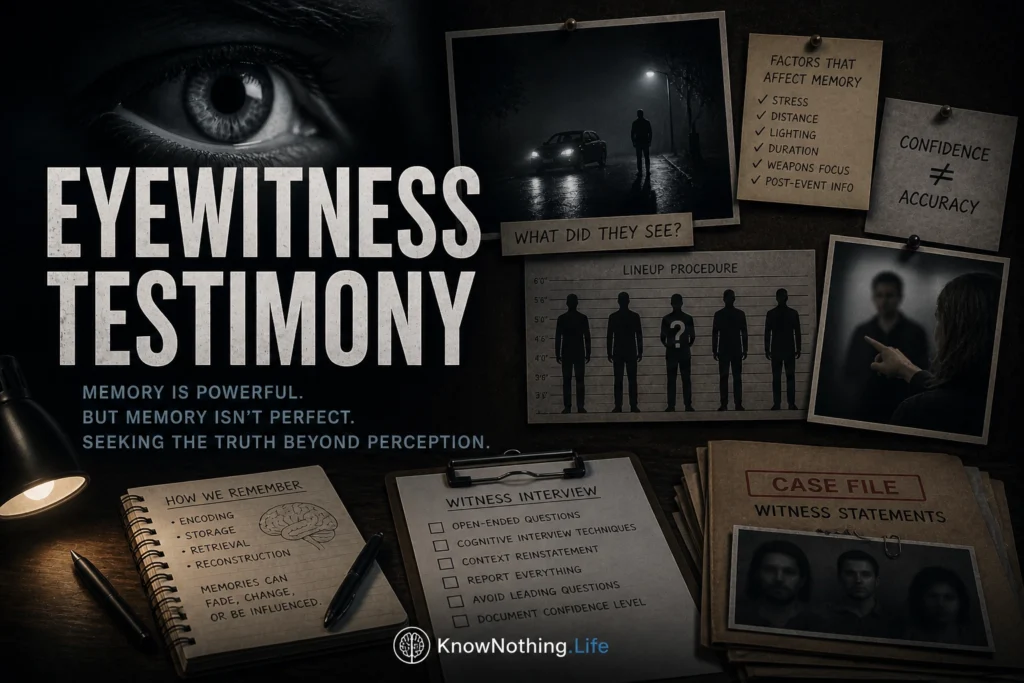
Eyewitness accuracy is shaped by a complex interplay of factors, often categorized as estimator variables and system variables. Estimator variables are aspects of the situation that cannot be controlled, such as lighting conditions, distance from the event, and the presence of stress. One well-documented phenomenon is the weapon focus effect, where a witness’s attention is drawn to a weapon, reducing their ability to recall other details like the perpetrator’s face. This narrowing of attention can significantly impair identification accuracy.
Stress also plays a critical role. While moderate levels of arousal may enhance memory, extreme stress—common in criminal situations—can disrupt both encoding and retrieval processes. Research by Gary Wells has shown that high-stress conditions often lead to less reliable identifications. Contrary to popular belief, a witness’s confidence is not a reliable indicator of accuracy, particularly when that confidence has been influenced by external factors such as feedback or repeated questioning.
System variables, in contrast, are elements that can be controlled within the legal process. These include how lineups are conducted, how questions are phrased, and how information is presented to witnesses. Suggestive questioning, for example, can unintentionally lead witnesses to adopt details that were not part of their original experience. Similarly, poorly constructed lineups can increase the likelihood of misidentification. Understanding and controlling these variables is essential for improving the reliability of eyewitness testimony.
The Misinformation Effect
One of the most influential discoveries in the psychology of memory is the misinformation effect, first demonstrated by Elizabeth Loftus and John Palmer. In their classic experiment, participants viewed footage of a car accident and were later asked questions that included subtly different wording. Those who were asked how fast the cars were going when they “smashed” into each other gave higher speed estimates and were more likely to report seeing broken glass, even though no glass was present.
This finding illustrates how post-event information can become integrated into a witness’s memory. The brain does not always distinguish between original experiences and later suggestions, leading individuals to confidently recall details that were never actually observed. Loftus emphasized this point in her book Eyewitness Testimony (1979), noting that memory is vulnerable to distortion at every stage, from perception to recall.
The misinformation effect has profound implications for the legal system. Witnesses are often exposed to new information after an event, whether through media coverage, conversations with others, or questioning by authorities. Each of these exposures carries the potential to alter memory. This makes it difficult to determine which aspects of a testimony reflect the original event and which are the result of later influence.
Eyewitness Identification and Lineups
Eyewitness identification is one of the most critical and controversial aspects of testimony. Mistaken identifications have been identified as a leading cause of wrongful convictions, a problem highlighted by organizations such as the Innocence Project. DNA exoneration cases have repeatedly shown that confident eyewitnesses can be wrong, sometimes with devastating consequences.
Traditional lineup procedures have been criticized for encouraging relative judgment, where witnesses compare individuals to each other rather than to their memory of the perpetrator. This can lead to the selection of the person who looks most similar to the suspect, even if the actual perpetrator is not present. Sequential lineups, in which individuals are presented one at a time, have been proposed as a solution, as they encourage absolute judgment and reduce false identifications.
Double-blind procedures represent another important reform. In these setups, the administrator conducting the lineup does not know who the suspect is, preventing them from unintentionally influencing the witness. As Gary Wells has argued, improving procedures is essential for reducing error. By implementing evidence-based practices, the legal system can enhance the reliability of eyewitness identification and reduce the risk of wrongful convictions.
Confidence and Courtroom Perception
In the courtroom, eyewitness testimony is often judged not only by its content but by the confidence and demeanor of the witness. Jurors tend to equate confidence with accuracy, assuming that a certain and composed witness is more credible. However, psychological research has consistently shown that confidence is a poor predictor of accuracy, particularly when it has been influenced by external factors.
Confidence can be shaped by feedback, repetition, and social reinforcement. For example, if a witness is told they made the “correct” identification, their confidence may increase, even if the identification was mistaken. This phenomenon, known as the confidence malleability effect, can make erroneous testimony particularly persuasive. Once confidence is established, it becomes difficult for jurors to distinguish between genuine accuracy and inflated certainty.
The courtroom environment itself can further influence testimony. The stress of legal proceedings, the passage of time, and the adversarial nature of cross-examination can all affect how memories are recalled and presented. Expert testimony from psychologists is increasingly used to educate jurors about these issues, but the persuasive power of firsthand accounts remains strong. This creates an ongoing challenge for the justice system in balancing the value of eyewitness evidence with its limitations.
Legal Implications and Reform
The recognition of memory’s fallibility has led to significant discussions about legal reform. Courts have begun to incorporate psychological insights into their procedures, acknowledging that eyewitness testimony must be treated with caution. The U.S. Supreme Court case Manson v. Brathwaite established criteria for evaluating eyewitness identification, focusing on factors such as the witness’s opportunity to view the suspect and the consistency of their description.
Despite these advancements, the integration of psychological science into the legal system remains incomplete. Some jurisdictions have adopted reforms such as standardized lineup procedures and improved jury instructions, while others continue to rely on outdated assumptions about memory. The variability in legal standards highlights the need for continued collaboration between researchers and legal professionals.
Efforts to improve eyewitness reliability include recording interviews, using non-suggestive questioning techniques, and educating jurors about the limitations of memory. These measures aim to reduce the risk of error while preserving the valuable insights that eyewitnesses can provide. As research continues to evolve, the legal system must adapt to ensure that justice is informed by the best available scientific evidence.
Conclusion
Eyewitness testimony remains a cornerstone of the legal system, yet it is deeply influenced by the complexities of human memory. Far from being a perfect record of events, memory is a dynamic and reconstructive process shaped by perception, stress, and suggestion. Research by figures such as Elizabeth Loftus and Gary Wells has revealed the many ways in which eyewitness accounts can be distorted, challenging traditional assumptions about their reliability.
The task facing the legal system is not to discard eyewitness testimony, but to understand and manage its limitations. By implementing evidence-based procedures and incorporating psychological insights, it is possible to reduce errors and improve the accuracy of testimony. In doing so, the justice system can move closer to its fundamental goal: the fair and accurate determination of truth.