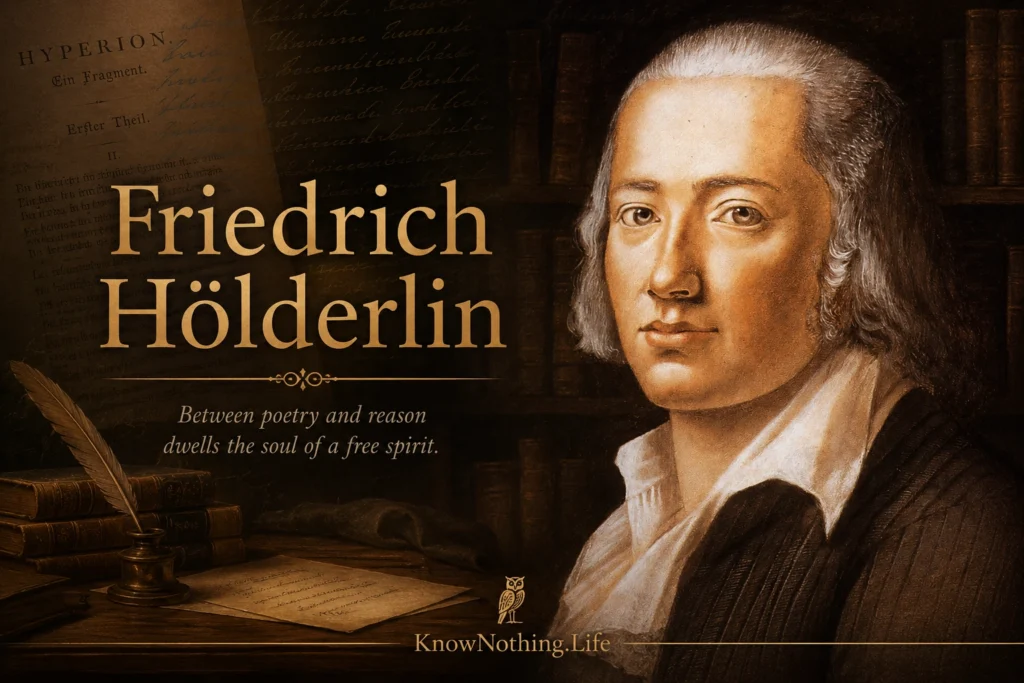
Johann Christian Friedrich Hölderlin was born on March 20, 1770, in Lauffen am Neckar in Württemberg, in southwestern Germany. His early life was marked by loss. His father died when Hölderlin was still very young, and his stepfather also died during his childhood. These losses shaped a temperament that would later turn again and again toward absence, longing, homecoming, and the search for a vanished unity. Hölderlin’s poetry often sounds as if it is listening for something that has withdrawn: the gods, Greece, childhood, love, homeland, or a harmony once felt but no longer possessed.
His family expected him to enter the Lutheran ministry, and his education followed that path. He studied at the monastery schools of Denkendorf and Maulbronn before entering the Tübingen Stift, the famous Protestant seminary where he studied theology. There he formed friendships with two future giants of German philosophy: G. W. F. Hegel and F. W. J. Schelling. Together, they absorbed the force of Kant, the French Revolution, Greek antiquity, and the new philosophical language of freedom. Hölderlin would never become a church minister, but his religious education never left him. It became poetry: hymnic, searching, broken, and luminous.
Tübingen, Philosophy, and the Ideal of Unity
At Tübingen, Hölderlin read Greek literature, philosophy, theology, and modern German thought. He admired ancient Greece not as a decorative classical past but as an image of spiritual wholeness. In his imagination, Greece represented a world where nature, art, religion, body, and community had not yet been torn apart by modern self-consciousness. This longing for unity became one of the deepest currents in his work. He was not simply nostalgic. He was trying to understand why modern human beings feel divided from nature, from the divine, from one another, and from themselves.
His intellectual world overlapped with the birth of German Idealism. Hölderlin studied Fichte’s philosophy in Jena and wrestled with the problem of the self, freedom, and absolute being. Unlike Fichte, he did not think the self could be the final ground of reality. He sensed a deeper unity prior to the division between subject and object. Yet he increasingly came to believe that poetry could approach this unity more powerfully than abstract philosophy. This is why Hölderlin matters not only as a lyric poet but as a philosophical writer: he turned metaphysical longing into poetic form.
Schiller, Jena, and the Vocation of Poetry
After leaving the seminary, Hölderlin worked as a private tutor, a role that gave him income but rarely happiness. Friedrich Schiller helped him find employment and encouraged his early literary efforts. Through Schiller, Hölderlin entered the wider world of German letters and came near Goethe, Fichte, and the literary culture of Jena. Yet he never fully belonged to the Weimar classicist circle or the early Romantic circle. He admired them, learned from them, and stood apart from them. His voice was too severe, too inward, too Greek, too prophetic to fit comfortably into any school.
During these years, Hölderlin worked on his great epistolary novel, Hyperion, which would appear in two volumes in 1797 and 1799. The novel tells the story of Hyperion, a young Greek idealist who loves beauty, freedom, nature, and Diotima, but is wounded by political failure and human fragmentation. In one famous passage, Hölderlin writes that “the state has always been made a hell” because man has tried to make it “his heaven.” The line shows his suspicion of political absolutism. For Hölderlin, no state can manufacture spiritual wholeness. Law may protect life, but it cannot create love, beauty, or divine inspiration.
Diotima and the Frankfurt Years
In 1796, Hölderlin became tutor in the Frankfurt household of the banker Jakob Gontard. There he met Gontard’s wife, Susette Gontard, who became the great love of his life and the inspiration for Diotima in Hyperion and many poems. Their relationship was emotionally intense and, in practical terms, impossible. Susette was married, socially unavailable, and embedded in a world where such love could not be openly fulfilled. When the relationship was discovered, Hölderlin had to leave the household in 1798.
The Frankfurt period transformed his poetry. Diotima was not merely a private beloved; she became for Hölderlin a figure of beauty, reconciliation, and divine presence. Through her, he imagined the possibility that the torn modern soul might still encounter wholeness. Yet the loss of this love deepened the tragic pressure in his work. Hölderlin’s later poems do not simply mourn personal separation. They turn separation into a universal condition: human beings live between nearness and distance, revelation and withdrawal, longing and silence.
Hyperion and The Death of Empedocles
Hyperion is one of the great prose works of German literature. Written as letters, it combines novel, lyric meditation, political reflection, and philosophical confession. Its hero dreams of Greek liberation from Turkish rule, but the political struggle collapses into disappointment and violence. Diotima dies, and Hyperion must seek reconciliation not through victory but through nature, memory, and spiritual acceptance. The book’s power lies in its movement between exaltation and despair. Hölderlin gives the modern soul a Greek mask, then lets that mask crack.
Around the same time, Hölderlin worked on the unfinished tragedy The Death of Empedocles. The subject was the ancient Greek philosopher said to have leaped into Mount Etna. Hölderlin returned to the drama in multiple versions, using Empedocles as a figure of spiritual excess, alienation, sacrifice, and failed mediation between humanity and nature. The work remained unfinished, but its fragments reveal one of Hölderlin’s central concerns: what happens to the person who feels the divine too intensely for ordinary civic life? Empedocles, like Hyperion, is both visionary and broken.
The Great Hymns and Late Poetry
After 1800, Hölderlin entered the most powerful phase of his poetic life. He wrote odes, elegies, and hymns of extraordinary originality, including “Bread and Wine,” “Patmos,” “The Rhine,” “Germania,” “Remembrance,” and “The Ister.” These poems brought together Greek myth, Christianity, rivers, homeland, exile, night, wine, bread, gods, and historical destiny. Their language often feels both ancient and startlingly modern. Hölderlin did not use myth as ornament. He used it as a way of thinking about time, loss, and the possible return of sacred meaning.
One of his most famous lines comes from “Patmos”: “Where there is danger, the rescue grows as well.” Another, from the poem known as “In Lovely Blue,” is often rendered as “poetically man dwells on this earth.” These lines became especially important for later philosophers and poets because they express Hölderlin’s deepest hope: that human beings are not saved by control alone, but by a transformed way of dwelling. Poetry is not escape from reality. It is a more receptive, reverent, and truthful relation to reality.
Illness, Tübingen, and the Tower Years
In 1802, Hölderlin traveled to Bordeaux for another tutoring position, but returned to Germany in a state of severe emotional and mental distress. That same year, Susette Gontard died, a loss that deepened his crisis. Over the next several years, his condition worsened. In 1805 he was briefly caught up in a political investigation connected to his friend Isaac von Sinclair, and in 1806 he was taken to a clinic in Tübingen. In 1807, he was released into the care of the carpenter Ernst Zimmer, who admired Hyperion and housed him in a tower overlooking the Neckar River.
Hölderlin lived in that tower for the remaining decades of his life, until his death on June 7, 1843. He continued to write short poems, often signing them with the name “Scardanelli” and giving them strange dates. For a long time, this late work was dismissed as merely the product of illness. Modern readers have been more cautious. Some poems are simple, lucid, and haunting, as if the great hymnic voice had withdrawn into a smaller but still mysterious music. The tower years remain one of the most moving and difficult chapters in literary biography.
Legacy and Lasting Importance
Hölderlin was not widely recognized during his lifetime. His reputation grew slowly, then dramatically in the twentieth century. Writers, philosophers, and critics came to see him as one of Germany’s greatest poets and one of the most profound literary witnesses to modern spiritual homelessness. His influence reached Rilke, Nietzsche, Heidegger, Paul Celan, and many later poets and thinkers. Heidegger’s intense engagement with Hölderlin helped make him central to philosophical discussions of language, being, dwelling, and the sacred.
Friedrich Hölderlin’s lasting importance lies in the singular fusion of poetry and philosophy in his work. He wrote about Greece, but he was not merely a classicist. He wrote about gods, but he was not simply a religious poet. He wrote about nature, but not as scenery. He wrote about madness, exile, love, politics, and longing as signs of a deeper rupture in modern existence. His poems ask whether human beings can still receive the sacred in a disenchanted age. That question remains alive, which is why Hölderlin still speaks with such strange force: difficult, radiant, wounded, and unforgettable.