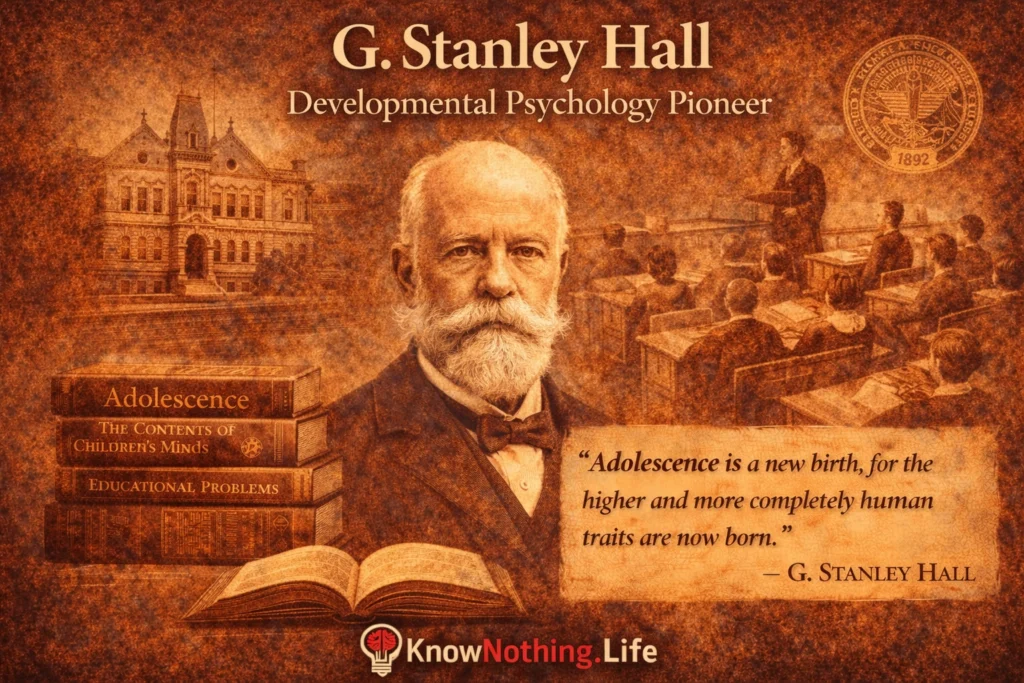
G. Stanley Hall was a central architect of early American psychology, a figure whose influence extended far beyond theory into the very structure of the discipline itself. As a pioneer of developmental psychology and a leading academic organizer, Hall helped transform psychology from a fledgling field into a recognized scientific and educational enterprise in the United States. His work on adolescence, education, and human development established frameworks that continue to shape psychological thought.
Hall’s legacy is not confined to his writings; it is equally rooted in his institutional achievements. As the first president of American Psychological Association and the founding president of Clark University, he played a decisive role in shaping psychology’s academic identity. His efforts brought together scholars, created platforms for research, and introduced European intellectual traditions to American audiences, helping to define the trajectory of modern psychology.
Early Life and Intellectual Formation
Granville Stanley Hall was born on February 1, 1844, in Ashfield, Massachusetts, into a rural and religious environment that emphasized discipline and moral development. Initially intending to pursue a career in the ministry, Hall’s early education was steeped in theology and classical studies. However, his intellectual interests gradually shifted toward philosophy and science, reflecting broader changes occurring in the intellectual landscape of the 19th century.
Hall’s academic journey took a decisive turn when he traveled to Germany, where he encountered the emerging field of experimental psychology. There, he studied under Wilhelm Wundt, whose laboratory in Leipzig was pioneering scientific approaches to the study of the mind. This experience profoundly influenced Hall, convincing him that psychology could and should be pursued as a rigorous scientific discipline.
Upon returning to the United States, Hall became one of the first Americans to earn a doctorate in psychology. His exposure to European methods, combined with his own intellectual ambitions, positioned him as a key figure in introducing and adapting experimental psychology to the American context. He sought not only to replicate Wundt’s methods but to expand them, particularly in the study of development and education.
Founding American Psychology
Hall’s contributions to psychology were as much organizational as they were theoretical. In 1892, he became the first president of the American Psychological Association, helping to establish a professional community for psychologists in the United States. Under his leadership, the APA provided a forum for research, collaboration, and the advancement of psychological science.
As president of Clark University, Hall created one of the first major centers for psychological research in America. He invited leading European thinkers, including Sigmund Freud, to lecture at Clark, introducing new ideas that would have a lasting impact on American intellectual life. These events helped bridge the gap between European and American psychology, fostering a global exchange of ideas.
Hall was also a prolific mentor, supervising numerous doctoral students who would go on to shape the field. Among them were influential figures such as John Dewey and James McKeen Cattell. Through his teaching and leadership, Hall played a crucial role in training the next generation of psychologists, ensuring the continued growth and development of the discipline.
The Study of Adolescence
Hall’s most famous and enduring contribution is his work on adolescence, a stage of life he helped define and conceptualize as a distinct period of development. In his landmark book Adolescence, he described this phase as a time of “storm and stress,” characterized by emotional turbulence, conflict, and rapid change.
Hall argued that adolescence represents a critical transitional period between childhood and adulthood, during which individuals undergo significant physical, psychological, and social transformations. He believed that this stage recapitulates earlier stages of human evolution, a theory influenced by evolutionary thinking prevalent at the time. Although aspects of this theory have been criticized or revised, his emphasis on adolescence as a unique developmental stage remains influential.
He wrote, “Adolescence is a new birth, for the higher and more completely human traits are now born.” This statement reflects his belief in the transformative potential of this period, highlighting its importance for personal growth and development. By bringing attention to adolescence, Hall opened a new area of study that continues to be central to psychology and education.
Educational Theory and Child Study Movement
Hall was also a leading figure in the child study movement, which sought to apply scientific methods to the study of children’s development and education. He believed that understanding the natural stages of development was essential for creating effective educational practices. His work emphasized the importance of aligning teaching methods with the developmental needs of students.
He advocated for an education system that recognized the individuality of each child, arguing that rigid, standardized approaches were inadequate. Instead, Hall promoted experiential learning and the cultivation of curiosity, encouraging educators to consider the psychological processes underlying learning. His ideas contributed to the broader progressive education movement, influencing thinkers such as John Dewey.
Hall’s approach to education was deeply rooted in his developmental perspective. He viewed learning as a dynamic process shaped by biological, psychological, and social factors. By integrating these elements, he sought to create a more holistic understanding of education, one that would support the growth and development of the whole person.
Influence, Criticism, and Legacy
G. Stanley Hall’s influence on psychology is both profound and complex. As a pioneer of developmental psychology, he helped establish key concepts and areas of study that remain central to the field. His work on adolescence, in particular, has had a lasting impact, shaping research and practice in psychology, education, and related disciplines.
However, Hall’s theories have also been subject to criticism. Some of his ideas, particularly those influenced by recapitulation theory, are now considered outdated. Critics have also questioned aspects of his views on development and education, noting that they sometimes reflect the cultural assumptions of his time. Despite these limitations, his contributions to the institutional and intellectual development of psychology are undeniable.
Hall’s legacy is perhaps best understood in terms of his role as a builder of the field. He created institutions, fostered collaboration, and promoted the scientific study of the mind. His efforts helped establish psychology as a recognized discipline in the United States, paving the way for future developments.
Conclusion
G. Stanley Hall’s life and work represent a critical chapter in the history of psychology. Through his research, leadership, and vision, he helped shape the discipline at a formative moment, establishing foundations that continue to influence contemporary thought.
His emphasis on development, particularly during adolescence, opened new avenues for understanding human growth and behavior. At the same time, his institutional contributions ensured that psychology would have the structures necessary to thrive as a scientific field.
In reflecting on Hall’s legacy, one is reminded of his enduring impact on both the content and context of psychology. He not only advanced ideas but created the conditions under which those ideas could flourish. As psychology continues to evolve, his contributions remain a testament to the importance of both intellectual innovation and institutional leadership.