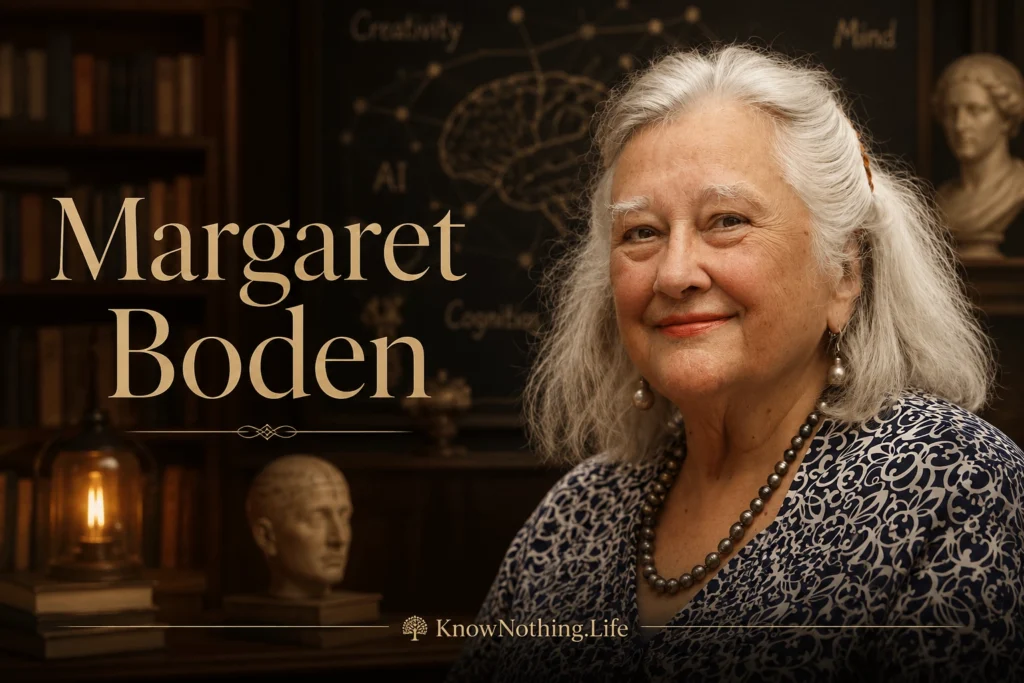
Margaret Ann Boden was born on November 26, 1936, in London, and became one of the most important figures in cognitive science, artificial intelligence, philosophy of mind, and the study of creativity. Known widely as Maggie Boden, she belonged to the first generation of scholars who treated artificial intelligence not merely as engineering, but as a new way to ask old questions about the mind. Her work crossed boundaries that universities often kept apart: philosophy, psychology, computer science, neuroscience, linguistics, art, and ethics.
Boden studied medical sciences at Newnham College, Cambridge, where her interest in mind and brain began to take shape. She later moved into philosophy and psychology, eventually completing a PhD at Harvard. This unusual path gave her work its distinctive character. She was never simply a philosopher commenting from outside science, nor a computer scientist absorbed only in machines. She wanted to know how minds work, how creativity happens, and whether computer models could help clarify the processes behind thought, imagination, learning, and consciousness.
Birmingham, Harvard, and the Study of Mind
Boden began her academic career as a lecturer in philosophy at the University of Birmingham in 1959. After time at Harvard as a Harkness Fellow, she joined the University of Sussex in 1965 as a lecturer in philosophy and psychology. Sussex became the central institutional home of her career, and it suited her intellectual temperament. The university was young, experimental, interdisciplinary, and open to new combinations of scholarship. Boden’s work flourished there because she was building a field that did not fit neatly into existing departments.
Her first major book, Purposive Explanation in Psychology, appeared in 1972 and grew from her Harvard doctoral research. In it, she argued that psychology could not avoid questions about goals, purposes, and mental organization. The book also showed her early belief that artificial intelligence might serve as a form of theoretical psychology. A program could be more than a practical tool; it could be a working model of a possible mental process. For Boden, computers were not replacements for minds. They were instruments for thinking more precisely about minds.
Artificial Intelligence and Natural Man
Boden’s 1977 book Artificial Intelligence and Natural Man established her reputation as one of the clearest interpreters of AI for both specialists and educated general readers. At a time when artificial intelligence was still unfamiliar to most people, she explained its ambitions, methods, promises, and philosophical implications without either hype or dismissal. The book examined symbolic reasoning, learning, language, perception, problem solving, and machine intelligence while constantly returning to the human question: what does AI reveal about us?
The title itself is important. Boden was not interested in artificial intelligence as an isolated technical project. She wanted to know what artificial systems could teach “natural man,” meaning human beings as biological, psychological, social, and creative creatures. The book helped introduce AI as a field that mattered to psychology and philosophy, not just computing. It also showed Boden’s lifelong balance: she was fascinated by AI, but she resisted simplistic claims that machines had already explained everything important about human thought.
The Creative Mind
Boden’s best-known work is The Creative Mind: Myths and Mechanisms, first published in 1990 and later revised. The book challenged the romantic idea that creativity is mysterious, magical, or beyond explanation. Boden did not deny the wonder of creativity. She wanted to understand it without reducing it to something trivial. Her famous definition says that creativity involves ideas or artifacts that are “new, surprising, and valuable.” That formula became one of the most widely used definitions in modern creativity research.
The strength of the definition lies in its balance. Novelty alone is not enough, because random nonsense can be new. Value alone is not enough, because a useful idea may be routine. Surprise matters because creativity changes expectation. Boden asked how such surprise can occur. Her answer was not that creativity descends from nowhere, but that minds work within structured “conceptual spaces.” Creative thought may explore those spaces, combine elements from different spaces, or transform the rules that define what is possible.
Three Forms of Creativity
Boden’s distinction between combinational, exploratory, and transformational creativity became central to her legacy. Combinational creativity brings familiar ideas together in unfamiliar ways, as when metaphors, jokes, analogies, or artistic hybrids connect domains that normally remain separate. Exploratory creativity works within an existing style, system, or set of rules, pushing its possibilities further. Transformational creativity changes the space itself, altering the rules so that ideas previously unthinkable become possible.
This framework allowed Boden to discuss creativity in science, music, art, literature, mathematics, and artificial intelligence without flattening them into one simple process. Mozart, Kekulé, Coleridge, jazz improvisers, computer artists, and scientific theorists could all be discussed in relation to generative systems and conceptual constraints. Her work was influential because it explained creativity as structured freedom. Creative people do not simply break all rules. Often they master a system deeply enough to explore, stretch, or transform it.
Cognitive Science at Sussex
Boden was not only a writer; she was an institution builder. At Sussex, she helped create one of the world’s most important interdisciplinary environments for cognitive science and artificial intelligence. In the 1970s, she worked with colleagues including Aaron Sloman and Max Clowes to establish the Cognitive Studies Programme, which brought together philosophers, psychologists, linguists, AI researchers, and computer scientists to study the mind across disciplinary boundaries.
In 1987, Sussex created the School of Cognitive and Computing Sciences, often called COGS, with Boden as its founding dean. This was one of the great institutional moments in British cognitive science. It gave students and researchers a place to ask questions that belonged to no single department: how perception works, how language develops, how minds represent the world, how machines learn, how consciousness might arise, and how intelligence can be modeled. Boden’s leadership helped make Sussex a major center for AI and cognitive science.
Mind as Machine and the History of Cognitive Science
In 2006, Boden published Mind as Machine: A History of Cognitive Science, a two-volume work of extraordinary scope. The book traced the intellectual history of efforts to understand mind mechanistically, from philosophy and psychology to cybernetics, linguistics, neuroscience, AI, and computer science. It was not a neutral encyclopedia. Boden described it as a personal historical essay, shaped by her own judgment about what mattered and why. That made the work both scholarly and unmistakably hers.
The title, Mind as Machine, can mislead if read too crudely. Boden did not mean that human beings are simple machines or that consciousness is easy to explain. Rather, she explored how mechanistic models can illuminate mental processes. Her central question was how complex patterns of thought, perception, creativity, and understanding could arise from organized systems. This question placed her in a long tradition running from Hobbes and Leibniz to Turing, Newell, Simon, and contemporary cognitive science.
AI, Art, and Human Creativity
Boden continued to write about AI, art, and creativity in works such as Creativity and Art: Three Roads to Surprise, AI: Its Nature and Future, and From Fingers to Digits: An Artificial Aesthetic, co-authored with Ernest Edmonds. She was especially important because she took machine creativity seriously without treating it naively. She knew that computer systems could generate music, images, patterns, and ideas that surprise human audiences. But she also insisted that the philosophical question of whether machines are “really” creative is not answered by spectacle alone.
Her position remains highly relevant in the age of generative AI. Boden taught that the question is not simply whether a machine can produce something impressive. The deeper questions concern process, understanding, intention, evaluation, embodiment, and value. A system may generate outputs that are novel and surprising, but creativity also involves how those outputs arise, how they are judged, and what kind of agency is involved. Boden’s framework remains one of the best tools for thinking clearly about AI art, machine writing, and computational imagination.
Honors, Death, and Lasting Legacy
Boden received many honors across her career. She was elected a Fellow of the British Academy in 1983, later served as its vice-president, became a Fellow of the Association for the Advancement of Artificial Intelligence, was appointed OBE in 2001, and received the ACM-AAAI Allen Newell Award in 2017. Her books were translated into many languages, and she became one of the rare scholars whose work mattered both inside technical fields and far beyond them.
Margaret Boden died on July 18, 2025, at the age of eighty-eight. Her legacy lies in the way she made creativity intellectually respectable without making it dull. She showed that explanation need not destroy wonder. To understand creativity is not to deny genius, imagination, art, or surprise. It is to ask how such things are possible. Boden remains essential because she gave cognitive science one of its broadest visions: a field in which machines help us understand minds, minds help us understand creativity, and creativity reveals the strange power of structured thought.