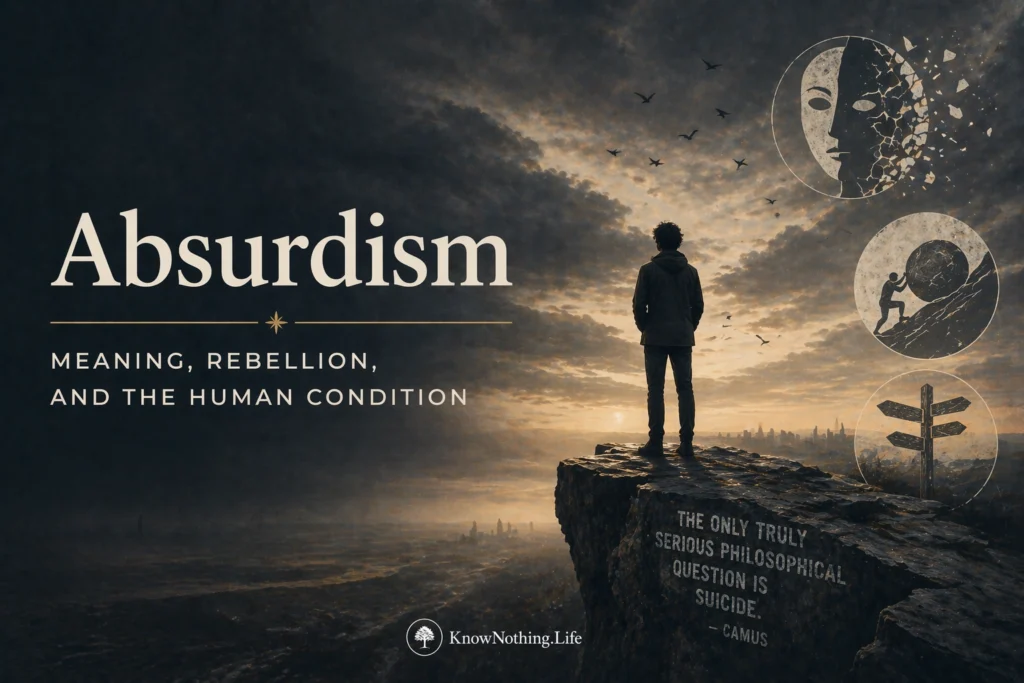
Absurdism is a philosophical perspective that confronts one of the most unsettling tensions in human existence: the clash between our deep desire for meaning and the apparent indifference of the universe. It does not begin with comforting assumptions about purpose or order, but with the recognition that human beings seek clarity, coherence, and significance in a world that offers none inherently. This confrontation gives rise to what is known as the absurd.
The philosophy of absurdism is most closely associated with Albert Camus, who explored this tension not as a problem to be solved but as a condition to be understood and lived. Rather than resolving the gap between human longing and cosmic silence, absurdism asks how individuals can respond to it. It challenges us to consider whether meaning must be discovered—or whether life can still be meaningful in its absence.
The Nature of the Absurd
The absurd arises from a relationship, not from the world alone or the human mind alone, but from their interaction. Human beings are creatures of reason, constantly seeking patterns, explanations, and purposes. Yet when these expectations are directed toward the universe, they encounter a silence that resists interpretation. This mismatch between expectation and reality creates the experience of the absurd.
Albert Camus emphasized that the absurd is not a metaphysical property of the world, but a condition that emerges when human consciousness confronts its limits. The universe does not declare itself meaningless; rather, it fails to provide the kind of meaning that human beings demand. This realization can be disorienting, as it undermines deeply held assumptions about purpose and order.
However, absurdism does not interpret this condition as purely negative. Instead, it sees the recognition of the absurd as a moment of clarity, stripping away illusions and forcing individuals to confront reality as it is. In doing so, it opens the possibility for new ways of understanding and engaging with life.
The Rejection of False Solutions
One of the central arguments of absurdism is the rejection of what Albert Camus called “philosophical suicide.” This refers to attempts to escape the absurd by appealing to systems that impose meaning where none can be found, such as certain forms of religion or metaphysical speculation. While these approaches may provide comfort, Camus argued that they ultimately avoid the truth of the human condition.
Philosophical suicide involves abandoning reason in favor of belief, accepting answers that cannot be justified by evidence or experience. For Camus, this represents a betrayal of intellectual honesty, as it replaces confrontation with evasion. Instead of facing the absurd, it seeks to dissolve it through faith or abstraction.
Absurdism also rejects literal suicide as a response to the absence of meaning. While the recognition of the absurd may lead to despair, ending one’s life does not resolve the underlying tension. Rather, it eliminates the very consciousness that gives rise to the question. For absurdism, the challenge is not to escape the absurd but to live with it fully and consciously.
Revolt as a Response to the Absurd
In place of escape, absurdism proposes revolt as a fundamental response. Revolt is not a political act in the conventional sense, but an ongoing commitment to living in defiance of the absurd. It involves acknowledging the lack of inherent meaning while refusing to succumb to nihilism or resignation.
For Albert Camus, revolt is a form of affirmation. By continuing to live, to act, and to create, individuals assert their existence against the silence of the universe. This act of defiance does not eliminate the absurd but transforms it into a source of strength and vitality.
Revolt is closely tied to awareness. It requires a constant recognition of the absurd and a refusal to fall back into comforting illusions. This makes it both demanding and liberating, as it frees individuals from the need to conform to predetermined meanings while challenging them to take responsibility for their lives.
Freedom and the Absurd Life
The recognition of the absurd has profound implications for freedom. Without inherent meaning or predetermined purpose, individuals are not bound by external frameworks that dictate how they should live. This absence of constraints creates a space for radical freedom, where choices are not limited by ultimate ends.
Albert Camus argued that this freedom is both exhilarating and daunting. Without a fixed purpose, individuals must create their own paths, guided by their desires, values, and experiences. This does not mean that anything is permissible, but rather that meaning must be constructed through action rather than discovered.
The absurd life is characterized by intensity and engagement. Freed from the need to justify actions in terms of ultimate purpose, individuals can focus on the richness of experience itself. This includes embracing passion, creativity, and the immediacy of the present, finding value in the act of living rather than in any final destination.
The Myth of Sisyphus
One of the most powerful illustrations of absurdism is found in The Myth of Sisyphus, where Camus reinterprets the ancient Greek myth of Sisyphus. Condemned to roll a boulder up a hill only for it to roll back down each time, Sisyphus represents the repetitive and seemingly futile nature of human existence.
At first glance, Sisyphus’ fate appears tragic and meaningless. However, Camus invites us to imagine Sisyphus as happy. By becoming aware of his condition and embracing it, Sisyphus transforms his punishment into a form of rebellion. The act of pushing the boulder becomes an expression of his will, rather than a sign of his defeat.
This interpretation captures the essence of absurdism. Meaning is not found in the outcome of actions but in the attitude with which they are performed. By embracing the struggle itself, individuals can find a form of fulfillment that transcends the limitations of the absurd.
Absurdism and Existentialism
Absurdism is often associated with existentialism, but the two philosophies differ in important ways. Both recognize the absence of inherent meaning and emphasize the role of individual choice, but they diverge in their responses to this condition.
Existentialists like Jean-Paul Sartre argue that individuals must create meaning through their actions, effectively filling the void left by the absence of predetermined purpose. Absurdism, on the other hand, resists this move, maintaining that the search for ultimate meaning remains unresolved.
For absurdists, the tension between human longing and the world’s indifference cannot be eliminated. Instead of resolving this tension, they embrace it as a defining feature of existence. This distinction highlights the unique position of absurdism within the broader landscape of modern philosophy.
The Emotional Landscape of the Absurd
The recognition of the absurd gives rise to a range of emotional responses, including anxiety, alienation, and a sense of disorientation. These feelings reflect the breakdown of familiar frameworks and the challenge of confronting a world without inherent meaning.
However, absurdism also identifies positive dimensions within this emotional landscape. The absence of predetermined meaning can lead to a sense of liberation, freeing individuals from rigid expectations and allowing for greater spontaneity and creativity. This duality captures the complexity of the human response to the absurd.
By engaging with these emotions rather than avoiding them, individuals can develop a deeper understanding of themselves and their circumstances. This process involves both struggle and growth, reflecting the dynamic nature of the absurd experience.
The Relevance of Absurdism Today
In contemporary society, absurdism remains highly relevant, addressing concerns that resonate across cultural and historical contexts. The search for meaning in a rapidly changing and often uncertain world mirrors the tensions identified by absurdist philosophy.
Technological advancements, shifting social structures, and global challenges have intensified questions about purpose and identity. In this context, absurdism offers a framework for navigating uncertainty without relying on absolute answers. It encourages individuals to engage with life actively, even in the absence of clear direction.
Absurdism also intersects with modern discussions in psychology and literature, influencing how individuals understand resilience, creativity, and the human capacity to adapt. Its emphasis on awareness, freedom, and engagement continues to inspire new interpretations and applications.
Final Thoughts
Absurdism presents a stark yet compelling vision of human existence, grounded in the recognition of the tension between our search for meaning and the world’s indifference. Rather than offering solutions, it challenges individuals to confront this condition directly and to find ways of living within it.
Through concepts such as revolt, freedom, and the reinterpretation of struggle, absurdism transforms what might seem like a bleak outlook into a source of vitality and strength. It invites individuals to embrace life in all its complexity, finding value not in ultimate answers but in the act of living itself.
In the end, absurdism does not resolve the question of meaning—it redefines it. By shifting the focus from external validation to internal engagement, it offers a powerful and enduring perspective on what it means to exist as a human being in an uncertain world.