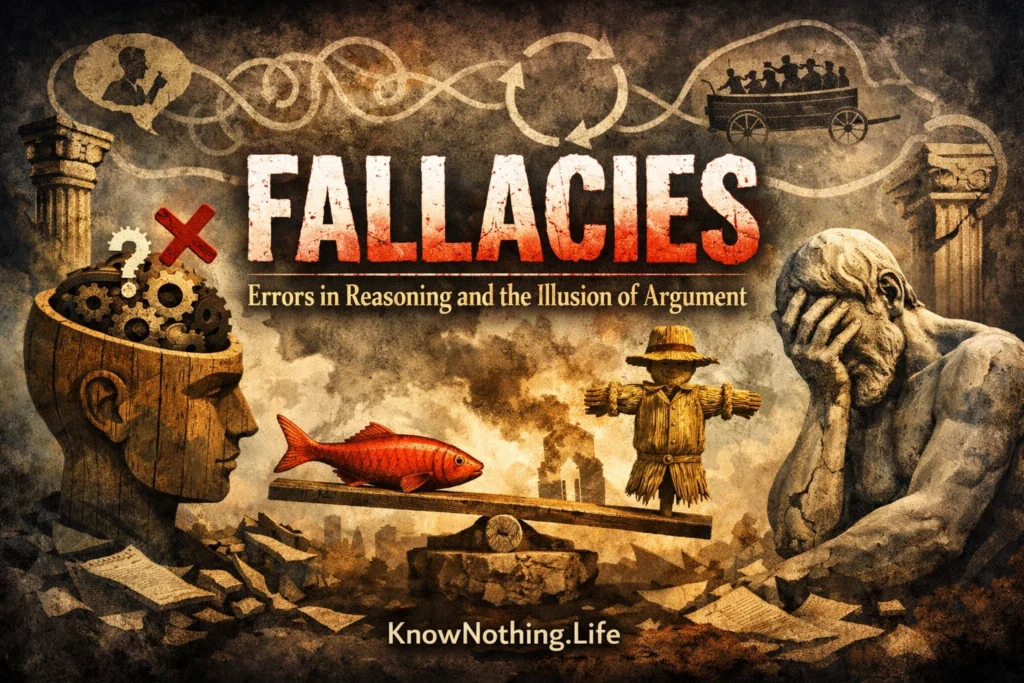
Fallacies are systematic errors in reasoning that undermine the strength, validity, or relevance of an argument. They are not merely mistakes in logic but patterns of flawed thinking that often appear persuasive, especially in everyday discourse. From political debates to advertising, fallacies shape how arguments are presented and received, influencing beliefs and decisions in subtle yet powerful ways. Understanding fallacies is therefore essential not only for philosophers and logicians but for anyone seeking to think clearly and critically.
The study of fallacies has deep roots in the history of philosophy, beginning with Aristotle, who cataloged common forms of deceptive reasoning in his work Sophistical Refutations. Aristotle recognized that some arguments appear valid while actually being flawed, and he sought to identify these patterns in order to guard against them. In modern times, scholars such as Charles Hamblin and Douglas Walton have expanded this study, emphasizing the role of context and dialogue in understanding fallacious reasoning. Fallacies thus occupy a central place in both formal and informal logic, bridging the gap between abstract theory and real-world argumentation.
The Nature of Fallacious Reasoning
At its core, a fallacy is a defect in an argument that weakens its ability to support its conclusion. However, not all fallacies are alike. Some involve structural errors, such as invalid argument forms, while others arise from misleading language, irrelevant appeals, or faulty assumptions. What unites them is their capacity to give the illusion of sound reasoning while failing to meet the standards of logical rigor.
One of the defining features of fallacies is their persuasive power. Unlike obvious errors, fallacies often succeed precisely because they mimic legitimate forms of reasoning. For example, an argument may appeal to authority in a way that seems credible but relies on an irrelevant or unqualified source. Similarly, emotional appeals can be compelling even when they do not provide logical support for a conclusion. This dual nature—being both flawed and persuasive—makes fallacies particularly important to study.
Charles Hamblin, in his influential book Fallacies, challenged the traditional view that fallacies could be neatly classified as logical errors. He argued that fallacies should be understood in the context of dialogue, where arguments are evaluated based on their role in a conversation. As Hamblin noted, “The standard treatment of fallacies is unsatisfactory,” pointing to the need for a more nuanced approach that considers how arguments function in real-world interactions.
Formal vs. Informal Fallacies
Fallacies are commonly divided into two broad categories: formal and informal. Formal fallacies occur when there is a flaw in the logical structure of an argument, making it invalid regardless of its content. These errors can often be identified through symbolic analysis, as they violate the rules of formal logic. An example is affirming the consequent: “If p, then q; q; therefore, p,” which appears plausible but is logically invalid.
Informal fallacies, by contrast, arise from issues related to content, context, or language rather than structure. These include errors such as ad hominem attacks, straw man arguments, and false dilemmas. Informal fallacies are more difficult to identify because they depend on the nuances of language and the specific circumstances in which an argument is made. They often involve irrelevant considerations that distract from the actual issue at hand.
The distinction between formal and informal fallacies highlights the complexity of reasoning. While formal logic provides clear criteria for identifying structural errors, informal logic requires a more flexible and context-sensitive approach. Douglas Walton emphasized this point, arguing that many so-called fallacies are not inherently flawed but become problematic in certain contexts. He wrote, “A fallacy is a type of argument that is generally considered to be incorrect, but that may be reasonable in some contexts,” underscoring the importance of situational analysis.
Common Types of Fallacies
A wide variety of fallacies have been identified, each representing a distinct pattern of flawed reasoning. Among the most common is the ad hominem fallacy, which attacks the character of a person rather than addressing the argument itself. This type of reasoning shifts the focus away from the issue, undermining rational discussion. Another prevalent fallacy is the straw man, where an opponent’s position is misrepresented in order to make it easier to attack.
The false dilemma is another significant fallacy, presenting a situation as having only two possible outcomes when, in reality, more options exist. This form of reasoning simplifies complex issues, often forcing a choice between extremes. Similarly, the slippery slope fallacy assumes that a particular action will inevitably lead to a chain of negative consequences without sufficient evidence.
These fallacies are not merely theoretical constructs; they appear frequently in everyday discourse, shaping how arguments are framed and understood. Aristotle recognized this in his analysis of sophistical arguments, noting that deceptive reasoning often relies on ambiguity and emotional appeal. His work remains foundational in understanding how fallacies operate and why they are so effective.
Fallacies in Rhetoric and Persuasion
Fallacies play a central role in rhetoric, the art of persuasion. While logic aims at truth, rhetoric often seeks to influence belief and action, sometimes at the expense of rigorous reasoning. This does not mean that all persuasive arguments are fallacious, but it does highlight the potential for misuse of reasoning in persuasive contexts.
The relationship between fallacies and persuasion is complex. Some fallacies, such as appeals to emotion, can be effective in engaging an audience, even if they do not provide logical support. Others, like appeals to popularity (bandwagon), exploit social dynamics to create the impression of validity. Understanding these mechanisms is essential for evaluating arguments critically and resisting manipulation.
Chaïm Perelman, in The New Rhetoric, emphasized that argumentation is aimed at gaining the adherence of an audience. He wrote, “The aim of argumentation is to gain the adherence of minds,” highlighting the persuasive dimension of reasoning. Informal logic builds on this insight by examining how fallacies function within rhetorical contexts, revealing the interplay between logic and persuasion.
Cognitive Bias and Psychological Roots
The persistence of fallacies is closely tied to cognitive biases—systematic patterns of thinking that influence how individuals process information. These biases can lead people to accept fallacious arguments because they align with preexisting beliefs or emotional responses. For example, confirmation bias encourages individuals to favor information that supports their views, making them more susceptible to fallacious reasoning.
Psychologists such as Daniel Kahneman have explored how cognitive processes shape reasoning. In Thinking, Fast and Slow, Kahneman distinguishes between intuitive, fast thinking and deliberate, slow thinking. Fallacies often arise from the former, where quick judgments are made without careful analysis. As Kahneman observed, “A reliable way to make people believe in falsehoods is frequent repetition,” illustrating how cognitive biases can reinforce fallacious beliefs.
Understanding the psychological roots of fallacies provides a deeper perspective on why they are so prevalent. It suggests that fallacies are not merely logical errors but reflections of how human cognition operates. Addressing them therefore requires not only logical training but also awareness of cognitive tendencies.
The Role of Fallacies in Critical Thinking
The study of fallacies is a cornerstone of critical thinking, providing tools for evaluating arguments and avoiding errors in reasoning. By learning to identify fallacies, individuals can become more discerning consumers of information and more effective communicators. This skill is particularly important in an age of information overload, where misleading arguments are widespread.
Critical thinking involves more than recognizing fallacies; it requires the ability to assess evidence, consider alternative perspectives, and construct coherent arguments. Fallacies serve as a guide to what can go wrong in reasoning, highlighting the importance of clarity, relevance, and logical consistency. They also encourage a reflective approach to thinking, where assumptions are questioned and conclusions are carefully examined.
John Stuart Mill emphasized the value of open debate and critical inquiry in his work On Liberty. He argued that exposing arguments to scrutiny is essential for discovering truth, writing, “He who knows only his own side of the case knows little of that.” This perspective aligns with the goals of informal logic, which seeks to foster critical engagement with arguments and ideas.
Conclusion
Fallacies reveal both the fragility and the resilience of human reasoning. They demonstrate how easily arguments can go wrong, yet also how patterns of error can be identified and corrected through careful analysis. From the early insights of Aristotle to the modern work of Douglas Walton and Daniel Kahneman, the study of fallacies has evolved into a rich and interdisciplinary field.
In understanding fallacies, we gain insight not only into flawed reasoning but into the nature of thought itself. We learn how arguments persuade, how biases shape beliefs, and how critical thinking can counteract these influences. Fallacies thus serve as both a warning and a guide—highlighting the pitfalls of reasoning while pointing the way toward clearer, more rational thought.
Ultimately, the study of fallacies is not merely an academic exercise but a practical necessity. In a world filled with competing claims and persuasive messages, the ability to recognize and analyze fallacious reasoning is essential for making informed decisions and engaging in meaningful dialogue. It is through this awareness that we can move closer to the ideal of reasoned understanding, where arguments are evaluated not by their appeal but by their merit.