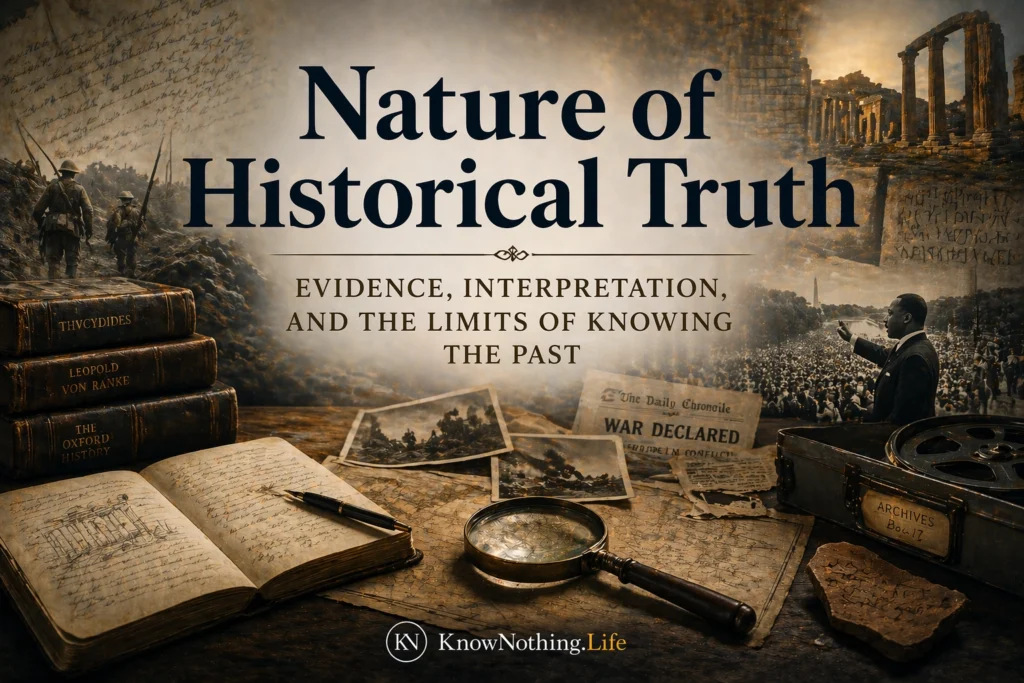
The question of historical truth lies at the heart of how we understand the past. Unlike the natural sciences, where truths can often be tested through repeatable experiments, history deals with events that have already occurred and cannot be directly observed again. This raises a fundamental philosophical problem: what does it mean for a historical claim to be true? Is historical truth simply a matter of accurately recording facts, or does it involve interpretation, perspective, and narrative construction?
The pursuit of historical truth is not merely academic. It shapes collective memory, national identity, and moral judgment. Disagreements about historical events often reflect deeper conflicts over meaning and values, demonstrating that truth in history is intertwined with interpretation. The philosophy of history thus turns to questions about evidence, objectivity, and the limits of human understanding, seeking to clarify how knowledge of the past can be justified and what kinds of truth claims are possible.
Facts and Evidence
At the most basic level, historical truth relies on evidence. Documents, artifacts, testimonies, and physical remains provide the raw materials from which historians reconstruct past events. These sources are not self-explanatory; they must be interpreted within a broader context. A single document, for example, may reveal certain details while obscuring others, and its reliability depends on factors such as authorship, intent, and preservation.
Historians employ critical methods to evaluate evidence, assessing authenticity, consistency, and corroboration. The goal is to build a coherent account that aligns with available data while remaining open to revision as new evidence emerges. However, the fragmentary nature of historical records means that complete certainty is often unattainable. Historical truth, therefore, is not absolute in the same sense as mathematical truth but is instead grounded in the best available evidence and reasoned judgment.
Objectivity and Bias
The ideal of objectivity has long guided historical inquiry, with scholars striving to present accounts that are free from personal or ideological bias. The work of Leopold von Ranke exemplifies this aspiration, emphasizing the importance of describing events “as they actually happened.” Yet the possibility of complete objectivity has been widely questioned, as historians inevitably approach their subjects with particular perspectives and assumptions.
Bias can enter historical accounts in subtle ways, influencing which events are considered significant, how sources are interpreted, and what narratives are constructed. Cultural, political, and personal factors all shape the historian’s viewpoint. Recognizing these influences does not necessarily undermine the pursuit of truth but highlights the need for critical reflection and methodological rigor. Historical truth emerges not from the elimination of perspective but from the careful examination and balancing of multiple viewpoints.
Interpretation and Narrative
Historical truth is deeply connected to interpretation. Facts alone do not constitute history; they must be organized into narratives that explain relationships, causes, and consequences. This process involves selecting certain events as meaningful while excluding others, creating a structure that gives coherence to the past. Different historians may construct different narratives from the same set of facts, leading to varying interpretations.
The philosopher Hayden White argued that historical writing shares features with literary storytelling, including the use of plot structures and rhetorical devices. This perspective suggests that historical truth is not simply discovered but also shaped through narrative form. While this does not imply that history is fictional, it does indicate that the way events are presented influences how they are understood. The challenge lies in balancing narrative coherence with fidelity to evidence.
Correspondence and Coherence
Philosophical theories of truth provide different frameworks for understanding historical claims. The correspondence theory of truth holds that a statement is true if it accurately reflects reality. Applied to history, this means that a historical account is true if it corresponds to what actually happened. However, determining such correspondence is complicated by the indirect nature of historical knowledge.
The coherence theory of truth offers an alternative perspective, suggesting that a claim is true if it fits consistently within a broader system of beliefs or evidence. In historical practice, this involves constructing accounts that align with multiple sources and established knowledge. Both approaches highlight important aspects of historical truth, but neither fully resolves the challenges posed by incomplete evidence and interpretive complexity. Historians often rely on a combination of correspondence and coherence in evaluating truth claims.
Causation and Explanation
Understanding historical truth also involves explaining why events occurred. Causal explanations seek to identify the factors that contributed to particular outcomes, whether they involve individual actions, social structures, or broader economic forces. These explanations are inherently interpretive, as historians must decide which factors are most significant and how they interact.
Philosophers like R. G. Collingwood emphasized the importance of understanding the intentions and thoughts of historical actors. According to this view, historical truth involves reconstructing the reasoning behind actions, rather than merely describing external events. This approach highlights the complexity of causation in history, where multiple factors often converge and simple explanations are insufficient.
The Role of Perspective
Perspective plays a crucial role in shaping historical truth. Different groups may interpret the same events in different ways, reflecting their experiences, values, and interests. For example, a political revolution may be seen as a struggle for freedom by some and as a disruption of order by others. These differing perspectives do not necessarily negate the possibility of truth but illustrate its multifaceted nature.
The inclusion of diverse perspectives has become an important focus in contemporary historiography, as scholars seek to recover voices that have been marginalized or overlooked. This expansion of viewpoints enriches historical understanding, providing a more comprehensive picture of the past. At the same time, it raises questions about how to reconcile conflicting interpretations and establish shared standards of truth.
Limits of Historical Knowledge
Despite advances in methodology and access to sources, there are inherent limits to what can be known about the past. Many events leave little or no trace, and existing records may be incomplete, biased, or lost. Even when evidence is available, it may not provide definitive answers to all questions. These limitations mean that historical knowledge is always provisional, subject to revision and reinterpretation.
The recognition of these limits does not render historical inquiry meaningless but underscores its complexity. Historians must navigate uncertainty, balancing skepticism with the need to construct coherent accounts. The pursuit of historical truth is thus an ongoing process, involving continual reassessment and dialogue rather than final conclusions.
Ethics and Historical Truth
The study of historical truth also has ethical dimensions. Representing the past accurately is not only an intellectual responsibility but also a moral one, particularly when dealing with events involving injustice, suffering, or conflict. Misrepresentation or distortion of history can have real-world consequences, influencing public understanding and policy decisions.
Ethical considerations extend to issues such as the use of sources, the treatment of sensitive topics, and the responsibility to acknowledge multiple perspectives. Historians must navigate these challenges while maintaining a commitment to truth and integrity. The ethical dimension of historical truth highlights its significance beyond academic inquiry, emphasizing its impact on society and collective memory.
Conclusion
The nature of historical truth is complex and multifaceted, involving evidence, interpretation, and philosophical reflection. While the past cannot be directly observed, it can be understood through careful analysis of sources and thoughtful construction of narratives. Historical truth is not absolute in the sense of complete certainty, but it is grounded in reasoned judgment and critical inquiry.
By examining issues of objectivity, perspective, and the limits of knowledge, the philosophy of history provides valuable insights into how we understand the past. It reminds us that historical truth is both a goal and a process, requiring ongoing engagement with evidence and interpretation. In this way, the study of historical truth contributes to a deeper understanding of human experience and the ways in which it is remembered and interpreted over time.