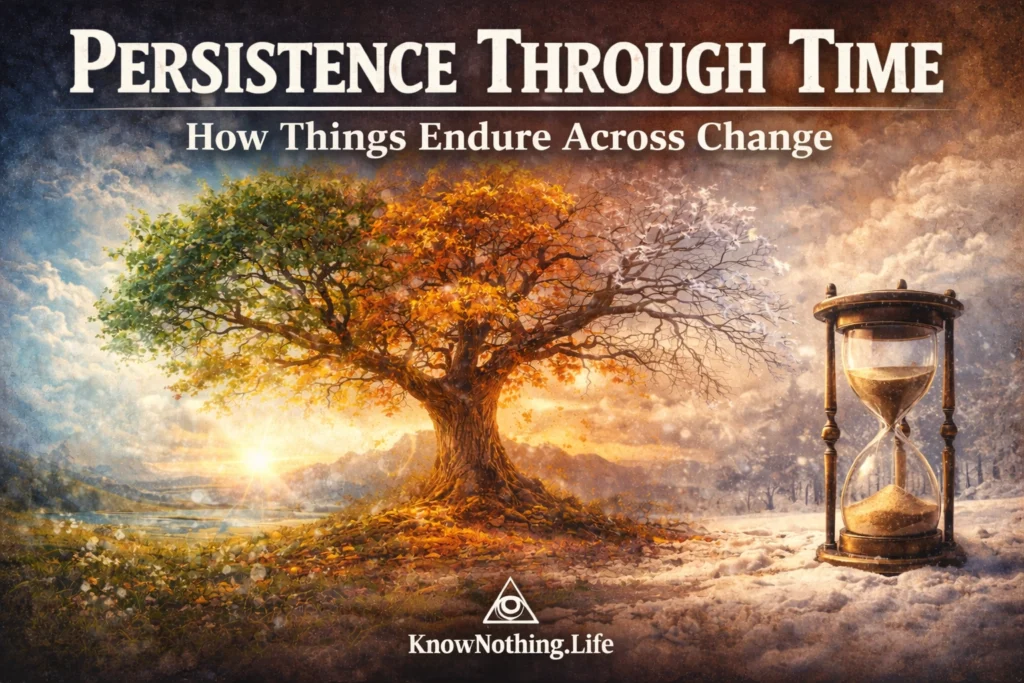
Persistence through time is a central problem in metaphysics, concerned with how objects, persons, and entities continue to exist as the same things despite undergoing change. From everyday objects like a chair that wears down over years to human beings who grow, learn, and transform, the question remains: what allows something to persist as the same entity over time? This issue sits at the intersection of identity, change, and existence, forming a foundational inquiry into the structure of reality.
At first glance, persistence seems intuitive. We assume that objects endure—that the person we were yesterday is the same person we are today. Yet this assumption becomes problematic when examined closely. If something changes, it is no longer exactly as it was. If it remains entirely unchanged, then no change has occurred. Philosophers have long sought to resolve this tension, proposing competing theories that attempt to explain how continuity and transformation coexist.
Ancient Foundations: Change and Permanence
The earliest philosophical reflections on persistence through time emerged in ancient Greece, particularly in the contrasting views of Heraclitus and Parmenides. Heraclitus emphasized constant change, asserting that reality is defined by flux. His famous statement, “No man ever steps in the same river twice,” captures the idea that both the observer and the observed are continually changing.
For Heraclitus, persistence is not a matter of static identity but of ongoing process. The river remains “the same” not because its waters are identical, but because its structure and pattern endure through change. This perspective suggests that persistence is compatible with transformation, as long as there is continuity in form or function.
In contrast, Parmenides denied the possibility of change altogether. In his poem On Nature, he argued that reality is unchanging and eternal, declaring, “What is, is; and what is not, is not.” For Parmenides, the appearance of change is an illusion, and true being is timeless. While this view eliminates the problem of persistence by denying change, it also conflicts with everyday experience, prompting later philosophers to seek more balanced accounts.
Aristotle and Endurance
Aristotle provided one of the most influential frameworks for understanding persistence through time. In Metaphysics, he introduced the concept of substance as that which persists while its properties change. A substance, such as a tree or a person, maintains its identity despite alterations in its attributes.
Aristotle distinguished between essential and accidental properties. Essential properties define what a thing is, while accidental properties can change without affecting its identity. For example, a person may change their appearance, location, or mood, but these changes do not alter their essential nature as a human being. This distinction allows for persistence through change by anchoring identity in stable features.
This theory of endurance suggests that objects are wholly present at each moment of their existence. They endure through time, maintaining their identity even as their properties vary. Aristotle’s account became a cornerstone of metaphysical thought, influencing both medieval and modern philosophy.
The Ship of Theseus and the Problem of Replacement
One of the most famous illustrations of persistence through time is the Ship of Theseus paradox. If a ship has all its parts gradually replaced over time, is it still the same ship? And if the original parts are reassembled into a second ship, which one is the true Ship of Theseus?
This paradox highlights the difficulty of defining persistence in terms of material composition. If identity depends on having the same parts, then the ship ceases to be the same as soon as any part is replaced. If identity depends on structure or function, then the ship may remain the same despite complete material change.
Philosophers have proposed various solutions. Some emphasize continuity of form, arguing that the organization of parts matters more than the parts themselves. Others focus on historical continuity, suggesting that an object’s identity is tied to its causal history. The Ship of Theseus demonstrates that persistence is not a simple matter of sameness but involves complex relationships between change, continuity, and context.
Endurantism vs. Perdurantism
In contemporary metaphysics, the debate over persistence through time is often framed in terms of endurantism and perdurantism. Endurantism, rooted in Aristotle’s view, holds that objects are wholly present at each moment of their existence. They endure through time, maintaining their identity as complete entities.
Perdurantism, by contrast, proposes that objects are extended in time as well as space. According to this view, an object is not wholly present at any single moment but consists of a series of temporal parts. Just as a road has different segments along its length, an object has different stages along its existence. Persistence is thus a matter of having connected temporal parts rather than maintaining strict identity.
Philosophers such as David Lewis developed sophisticated versions of perdurantism, arguing that this approach better accounts for change and continuity. By treating objects as four-dimensional entities, perdurantism allows for variation across time without requiring strict sameness at every moment.
Personal Persistence and Psychological Continuity
The problem of persistence becomes especially complex when applied to persons. What does it mean for a person to persist through time? John Locke argued that personal identity is grounded in psychological continuity, particularly memory. In An Essay Concerning Human Understanding, he wrote that identity extends as far as consciousness can reach.
This view suggests that persistence is not tied to the body or substance but to the continuity of mental states. If a person can remember past experiences, they are the same person who had those experiences. However, this raises questions about memory loss and psychological change. Can identity persist without memory? What happens when personality shifts dramatically?
Derek Parfit expanded on these ideas, arguing in Reasons and Persons that identity may not be what ultimately matters. Instead, he emphasized psychological connectedness and continuity, suggesting that persistence can be a matter of degree rather than an absolute condition. Parfit’s work challenges traditional notions of identity, proposing a more flexible understanding of personal persistence.
Scientific and Modern Perspectives
Advances in science have added new dimensions to the problem of persistence through time. In biology, organisms undergo constant cellular replacement, yet are considered the same individuals. In physics, theories about spacetime suggest that objects may be understood as four-dimensional entities, aligning with perdurantist views.
Neuroscience also complicates the picture of personal persistence. Changes in brain structure can alter memory, personality, and behavior, raising questions about the stability of identity. If the physical basis of the self is constantly changing, what grounds continuity?
These developments suggest that persistence is not a simple or uniform phenomenon. It may depend on context, varying across different domains such as physical objects, living organisms, and persons. The interplay between philosophical theory and scientific discovery continues to shape our understanding of how things endure over time.
The Significance of Persistence
The concept of persistence through time has profound implications for how we understand reality. It underlies notions of responsibility, continuity, and meaning. If objects and persons did not persist, concepts such as ownership, accountability, and identity would lose their coherence.
Philosophically, the problem of persistence reflects a deeper tension between change and stability. It challenges us to reconcile the dynamic nature of reality with the need for continuity. This tension is not only theoretical but also experiential, shaping how individuals perceive themselves and their place in the world.
Persistence also raises questions about the nature of existence itself. Is continuity an objective feature of reality, or is it constructed by the mind? The answer to this question influences how we interpret change, identity, and the structure of time.
Conclusion
Persistence through time remains one of the most enduring problems in philosophy, bridging ancient debates and modern theories. From the contrasting views of Heraclitus and Parmenides to the sophisticated frameworks of contemporary thinkers like David Lewis and Derek Parfit, it has inspired a wide range of perspectives.
By examining how things persist through change, this inquiry reveals the complexity of identity and the nature of existence. It shows that persistence is not a simple matter of sameness but a dynamic relationship between continuity and transformation.
Ultimately, the question of persistence invites ongoing reflection. It challenges us to consider what it means to remain the same in a world defined by change—a question that continues to shape both philosophical thought and human experience.