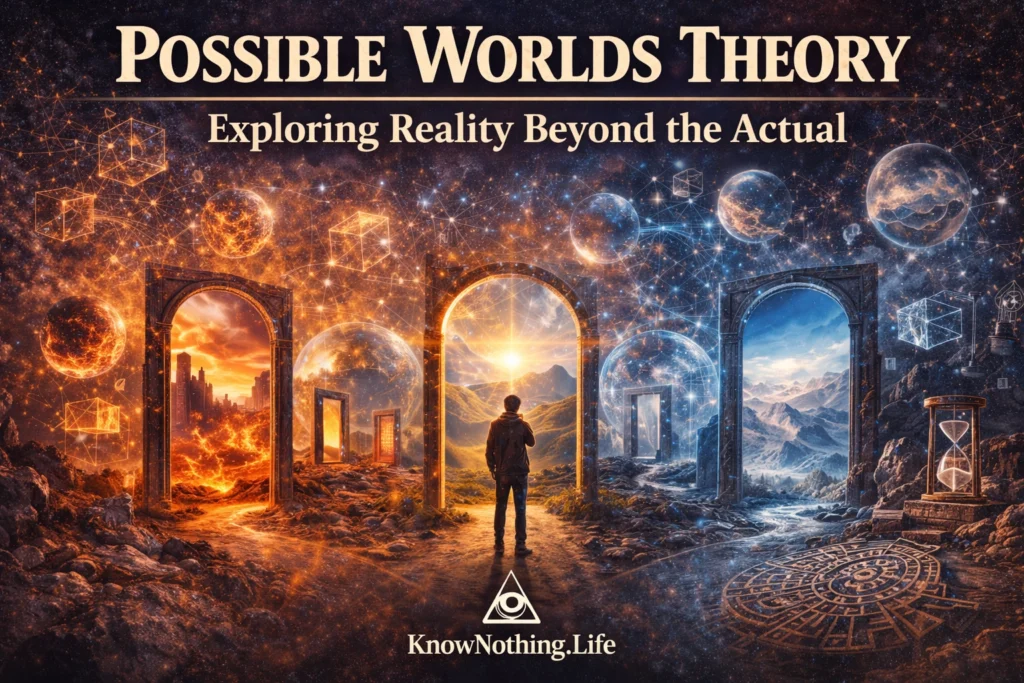
Possible worlds theory is one of the most powerful and imaginative frameworks in modern philosophy, offering a way to analyze necessity, possibility, and contingency by considering alternative versions of reality. At its core, the theory asks a simple but profound question: when we say something is possible, what exactly do we mean? Are we referring to mere logical consistency, or to the existence of other “worlds” in which things are different?
Rather than limiting reality to the actual world we inhabit, possible worlds theory expands the scope of philosophical inquiry to include all the ways things could have been. This approach has transformed discussions in metaphysics, logic, and the philosophy of language, providing a structured way to understand modal concepts. It allows philosophers to distinguish between what is necessarily true—true in all possible worlds—and what is contingently true—true only in the actual world.
Leibniz and the Origins of Possible Worlds
The concept of possible worlds originates with Gottfried Wilhelm Leibniz, who introduced the idea in his metaphysical and theological writings, including Monadology. Leibniz proposed that there are infinitely many possible worlds, each representing a complete way reality could have been. Among these, only one is actual—the world chosen by God.
Leibniz argued that God, being perfectly rational and good, selects the best possible world to bring into existence. He famously wrote, “This is the best of all possible worlds.” This claim reflects his belief in a rational order underlying reality, where every event has a sufficient reason. Possible worlds, in this framework, are not physical realities but conceptual constructs that represent alternative configurations of existence.
Leibniz’s theory provides a way of understanding contingency. Events that occur in the actual world could have been otherwise, as they are not necessary truths. Necessary truths, by contrast, are true in all possible worlds. This distinction forms the foundation of modal reasoning, allowing philosophers to analyze different kinds of truth with greater precision.
Modal Logic and the Formalization of Possibility
In the 20th century, possible worlds theory was formalized through the development of modal logic. Saul Kripke played a central role in this transformation, introducing a semantic framework in which modal statements are evaluated in terms of possible worlds.
According to Kripke’s model, a statement is necessary if it is true in all possible worlds, and possible if it is true in at least one. This approach provides a clear and systematic way of analyzing modal concepts, linking them to logical structures. Kripke’s work, particularly in Naming and Necessity, also introduced the idea of rigid designators—terms that refer to the same object in every possible world.
Kripke’s framework reveals that necessity and possibility are not merely linguistic features but reflect deeper metaphysical structures. It allows philosophers to explore questions about identity, reference, and truth across different scenarios, expanding the scope of philosophical analysis. The formalization of possible worlds theory has had a profound impact on both philosophy and logic.
David Lewis and Modal Realism
The most radical interpretation of possible worlds theory comes from David Lewis, who defended a position known as modal realism. In his work On the Plurality of Worlds, Lewis argued that possible worlds are not merely abstract constructs but real, concrete entities. According to Lewis, all possible worlds exist just as fully as the actual world, differing only in their contents.
Lewis famously stated, “The world we live in is just one among many.” This view treats possible worlds as parallel realities, each as real as our own but inaccessible to us. The term “actual” becomes indexical, meaning it refers to the world we happen to inhabit, just as “here” refers to our current location.
Modal realism provides a straightforward account of possibility and necessity. A statement is possible if it is true in some world, and necessary if it is true in all worlds. However, this view comes at a high metaphysical cost, as it requires accepting the existence of an immense plurality of worlds. Critics argue that this commitment is excessive, raising questions about whether such entities are necessary for explaining modality.
Alternatives to Modal Realism
Not all philosophers accept Lewis’s radical ontology. Many prefer more moderate approaches that treat possible worlds as abstract entities or conceptual tools. These views, often called modal actualism or ersatz realism, maintain that only the actual world exists, while possible worlds are representations rather than concrete realities.
For example, possible worlds may be understood as sets of propositions, descriptions, or states of affairs that capture how things could be. This approach avoids the ontological commitment to multiple real worlds while preserving the explanatory power of the theory. It allows philosophers to use the language of possible worlds without treating them as literal entities.
These alternatives highlight the flexibility of possible worlds theory. While Lewis’s modal realism offers a bold and comprehensive framework, other interpretations provide more conservative accounts that align with traditional metaphysical intuitions. The debate between these views reflects broader questions about the nature of existence and the limits of philosophical explanation.
Possible Worlds and Counterfactuals
One of the most significant applications of possible worlds theory is in the analysis of counterfactual statements—claims about what would have happened if things had been different. Statements such as “If the match had been struck, it would have lit” can be understood by considering possible worlds in which the relevant conditions are met.
David Lewis developed a detailed account of counterfactuals using possible worlds, arguing that their truth depends on what happens in the closest possible worlds—those most similar to the actual world. This approach provides a systematic way of evaluating hypothetical scenarios, linking them to modal reasoning.
Counterfactual analysis has wide-ranging implications, particularly in science and decision-making. It allows for the exploration of causal relationships, predictions, and alternative outcomes. By considering how events could have unfolded differently, possible worlds theory enhances our understanding of both necessity and contingency.
Possible Worlds and Human Thought
Beyond formal philosophy, possible worlds theory reflects a fundamental aspect of human cognition: the ability to imagine alternatives. People constantly consider what might happen, what could have happened, and what must happen, using these distinctions to guide reasoning and action.
This capacity for modal thinking is essential for planning, creativity, and problem-solving. It allows individuals to explore different scenarios, evaluate risks, and make informed decisions. Possible worlds theory provides a formal framework for understanding this intuitive process, connecting abstract philosophy with everyday experience.
In language, modal expressions such as “could,” “might,” and “must” reflect underlying possible worlds reasoning. These terms encode distinctions between different kinds of possibility and necessity, shaping how statements are interpreted. The integration of possible worlds into language and thought underscores their central role in human understanding.
The Philosophical Significance of Possible Worlds
Possible worlds theory expands the boundaries of philosophical inquiry, allowing for a richer understanding of reality. It reveals that the actual world is just one among many possibilities, each representing a different way things could be. This perspective challenges the assumption that reality is limited to what exists here and now.
The theory also provides a powerful tool for analyzing modal concepts, offering clarity and precision in discussions of necessity and possibility. It connects logic, metaphysics, and language, demonstrating the interconnectedness of these domains.
Philosophically, possible worlds theory raises deep questions about existence, identity, and truth. It invites reflection on the nature of reality and the extent to which alternative possibilities are meaningful. Whether understood as concrete realities or abstract constructs, possible worlds remain a central concept in modern philosophy.
Conclusion
Possible worlds theory represents a major development in the understanding of modality, offering a framework for exploring possibility and necessity. From the original insights of Gottfried Wilhelm Leibniz to the formalization by Saul Kripke and the radical realism of David Lewis, it has evolved into a rich and influential field.
These perspectives demonstrate that reality is not confined to what is actual but includes a vast landscape of possibilities. By examining these possibilities, philosophers gain a deeper understanding of truth, existence, and the structure of the world.
Ultimately, possible worlds theory invites us to think beyond the limits of the present, exploring the full range of what could be. In doing so, it reveals the depth and complexity of reality, opening new avenues for philosophical inquiry and understanding.