The Fourth Way is an esoteric system of self-development associated primarily with George Ivanovich Gurdjieff and P. D. Ouspensky. It teaches that ordinary human beings live much of their lives in a state of “waking sleep,” moving through habits, reactions, fantasies, emotions, and social roles without genuine self-awareness. The aim of the Fourth Way is not belief, worship, or withdrawal from life, but awakening: the gradual development of consciousness, attention, presence, will, and inner unity. It is called the Fourth Way because Gurdjieff contrasted it with three traditional spiritual paths: the way of the fakir, the way of the monk, and the way of the yogi.
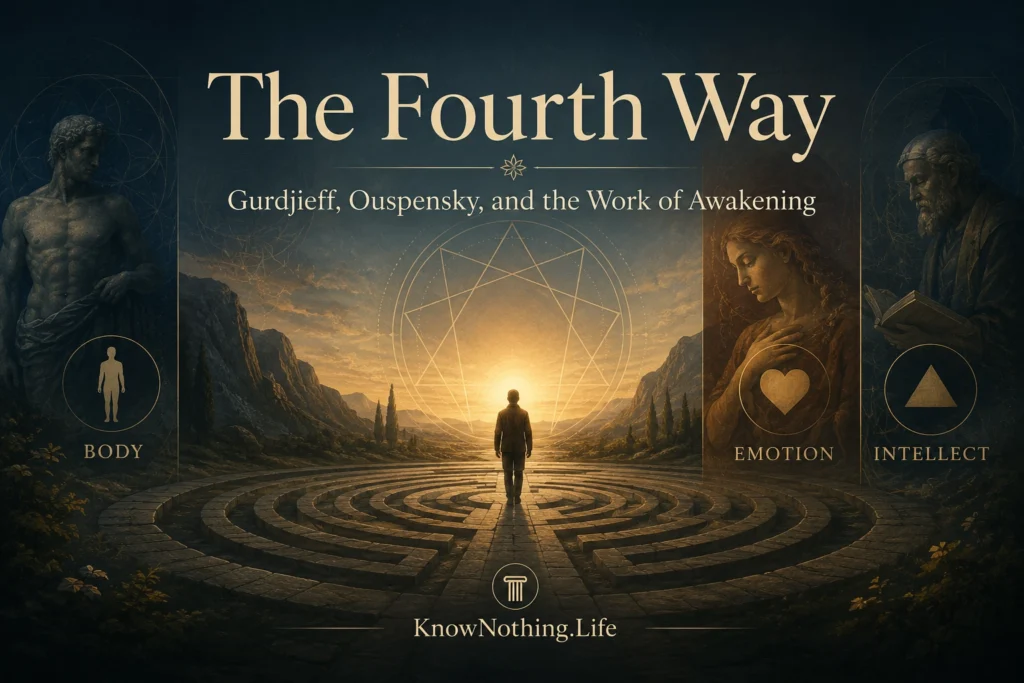
In Gurdjieff’s formulation, the fakir works primarily through the body, the monk through feeling and devotion, and the yogi through mind and concentration. The Fourth Way philosophy attempts to work on body, emotion, and intellect together while the student remains in ordinary life. It does not require retreat to a monastery, cave, desert, or temple. Instead, daily life becomes the field of practice. Work, family, conversation, irritation, fatigue, ambition, vanity, fear, and habit all become material for self-study. This is why the Fourth Way is often called simply “the Work”: it is work on oneself in the middle of life.
Gurdjieff and the Search for Hidden Knowledge
G. I. Gurdjieff was born in the late nineteenth century in the Caucasus region, an area shaped by Armenian, Greek, Russian, Turkish, Persian, and Central Asian influences. His early life is surrounded by uncertainty, partly because he cultivated mystery and partly because his autobiographical writings mix memory, teaching story, and symbolic narrative. In Meetings with Remarkable Men, Gurdjieff presents himself as a seeker traveling through monasteries, deserts, Sufi brotherhoods, ancient ruins, and hidden schools in search of objective knowledge about human transformation.
Whether every detail of these travels can be historically verified is less important than the function they serve in his teaching. Gurdjieff presented the Fourth Way as a fragment of ancient knowledge adapted for modern people. He did not offer a conventional religion. He did not ask students merely to believe doctrines. He challenged them to observe themselves with unusual honesty. His major written works include Beelzebub’s Tales to His Grandson, Meetings with Remarkable Men, and Life Is Real Only Then, When “I Am.” These books are difficult, symbolic, and deliberately resistant to casual reading. Gurdjieff wanted readers to struggle, not consume ideas passively.
Ouspensky and the Systematization of the Teaching
P. D. Ouspensky was a Russian philosopher, mathematician, journalist, and spiritual seeker who became Gurdjieff’s most famous interpreter. Before meeting Gurdjieff, Ouspensky had already written Tertium Organum, a philosophical work exploring higher dimensions, consciousness, and mystical knowledge. His encounter with Gurdjieff in Moscow in 1915 became a turning point. Ouspensky later recorded Gurdjieff’s early teaching in In Search of the Miraculous, one of the most important books on the Fourth Way.
Ouspensky’s genius was clarity. Where Gurdjieff was dramatic, paradoxical, and often intentionally obscure, Ouspensky organized the teaching into concepts, diagrams, lectures, and questions. His posthumously published book The Fourth Way presents a record of talks and answers based on Gurdjieff’s ideas as Ouspensky taught them from the 1920s through the 1940s. Some later Gurdjieff students believed Ouspensky made the teaching too intellectual, while Ouspensky believed he had preserved essential structure. Together, the two figures shaped the Fourth Way as both a living practice and a system of ideas.
Waking Sleep and Mechanical Humanity
One of the most unsettling Fourth Way teachings is the claim that ordinary human beings are largely mechanical. Gurdjieff did not mean that people are machines in a crude physical sense. He meant that most thoughts, emotions, gestures, opinions, and decisions arise automatically from conditioning. People say “I” as if they are unified, but in reality, according to the teaching, they contain many small “I’s”: one part wants discipline, another wants comfort; one part loves, another resents; one part believes, another doubts. The person imagines unity, but lives in contradiction.
This idea is psychologically powerful because it explains why people so often fail to do what they sincerely intend. They promise to change, then repeat old patterns. They decide to remain calm, then react with anger. They seek truth, then defend vanity. The Fourth Way says this happens because ordinary will is weak and fragmented. Real will must be developed through attention, self-observation, and inner struggle. Awakening begins when a person stops assuming they are conscious and begins seeing how unconscious they actually are.
Self-Observation and Self-Remembering
Self-observation is one of the central practices of the Fourth Way. It means watching oneself without immediate judgment, excuse, or identification. The student observes posture, tone of voice, emotional reactions, recurring thoughts, vanity, fear, defensiveness, imagination, and contradiction. The goal is not self-criticism but seeing. In ordinary life, people usually identify with every passing state: “I am angry,” “I am offended,” “I am afraid,” “I am right.” The Fourth Way asks the student to notice that these states arise and pass. They are not the whole self.
Self-remembering goes further. It is the attempt to be aware of oneself while also being aware of the world. Ouspensky described this as divided attention: one part of attention rests on the object or situation, while another part returns to the sense of oneself being present. This is not daydreaming, introspection, or self-analysis. It is a direct effort to awaken in the moment. Gurdjieff believed that without self-remembering, people do not truly remember their lives. They pass through experiences half-asleep, leaving behind only fragments.
The Three Centers
The Fourth Way teaches that human beings function through centers: intellectual, emotional, and moving-instinctive. The intellectual center thinks, compares, explains, and analyzes. The emotional center feels, values, loves, hates, fears, and desires. The moving-instinctive center governs movement, bodily habits, sensation, survival reactions, and physical intelligence. In a balanced person, these centers would cooperate. In ordinary life, they often interfere with one another.
A person may try to solve an emotional wound intellectually, think endlessly about what must be felt, or act impulsively before thought has entered. Someone may have brilliant ideas but poor emotional development, or intense feelings but little discipline. The Fourth Way does not treat spirituality as escape from the body or emotion. It insists that transformation requires the whole person. Attention must enter thought, feeling, and movement. To know oneself means seeing how all three centers operate in daily life.
Conscious Labor and Intentional Suffering
Two of Gurdjieff’s most important phrases are “conscious labor” and “intentional suffering.” Conscious labor means effort made with awareness, not merely automatic work for reward, status, survival, or habit. A person may work hard all day and still remain asleep inwardly. Conscious labor requires presence. It means doing what must be done while remembering oneself, resisting mechanical reactions, and serving something beyond vanity.
Intentional suffering is more easily misunderstood. It does not mean seeking pain for its own sake or glorifying misery. It means willingly enduring the discomfort required to become conscious. For example, one may suffer the humiliation of seeing one’s vanity, the irritation of not expressing anger, the discomfort of admitting self-deception, or the pain of not being admired. Ordinary suffering is mechanical; intentional suffering is accepted consciously for transformation. In this sense, the Fourth Way is not a path of comfort. It is a path of friction, because friction reveals the machine.
The Enneagram and Laws of Reality
Gurdjieff introduced the enneagram as a symbol of universal process. Long before it became associated with modern personality typing, the enneagram in Gurdjieff’s teaching represented dynamic laws of transformation, especially the Law of Three and the Law of Seven. The Law of Three describes creation through three forces: active, passive, and reconciling. The Law of Seven describes the non-linear movement of processes, suggesting that development does not proceed smoothly without conscious shocks.
These ideas can seem abstract, but their practical meaning is clear: change does not happen automatically. Every process loses force unless additional attention enters at the right moment. A person begins a discipline, relationship, project, or spiritual effort with energy, then drifts. Mechanical life pulls everything back toward sleep. The Fourth Way says conscious shocks are needed: moments of recollection, effort, truth, or sacrifice that redirect the process.
Criticism and Controversy
The Fourth Way has always been controversial. Gurdjieff’s style was authoritarian, theatrical, and sometimes shocking. Some students regarded him as a spiritual master of extraordinary insight; others saw manipulation, obscurity, or cult-like dynamics. His writings are difficult, his biography is uncertain, and some of his claims about ancient sources are hard to verify. Ouspensky’s more systematic presentation made the teaching accessible, but also raised questions about whether the living practice had been turned into a rigid intellectual system.
Yet the Fourth Way’s influence is undeniable. It shaped twentieth-century esotericism, psychology, theater, dance, literature, and spiritual practice. Figures such as J. G. Bennett, Maurice Nicoll, Jeanne de Salzmann, Rodney Collin, and others carried elements of the Work forward. Even critics often acknowledge the psychological force of its central ideas: mechanical life, divided attention, self-observation, identification, and the possibility of awakening within ordinary experience.
Final Thoughts
The Fourth Way is a teaching about awakening in the middle of life. It does not ask the student to escape the world, but to stop escaping from consciousness. Its central claim is severe: human beings are not as awake, unified, or free as they imagine. Yet its promise is equally powerful: through self-observation, self-remembering, conscious effort, and inner struggle, a person may begin to develop real presence and being.
Gurdjieff gave the teaching its force, myth, shock, and symbolic depth. Ouspensky gave it intellectual clarity and structure through works such as In Search of the Miraculous and The Fourth Way. Together, they created one of the most influential esoteric systems of the modern age. Whether approached as spiritual path, psychological discipline, or historical phenomenon, the Fourth Way remains compelling because it asks a question few people can answer easily: are we truly awake, or only dreaming that we are?