P.D. Ouspensky remains one of the most intriguing and enigmatic figures in modern philosophical and spiritual thought. A thinker who straddled the worlds of science, mysticism, and psychology, Ouspensky sought to uncover hidden dimensions of human consciousness and reality. Best known for his association with George Gurdjieff and his role in articulating the “Fourth Way,” Ouspensky’s work continues to influence seekers interested in self-development and inner transformation.
Unlike many philosophers of his time, Ouspensky did not limit himself to abstract speculation. His writings are driven by a persistent question: what does it mean to truly awaken? He argued that most people live in a state of mechanical unconsciousness, mistaking routine awareness for genuine consciousness. Through disciplined self-observation and inner work, he believed individuals could access higher states of being, transcending the limitations of ordinary thought.
Early Life and Intellectual Beginnings
Pyotr Demianovich Ouspensky was born in Moscow in 1878, into a period of intellectual ferment and cultural transformation in Russia. Initially trained in mathematics and journalism, he developed a strong interest in scientific and philosophical questions, particularly those concerning the nature of time, space, and human perception. His early career as a journalist allowed him to explore a wide range of ideas, from psychology to Eastern mysticism, laying the groundwork for his later philosophical pursuits.
Ouspensky’s intellectual journey was marked by a dissatisfaction with conventional scientific explanations of reality. While he respected the rigor of science, he felt it failed to address deeper questions about consciousness and existence. This led him to explore esoteric traditions, including Hinduism and Buddhism, as well as Western occult philosophies. His travels through the East exposed him to spiritual practices that emphasized direct experience over theoretical knowledge, profoundly shaping his outlook.
By the early 20th century, Ouspensky had begun to formulate his own philosophical ideas, combining scientific inquiry with mystical insight. His early writings reflect a search for a unified understanding of reality, one that could reconcile the material and the spiritual. This quest would eventually lead him to his most significant intellectual partnership.
Meeting Gurdjieff and the Fourth Way
The turning point in Ouspensky’s life came with his meeting with George Gurdjieff around 1915. Gurdjieff introduced him to a system of thought and practice aimed at awakening human consciousness, which would later become known as the Fourth Way. Unlike traditional spiritual paths that required withdrawal from ordinary life, the Fourth Way emphasized inner development while remaining engaged in everyday activities.
Ouspensky initially became one of Gurdjieff’s most prominent students and interpreters. He played a crucial role in presenting Gurdjieff’s complex teachings in a more structured and accessible form, particularly to Western audiences. However, their relationship was not without tension. Ouspensky eventually distanced himself from Gurdjieff, seeking to refine and present the teachings in a way he felt was more coherent and less dependent on the teacher’s personal authority.
The Fourth Way, as articulated by Ouspensky, centers on the idea that humans exist in a state of fragmented consciousness. It proposes that through intentional effort—such as self-observation, attention, and the struggle against mechanical habits—individuals can develop a more unified and aware state of being. This approach distinguishes itself by integrating physical, emotional, and intellectual development, rather than focusing on a single aspect of the self.
Major Works and Philosophical Ideas
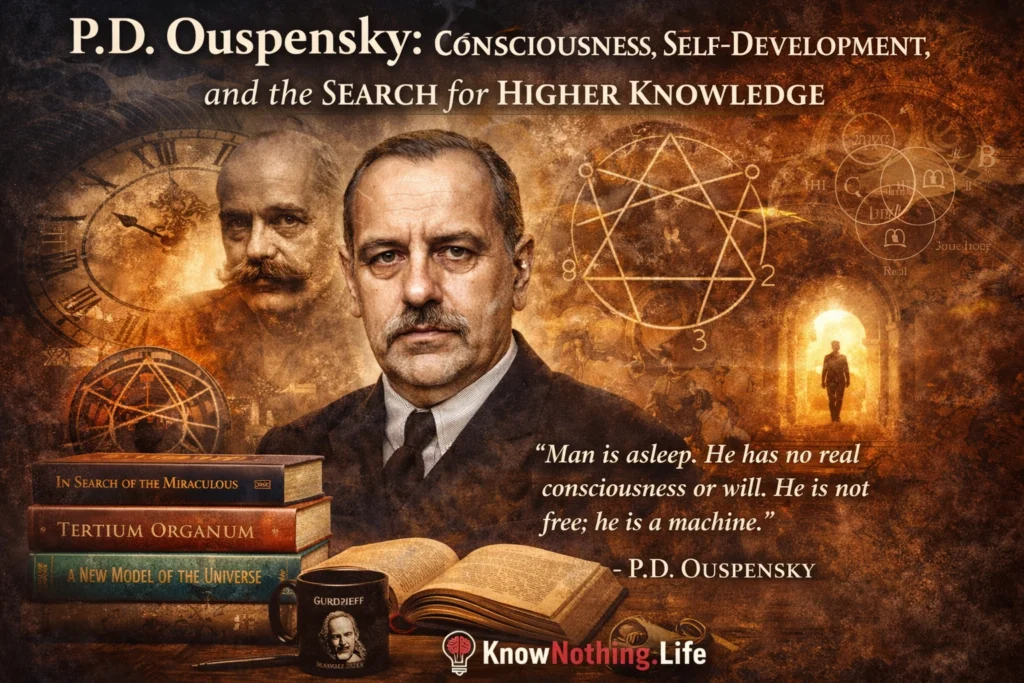
Ouspensky’s most influential work, Tertium Organum, presents a bold reinterpretation of reality, drawing on both science and mysticism. In this book, he explores the possibility of higher dimensions and argues that human perception is limited by the structure of consciousness itself. He famously wrote, “A man can only attain knowledge with the help of those who possess it,” emphasizing the importance of guidance in the pursuit of higher understanding.
Another cornerstone of his legacy is In Search of the Miraculous, a detailed account of Gurdjieff’s teachings as understood and recorded by Ouspensky. This work remains one of the most comprehensive introductions to the Fourth Way, offering insights into concepts such as self-remembering, the multiplicity of the self, and the illusion of unity. It has become a foundational text for students of esoteric philosophy and spiritual psychology.
Ouspensky’s philosophy also addresses the nature of time and recurrence. He was deeply influenced by the idea of eternal recurrence, proposing that human lives may repeat in cycles unless conscious effort is made to break free from mechanical patterns. This concept underscores his broader message: without awareness, individuals remain trapped in repetitive, unconscious behaviors.
Consciousness and the Mechanical Nature of Man
A central theme in Ouspensky’s thought is the idea that human beings are largely mechanical. He argued that thoughts, emotions, and actions are not truly under conscious control but are instead driven by automatic processes. This perspective challenges the common assumption of free will, suggesting that genuine freedom can only be achieved through the development of consciousness.
Ouspensky introduced the concept of “self-remembering,” a practice aimed at cultivating awareness of oneself in the present moment. This involves observing one’s thoughts, feelings, and actions without identification, creating a separation between the observer and the observed. Through this practice, individuals can begin to recognize the fragmented nature of their inner world and work toward greater unity.
He also emphasized the importance of effort and discipline in this process. Unlike passive forms of spirituality, Ouspensky’s approach requires active engagement and sustained attention. As he noted, “Man is asleep. He has no real consciousness or will. He is not free; he is a machine.” This stark assessment serves as both a critique and a call to action, urging individuals to awaken from their habitual patterns.
Influence and Legacy
P.D. Ouspensky’s influence extends across philosophy, psychology, and spiritual practice. His writings have inspired countless individuals seeking a deeper understanding of consciousness and self-development. By bridging Eastern and Western traditions, he contributed to a broader movement that sought to integrate spirituality with modern intellectual inquiry.
Despite his significant contributions, Ouspensky remains a somewhat controversial figure. Critics have questioned the empirical basis of his ideas, while others have debated his relationship with Gurdjieff and the interpretation of the Fourth Way. Nevertheless, his work continues to resonate with those who find value in its emphasis on self-awareness and inner transformation.
In the broader landscape of modern thought, Ouspensky occupies a unique position. He is neither a conventional philosopher nor a purely mystical teacher, but something in between—a guide for those navigating the complexities of consciousness. His legacy endures not only in his writings but in the ongoing practice of those who seek to apply his ideas in their own lives.
Conclusion
P.D. Ouspensky’s life and work represent a profound exploration of what it means to be conscious. Through his writings and teachings, he challenged deeply held assumptions about the nature of reality, the self, and human potential. His emphasis on self-observation, discipline, and inner development offers a path for those willing to question their own perceptions and habits.
In a world increasingly defined by distraction and automation, Ouspensky’s message remains strikingly relevant. His insistence that true understanding requires effort and awareness serves as a reminder that knowledge is not merely acquired but cultivated. By confronting the mechanical aspects of existence, individuals can begin the journey toward greater consciousness and freedom.
P.D. OUSPENSKY BOOKS
The Fourth Dimension (1909)
Tertium Organum: The Third Canon of Thought (1912)
The Symbolism of the Tarot (1913)
Talks with a Devil (1916)
Letters from Russia (1919)
The Psychology of Man’s Possible Evolution (1945)
Strange Life of Ivan Osokin (1947)
In Search of the Miraculous: Fragments of an Unknown Teaching (1949)
The Fourth Way: A Record of Talks and Answers to Questions Based on the Teaching of G. I. Gurdjieff (1957)