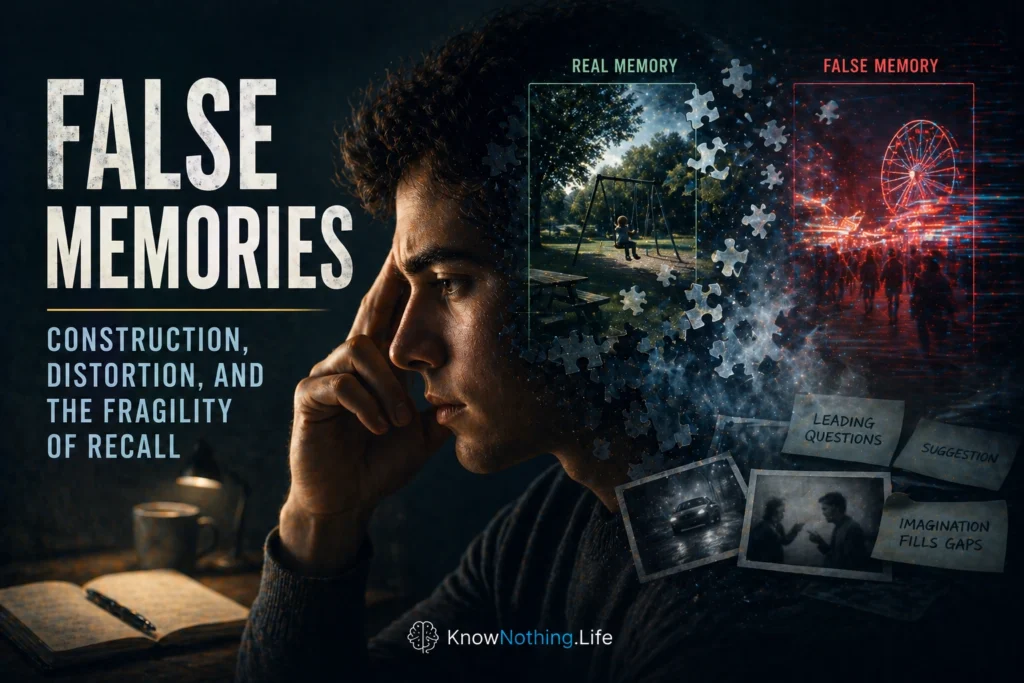
False memories are recollections of events or details that did not occur or that differ significantly from what actually happened. Far from being rare anomalies, they are a natural byproduct of how memory operates. Human memory is not a literal recording device but a reconstructive system that pieces together fragments of experience, guided by knowledge, expectations, and context. This reconstructive nature allows memory to be flexible and adaptive, but it also introduces the possibility of distortion and error.
At a deeper level, false memories reveal that remembering is an act of interpretation rather than simple retrieval. When individuals recall an event, they actively rebuild it using available cues and schemas—mental frameworks that organize knowledge. These reconstructions can incorporate accurate details alongside inferred or imagined elements, creating memories that feel vivid and convincing despite being partially or wholly incorrect. Understanding false memories therefore provides insight into the fundamental mechanisms of cognition, highlighting both the strengths and vulnerabilities of the human mind.
Historical Foundations and Early Research
The scientific study of false memories has roots in early research on memory distortion. One of the most influential figures in this area was Frederic Bartlett, who demonstrated that memory is shaped by cultural and cognitive schemas. In his classic experiments, participants recalled stories in ways that conformed to their own expectations and experiences, often altering details to make them more familiar or coherent. Bartlett’s work challenged the idea of memory as a faithful reproduction of events and introduced the concept of reconstruction.
Later research expanded on these ideas, particularly through the work of Elizabeth Loftus, who showed how easily memories can be influenced by suggestion. Her experiments revealed that subtle changes in wording or the introduction of misleading information could alter participants’ recollections of events. For example, asking how fast cars were going when they “smashed” rather than “hit” could lead to higher speed estimates and even false reports of broken glass.
These findings had profound implications, particularly in legal contexts where eyewitness testimony is often considered reliable. They demonstrated that memory is not immune to external influence and that confidence in a memory does not guarantee its accuracy. The historical development of false memory research underscores the importance of understanding how memory can be shaped and distorted.
Mechanisms of False Memory Formation
False memories arise from the same processes that support accurate memory, including encoding, storage, and retrieval. During encoding, information is selected and interpreted, often influenced by attention and prior knowledge. If encoding is incomplete or biased, the resulting memory trace may lack detail or contain inaccuracies. These gaps can later be filled in with inferred or imagined information, contributing to false memories.
Storage processes also play a role, as memories are not static but subject to change over time. As new information is acquired, it can interact with existing memories, altering their content. This process, sometimes referred to as memory updating, allows for the integration of new knowledge but can also introduce distortions. Over time, the distinction between original and added information may become blurred, making it difficult to determine what actually occurred.
Retrieval is perhaps the most critical stage in the formation of false memories. Each act of recall involves reconstructing the memory, often influenced by current beliefs, expectations, and context. This reconstruction can incorporate new elements, especially when cues are ambiguous or suggestive. Repeated retrieval can strengthen these altered memories, making them more resistant to correction. These mechanisms illustrate how false memories emerge naturally from the functioning of the memory system.
The Role of Schemas and Prior Knowledge
Schemas play a central role in shaping memory and contributing to false recollections. These mental frameworks help organize information and guide interpretation, allowing individuals to make sense of complex or incomplete input. While schemas enhance efficiency and understanding, they can also lead to systematic distortions by filling in gaps with expected or typical details.
For example, when recalling a familiar event, such as dining at a restaurant, individuals may remember details that were not present but are consistent with their schema of such experiences. This process, known as schema-driven reconstruction, reflects the brain’s tendency to prioritize coherence over accuracy. It allows for efficient processing but can result in the blending of actual and inferred information.
The influence of schemas extends beyond individual experiences to cultural and social contexts. Shared knowledge and expectations can shape how events are remembered, leading to common patterns of distortion within groups. Understanding the role of schemas highlights the interplay between memory and knowledge, revealing how past experience influences present recall.
Suggestibility and the Misinformation Effect
Suggestibility refers to the extent to which individuals’ memories can be influenced by external information. One of the most well-documented phenomena in this area is the misinformation effect, where exposure to misleading information after an event alters the memory of that event. This effect demonstrates how easily memory can be modified, even by subtle cues.
The misinformation effect often occurs when individuals are presented with leading questions or inaccurate descriptions of an event. These suggestions can become integrated into the memory, replacing or supplementing the original information. Over time, individuals may come to believe that the suggested details are part of their actual experience, illustrating the power of suggestion in shaping memory.
Factors such as stress, time delay, and confidence can influence susceptibility to suggestion. For example, longer delays between the event and recall increase the likelihood of incorporating misinformation, as the original memory becomes less distinct. Understanding suggestibility is crucial for evaluating the reliability of memory in contexts such as legal testimony and therapeutic settings.
False Memories in Everyday Life
False memories are not limited to laboratory settings; they occur frequently in everyday life. People may misremember conversations, misattribute sources of information, or recall events differently from others who experienced the same situation. These discrepancies highlight the subjective nature of memory and its susceptibility to distortion.
In social contexts, false memories can influence relationships and communication. Disagreements about past events often arise from differences in recollection, rather than intentional deception. These differences can be shaped by individual perspectives, emotional states, and subsequent experiences, illustrating the complexity of shared memory.
Despite their potential for error, false memories can serve adaptive functions. By integrating information and maintaining coherence, the memory system supports efficient decision-making and problem-solving. This adaptability suggests that memory is optimized not for perfect accuracy but for usefulness, balancing precision with flexibility.
Neural Basis of False Memories
The neural mechanisms underlying false memories involve many of the same brain regions associated with accurate memory. The hippocampus plays a key role in encoding and retrieving episodic memories, while the prefrontal cortex is involved in monitoring and evaluating information. These regions work together to reconstruct past experiences, but their interaction can also lead to errors.
Neuroimaging studies have shown that false memories can activate similar neural patterns as true memories, particularly when they are vivid and detailed. This overlap makes it difficult for the brain to distinguish between real and imagined events. However, differences in activation patterns, particularly in regions associated with sensory detail, can sometimes be used to identify false memories.
The involvement of multiple brain systems highlights the complexity of memory processes. False memories are not the result of a single malfunction but emerge from the normal functioning of the memory system. Understanding their neural basis provides insight into how the brain constructs and reconstructs experience.
Implications for Law, Therapy, and Society
The study of false memories has significant implications for various domains, particularly in legal and clinical contexts. In the legal system, eyewitness testimony is often a critical form of evidence, yet research on false memories has shown that such testimony can be unreliable. Factors such as suggestive questioning, stress, and time delays can influence recall, raising concerns about the accuracy of witness accounts.
In therapeutic settings, the potential for false memories has sparked debate about the use of techniques that may inadvertently suggest or reinforce inaccurate recollections. While exploring past experiences can be beneficial, it is important to consider the reconstructive nature of memory and the possibility of distortion. Ethical practices require careful attention to how memories are elicited and interpreted.
At a broader societal level, false memories can influence collective understanding of events, particularly in contexts such as media and public discourse. Misremembered or misrepresented information can shape beliefs and decisions, highlighting the importance of critical thinking and verification. The implications of false memory research extend beyond individual cognition to social and cultural processes.
Future Directions and the Science of Memory Accuracy
Research on false memories continues to evolve, integrating insights from cognitive psychology, neuroscience, and social science. Advances in brain imaging and experimental methods are providing new tools for studying how memories are formed, altered, and retrieved. These approaches are helping to identify factors that influence memory accuracy and to develop strategies for reducing errors.
Emerging research is also exploring individual differences in susceptibility to false memories, as well as the role of emotion and stress in shaping recall. Understanding these factors may lead to more effective interventions and improved practices in contexts where memory accuracy is critical. Additionally, the study of false memories is contributing to broader theories of cognition, highlighting the interplay between memory, perception, and knowledge.
As our understanding deepens, false memories continue to illuminate the nature of human memory. They reveal that memory is not a perfect record of the past but a dynamic and constructive process. By examining how and why memories can be distorted, cognitive psychology provides a more nuanced understanding of how we remember, interpret, and make sense of our experiences.