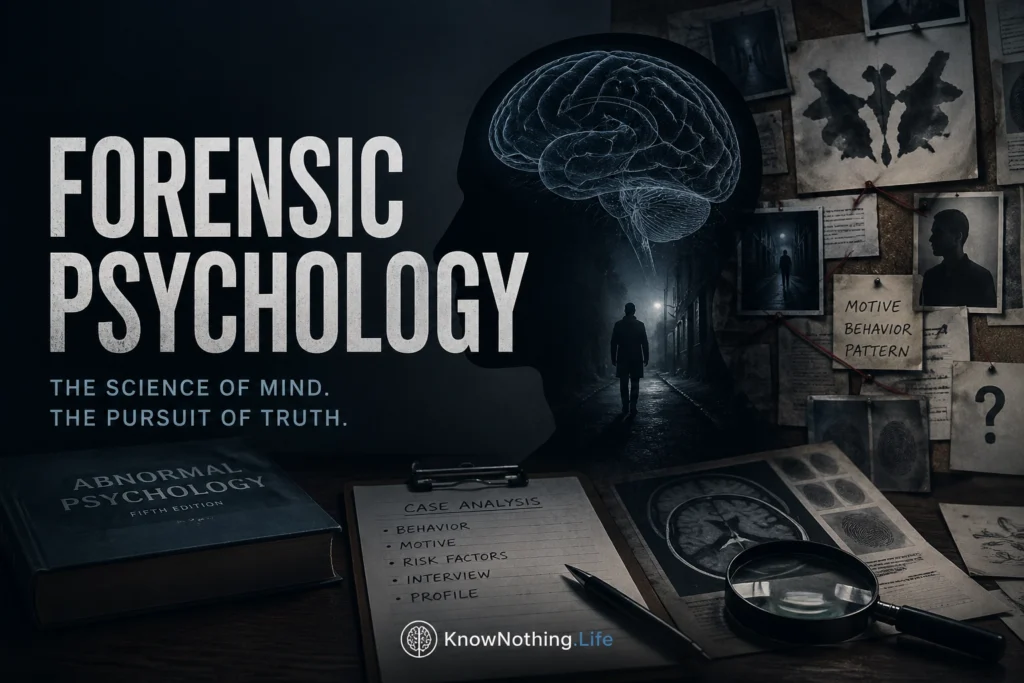
Forensic psychology is the application of psychological principles and methods to legal and criminal justice systems. It sits at the intersection of psychology and law, addressing issues such as criminal behavior, competency, eyewitness testimony, sentencing, and rehabilitation. Forensic psychologists work in courts, correctional facilities, law enforcement agencies, and research institutions, contributing expert knowledge that informs legal decisions and public policy. The field reflects an effort to bring scientific understanding to questions of responsibility, risk, and justice.
The roots of forensic psychology can be traced to early efforts to understand criminal behavior and assess credibility in legal contexts. As psychologist Hugo Münsterberg argued in On the Witness Stand, “The lawyer and the judge must learn to understand the workings of the human mind,” emphasizing the need for psychological insight in legal proceedings. This foundational idea continues to shape forensic psychology, which seeks to bridge the gap between scientific evidence and legal judgment.
Historical Development of Forensic Psychology
The development of forensic psychology has been closely linked to advances in both psychology and the legal system. In the late 19th and early 20th centuries, researchers began to study memory, perception, and suggestibility, recognizing their relevance to eyewitness testimony. Early experiments demonstrated that human memory is fallible and subject to distortion, challenging assumptions about the reliability of witness accounts.
One of the pioneers in this area was Alfred Binet, who conducted studies on children’s testimony and the influence of suggestion. Binet concluded that “the accuracy of testimony depends on the conditions under which it is obtained,” highlighting the importance of context. Over time, forensic psychology expanded to include the assessment of criminal responsibility, risk evaluation, and the psychological treatment of offenders. These developments reflect the growing recognition of psychology’s role in understanding and improving the justice system.
Criminal Behavior and Psychological Theories
Understanding criminal behavior is a central focus of forensic psychology, drawing on a range of theoretical perspectives. Biological theories examine genetic and neurological factors that may contribute to antisocial behavior, while psychological theories focus on personality, cognition, and learning processes. Social theories emphasize the influence of environment, culture, and social structure.
The work of Hans Eysenck proposed that personality traits such as extraversion and neuroticism are linked to criminal tendencies, suggesting that individuals with certain traits may be more prone to antisocial behavior. Meanwhile, social learning theory, developed by Albert Bandura, highlights the role of observation and reinforcement in shaping behavior. Bandura argued that “people learn not only from their own experiences but also by observing others,” which can explain how criminal behaviors are acquired and maintained. These perspectives illustrate the multifaceted nature of criminal behavior.
Assessment and Evaluation in Legal Contexts
Forensic psychologists play a crucial role in assessing individuals involved in legal proceedings. These assessments may include evaluations of competency to stand trial, criminal responsibility, risk of reoffending, and psychological harm. The goal is to provide objective, evidence-based information that can assist courts in making informed decisions.
Assessment methods often involve clinical interviews, psychological testing, and behavioral observation. Tools such as risk assessment instruments are used to estimate the likelihood of future offending, although these tools are not without limitations. Psychologist Paul E. Meehl emphasized the importance of statistical methods in prediction, noting that “clinical judgment alone is often less reliable than actuarial methods.” This insight has influenced the development of structured assessment approaches that combine clinical expertise with empirical data.
Eyewitness Testimony and Memory
Eyewitness testimony is a critical component of many legal cases, yet research has shown that memory is not a perfect record of events. Instead, it is reconstructive, influenced by factors such as stress, suggestion, and prior knowledge. Understanding the limitations of memory is essential for evaluating the reliability of witness accounts.
Research by Elizabeth Loftus has been particularly influential in this area. Loftus demonstrated that “memory is malleable and can be influenced by misleading information,” challenging the assumption that eyewitness testimony is inherently reliable. Her work has had significant implications for legal procedures, leading to changes in how lineups and interrogations are conducted. These findings highlight the importance of applying psychological research to improve the accuracy and fairness of the justice system.
Criminal Profiling and Investigative Psychology
Criminal profiling involves analyzing patterns of behavior to infer characteristics of offenders. While often associated with popular media, profiling is grounded in psychological principles and empirical research. It seeks to understand the motivations, personality traits, and behavioral patterns that underlie criminal activity.
Investigative psychology, developed by David Canter, provides a more systematic approach to profiling. Canter emphasized that “offenders reveal themselves through their actions,” suggesting that crime scenes can provide valuable information about the perpetrator. By analyzing patterns across cases, forensic psychologists can assist law enforcement in narrowing down suspects and understanding criminal behavior. However, profiling is not a precise science and must be used in conjunction with other investigative methods.
Psychology of Interrogation and Confessions
Interrogation techniques and the psychology of confessions are important areas of forensic psychology, particularly in understanding how individuals respond to questioning. While confessions can be powerful evidence, research has shown that false confessions can occur under certain conditions, such as coercion, stress, or suggestibility.
Psychologist Saul Kassin has extensively studied false confessions, noting that “innocent people sometimes confess to crimes they did not commit.” Factors such as lengthy interrogations, leading questions, and psychological pressure can increase the likelihood of false admissions. These findings have led to reforms in interrogation practices, emphasizing the need for safeguards to protect against wrongful convictions. Understanding the psychology of confession is essential for ensuring justice and accuracy in legal proceedings.
Mental Health and the Legal System
The relationship between mental health and the legal system is a key focus of forensic psychology. Issues such as competency to stand trial, the insanity defense, and the treatment of mentally ill offenders require careful consideration of psychological and legal principles. Forensic psychologists assess whether individuals understand the nature of legal proceedings and can participate in their defense.
The concept of criminal responsibility is particularly complex, as it involves determining whether an individual had the capacity to understand and control their actions at the time of an offense. As psychiatrist Karl Menninger argued, “Crime is a symptom of a deeper disorder,” highlighting the need to consider underlying psychological factors. This perspective has influenced approaches to rehabilitation and treatment, emphasizing the importance of addressing mental health issues within the justice system.
Ethics and Professional Practice
Forensic psychology involves significant ethical responsibilities, as practitioners must balance the needs of the legal system with the rights and well-being of individuals. Ethical issues include confidentiality, informed consent, and the potential for bias. Forensic psychologists must maintain objectivity and adhere to professional standards, even when working in adversarial contexts.
The American Psychological Association provides guidelines for forensic practice, emphasizing the importance of competence, integrity, and impartiality. As psychologist Alan Goldstein has noted, “The forensic psychologist’s primary obligation is to the truth,” underscoring the importance of scientific rigor and ethical responsibility. Navigating these challenges requires careful judgment and adherence to established principles.
Future Directions in Forensic Psychology
The field of forensic psychology continues to evolve, driven by advances in technology, neuroscience, and data analysis. New tools, such as brain imaging and digital forensics, are providing additional insights into behavior and decision-making. At the same time, there is growing emphasis on evidence-based practices and the integration of research into legal decision-making.
Issues such as wrongful convictions, racial bias, and the treatment of offenders are receiving increased attention, highlighting the need for continued reform and innovation. Forensic psychology is also expanding its role in areas such as terrorism, cybercrime, and victim support. As the legal system becomes more complex, the contributions of forensic psychology will remain essential in promoting justice and understanding human behavior.
Conclusion
Forensic psychology plays a vital role in bridging the gap between psychology and the legal system, providing insights that inform legal decisions and improve justice. By applying scientific methods to issues such as criminal behavior, memory, and assessment, the field contributes to a more accurate and fair legal process.
At its core, forensic psychology reflects the recognition that legal issues are deeply intertwined with human behavior. By understanding the psychological factors that influence actions and decisions, forensic psychologists help ensure that the pursuit of justice is grounded in evidence and informed by a deeper understanding of the human mind.