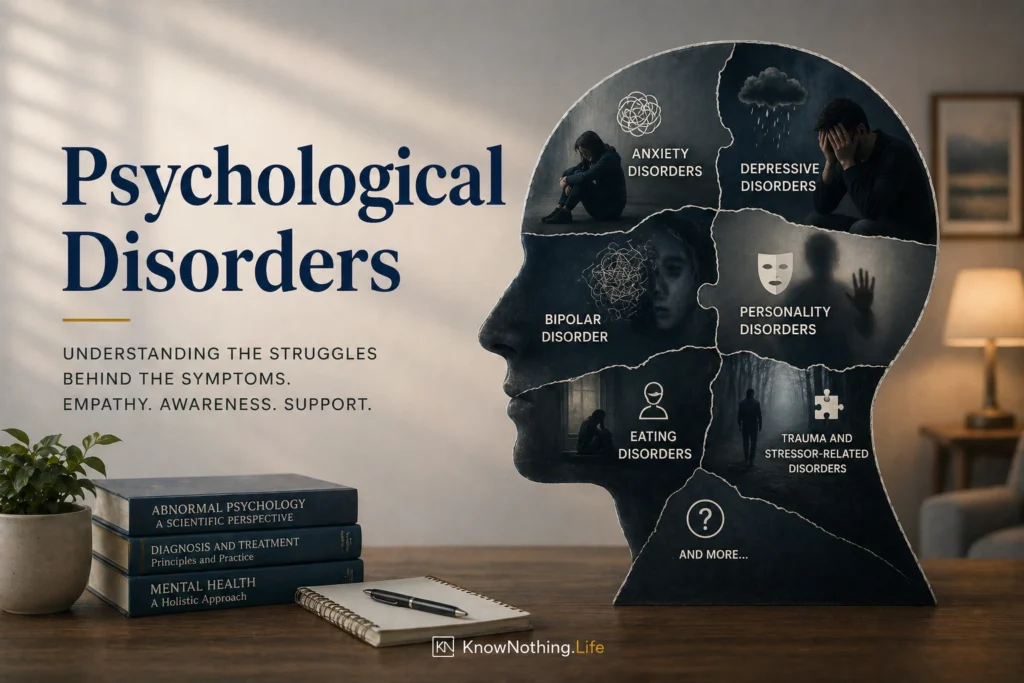
Psychological disorders—often referred to as mental disorders or psychopathology—are patterns of thought, emotion, and behavior that are maladaptive, distressing, and impair an individual’s ability to function effectively. While experiences such as sadness, anxiety, or unusual perceptions are part of normal human life, psychological disorders represent conditions in which these experiences become persistent, extreme, or disruptive. The challenge of defining disorder lies in distinguishing between normal variation and clinically significant dysfunction, a task that has occupied psychologists, psychiatrists, and philosophers for decades.
Modern frameworks emphasize multiple criteria for identifying psychological disorders, including deviance from social norms, personal distress, dysfunction in daily life, and potential danger to self or others. However, these criteria are not absolute, and cultural context plays a significant role in determining what is considered abnormal. As Thomas Szasz argued in The Myth of Mental Illness, the concept of mental disorder can reflect social judgments as much as medical realities. While his critique remains controversial, it highlights the complexity of defining and classifying psychological disorders in a way that is both scientifically valid and socially sensitive.
Classification and Diagnostic Systems
The classification of psychological disorders has been formalized through diagnostic systems designed to provide consistency and clarity. The most widely used system is the Diagnostic and Statistical Manual of Mental Disorders (DSM), published by the American Psychiatric Association. The DSM categorizes disorders based on clusters of symptoms, offering standardized criteria for diagnosis and facilitating communication among clinicians and researchers.
Despite its utility, the DSM has been subject to criticism for its categorical approach, which may oversimplify complex conditions. Critics argue that many disorders exist on a continuum rather than as discrete categories, and that individuals often exhibit symptoms that span multiple diagnoses. Allen Frances, who chaired the DSM-IV task force, cautioned in Saving Normal that overdiagnosis can pathologize normal variations in behavior, raising concerns about the boundaries of mental illness.
Alternative approaches, such as dimensional models, seek to address these limitations by focusing on degrees of symptom severity rather than categorical labels. These models aim to capture the complexity of psychological disorders more accurately, reflecting the variability and overlap observed in clinical practice. The ongoing evolution of diagnostic systems reflects the dynamic nature of the field, as researchers strive to balance reliability with validity.
Major Categories of Psychological Disorders
Psychological disorders encompass a wide range of conditions, each with distinct features and challenges. Anxiety disorders, for example, are characterized by excessive fear and worry, often accompanied by physical symptoms such as increased heart rate and tension. Disorders such as generalized anxiety disorder, panic disorder, and phobias illustrate the diverse ways in which anxiety can manifest.
Mood disorders, including major depressive disorder and bipolar disorder, involve disturbances in emotional state. Depression is marked by persistent sadness, loss of interest, and feelings of hopelessness, while bipolar disorder involves alternating periods of depression and mania. Aaron Beck, in Depression: Causes and Treatment, emphasized the role of negative thought patterns in maintaining depressive symptoms, highlighting the interplay between cognition and emotion.
Other categories include psychotic disorders, such as schizophrenia, which involve disruptions in perception and reality testing; personality disorders, characterized by enduring maladaptive patterns; and neurodevelopmental disorders, which typically emerge early in life. Each category reflects a different aspect of psychological functioning, illustrating the diversity and complexity of mental health conditions.
Causes and Risk Factors
The causes of psychological disorders are multifactorial, involving an interplay of biological, psychological, and social factors. Biological influences include genetic predispositions, neurochemical imbalances, and structural differences in the brain. Research has identified heritable components for many disorders, suggesting that vulnerability may be partly inherited.
Psychological factors, such as cognitive patterns and coping strategies, also play a crucial role. Martin Seligman, in his work on learned helplessness, demonstrated how repeated exposure to uncontrollable events can lead to a sense of powerlessness, contributing to depression. This research highlights the importance of perception and interpretation in shaping emotional responses.
Social and environmental factors further contribute to the development of disorders. Stressful life events, trauma, socioeconomic conditions, and cultural influences all affect mental health. George L. Engel proposed the biopsychosocial model in The Need for a New Medical Model, emphasizing the integration of these factors. This holistic approach remains central to contemporary understanding, recognizing that no single cause can fully explain psychological disorders.
Treatment and Intervention
The treatment of psychological disorders involves a range of approaches tailored to individual needs. Psychotherapy is a primary method, with cognitive-behavioral therapy (CBT) among the most widely used. CBT focuses on identifying and changing maladaptive thoughts and behaviors, offering practical strategies for managing symptoms. Other therapeutic approaches include psychodynamic therapy, which explores unconscious processes, and humanistic therapy, which emphasizes personal growth and self-understanding.
Pharmacological treatments also play a significant role, particularly for disorders with strong biological components. Medications such as antidepressants, antipsychotics, and mood stabilizers can help regulate neurochemical imbalances, reducing symptoms and improving functioning. However, medication is often most effective when combined with psychotherapy, reflecting the multifaceted nature of mental health.
Preventive interventions and public health initiatives are increasingly recognized as important components of mental health care. Early identification and intervention can reduce the severity and duration of disorders, while community-based programs aim to promote resilience and well-being. These efforts highlight the importance of addressing mental health at both individual and societal levels.
Stigma and Cultural Considerations
Stigma remains one of the most significant barriers to understanding and treating psychological disorders. Negative attitudes and misconceptions can lead to discrimination, social isolation, and reluctance to seek help. Efforts to reduce stigma focus on education, awareness, and the normalization of mental health discussions, aiming to create more supportive environments.
Cultural factors also influence the expression and interpretation of psychological disorders. Symptoms may be experienced and described differently across cultures, affecting diagnosis and treatment. For example, some cultures emphasize physical symptoms of distress, while others focus on emotional or cognitive aspects. Understanding these differences is essential for culturally competent care.
The intersection of stigma and culture underscores the importance of context in mental health. Psychological disorders cannot be fully understood without considering the social and cultural environments in which they occur. This perspective encourages a more inclusive and nuanced approach to mental health, recognizing the diversity of human experience.
Conclusion
Psychological disorders represent a complex and multifaceted aspect of human experience, reflecting the interplay of biological, psychological, and social factors. From classification systems and diagnostic challenges to treatment and cultural considerations, the study of psychopathology offers insights into both the vulnerabilities and resilience of the human mind.
While significant progress has been made in understanding and treating psychological disorders, challenges remain, particularly in addressing stigma and improving access to care. By integrating diverse perspectives and advancing research, psychology continues to refine its approach to mental health, striving to provide more effective and compassionate support. Ultimately, the study of psychological disorders not only deepens our understanding of mental illness but also illuminates the broader complexities of human behavior and well-being.