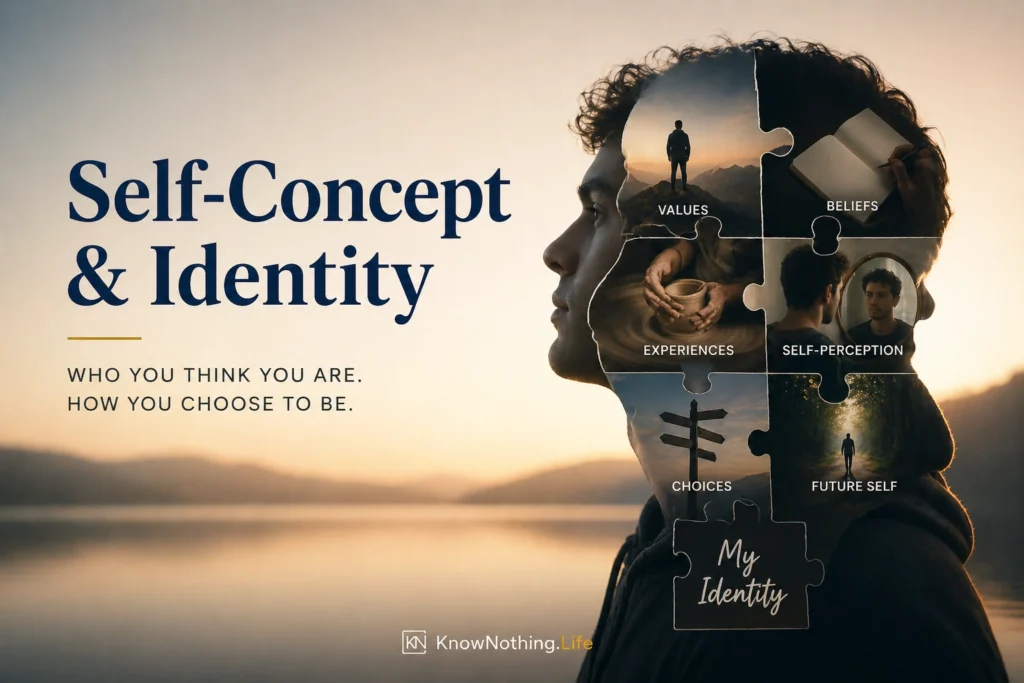
Self-concept and identity are central constructs in psychology, shaping how individuals understand themselves and their place in the world. The self-concept refers to the organized set of beliefs and perceptions that individuals hold about themselves, while identity encompasses the broader sense of who one is across time, including roles, values, and social affiliations. Together, these constructs form the foundation of personal experience, influencing behavior, relationships, and psychological well-being.
The study of self-concept and identity bridges multiple domains, including developmental psychology, social psychology, and philosophy. It raises enduring questions about continuity and change, individuality and social influence, and the extent to which the self is discovered or constructed. As William James observed in The Principles of Psychology, the self includes both the “I,” the subjective knower, and the “Me,” the known aspects of oneself. This distinction highlights the dual nature of the self as both an experiencing subject and an object of reflection, a theme that continues to shape contemporary research.
The Structure of the Self-Concept
The self-concept is not a single, unified entity but a complex and multifaceted system composed of various components. These include the actual self (how individuals perceive themselves), the ideal self (how they wish to be), and the ought self (how they believe they should be). Discrepancies among these components can lead to emotional discomfort, as individuals strive to reconcile differences between their current state and their aspirations or obligations.
Carl Rogers emphasized the importance of congruence between the self-concept and experience in promoting psychological well-being. In On Becoming a Person, Rogers argued that when individuals experience inconsistency between their self-perceptions and reality, they may distort or deny experiences to maintain a coherent sense of self. He famously wrote, “The curious paradox is that when I accept myself just as I am, then I can change,” underscoring the role of acceptance in personal growth.
The self-concept is also shaped by feedback from others, particularly through processes of social comparison and reflection. Charles Horton Cooley introduced the concept of the “looking-glass self,” suggesting that individuals form their self-concepts based on how they believe others perceive them. This perspective highlights the social nature of the self, emphasizing that identity is not formed in isolation but through interaction with others.
Identity Development Across the Lifespan
Identity development is a dynamic process that unfolds across the lifespan, influenced by both internal exploration and external expectations. One of the most influential frameworks in this area was developed by Erik Erikson, who proposed that individuals pass through a series of psychosocial stages, each characterized by a central conflict. During adolescence, the key challenge is identity versus role confusion, where individuals explore different roles and values to establish a coherent sense of self.
Building on Erikson’s work, James Marcia introduced the concept of identity statuses, categorizing individuals based on their levels of exploration and commitment. In Development and Validation of Ego-Identity Status, Marcia identified four statuses: identity diffusion, foreclosure, moratorium, and identity achievement. These categories provide a nuanced understanding of how individuals navigate the process of identity formation, recognizing that development is not linear but involves periods of uncertainty and change.
Identity development continues beyond adolescence, as individuals encounter new roles and experiences throughout adulthood. Career choices, relationships, and life transitions all contribute to the ongoing construction of identity. This perspective challenges the notion of a fixed self, suggesting instead that identity is continually negotiated and redefined over time.
Social Identity and Group Membership
While self-concept emphasizes individual perceptions, identity is also deeply rooted in social contexts. Social identity theory, developed by Henri Tajfel, highlights the role of group membership in shaping the self. According to this theory, individuals derive part of their identity from the groups to which they belong, such as nationality, ethnicity, or profession. These group affiliations provide a sense of belonging and contribute to self-esteem.
Social identity processes involve categorization, identification, and comparison. Individuals categorize themselves and others into groups, identify with certain groups, and compare their groups to others. These processes can lead to in-group favoritism and out-group bias, influencing attitudes and behavior. Tajfel’s work demonstrated that even minimal group distinctions can produce strong identification and discrimination, underscoring the power of social identity.
The interplay between personal and social identity is complex, as individuals navigate multiple roles and affiliations. In some contexts, personal identity may be more salient, while in others, group identity takes precedence. This dynamic interaction reflects the multifaceted nature of the self, which encompasses both individuality and social belonging.
Narrative Identity and Meaning
Beyond traits and roles, identity can also be understood as a narrative—a story that individuals construct about their lives. Dan P. McAdams, in The Stories We Live By, argued that people create internalized life stories that integrate past experiences with present understanding and future aspirations. These narratives provide a sense of coherence and meaning, helping individuals make sense of their lives.
Narrative identity emphasizes the interpretive nature of the self, highlighting how individuals select, organize, and interpret experiences. The same event can be incorporated into different narratives, leading to different understandings of the self. For example, a failure may be viewed as a defining setback or as a learning experience, depending on the narrative framework.
This perspective underscores the role of meaning-making in identity development. As individuals reflect on their experiences, they construct narratives that shape their sense of purpose and direction. These narratives are influenced by cultural and social contexts, as well as personal values, illustrating the interplay between individual agency and external influences.
Challenges and Changes in Identity
Identity is not always stable or coherent; it can be disrupted by life events, social pressures, or internal conflicts. Periods of transition, such as adolescence, career changes, or migration, often involve re-evaluating and reconstructing the self. These challenges can lead to growth but may also produce confusion or distress.
Contemporary society presents unique challenges for identity development, including increased exposure to diverse perspectives and the influence of digital environments. Social media, for example, allows individuals to curate and present aspects of their identity, raising questions about authenticity and self-presentation. These platforms can both support and complicate identity formation, providing opportunities for exploration while also creating pressures for conformity.
Psychological research continues to explore how individuals navigate these challenges, emphasizing resilience and adaptability. Identity is increasingly viewed as a flexible and evolving construct, shaped by ongoing interactions between the individual and the environment. This perspective highlights the capacity for change, even in the face of uncertainty.
Conclusion
Self-concept and identity are central to understanding human behavior, providing a framework for exploring how individuals perceive themselves and relate to the world. From the structural components of the self to the dynamic processes of identity development, these constructs reveal the complexity of human experience. Theories from James, Rogers, Erikson, Tajfel, and McAdams offer diverse perspectives, each contributing to a richer understanding of the self.
Ultimately, the study of self-concept and identity underscores the interplay between stability and change, individuality and social influence, and experience and interpretation. It reveals that the self is not a fixed entity but a dynamic process, continually shaped by reflection, interaction, and meaning-making. In this ongoing process, individuals construct a sense of who they are, navigating the challenges and possibilities of human existence.