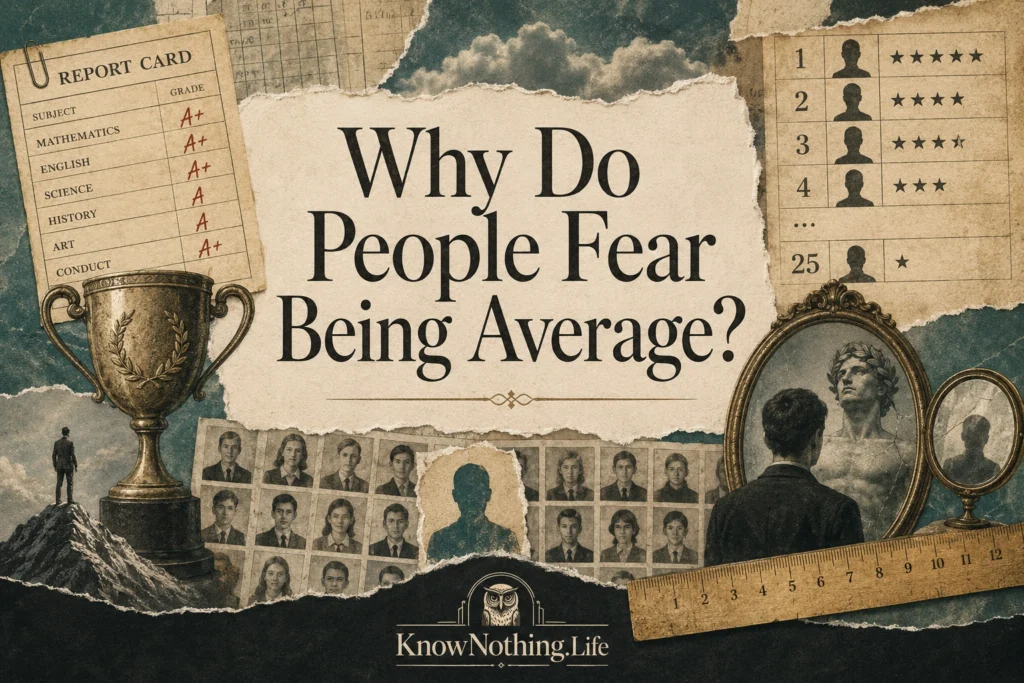
Being average should not be frightening. Statistically, most people will fall somewhere near the middle on most abilities, achievements, incomes, appearances, and measures of success. No one can occupy the top tier of every hierarchy, and even highly accomplished people are ordinary in countless areas of life. Yet the idea of being “average” can provoke a surprisingly strong emotional reaction. For some people, an ordinary career feels like failure. A normal income seems disappointing. A quiet life seems wasted. Being reasonably competent is not enough if someone else appears exceptional. The fear is not always that life will be bad; it is that life will be unremarkable.
Psychologically, this fear makes more sense when “average” stops functioning as a statistical description and becomes a judgment about personal worth. Human beings evaluate themselves partly through comparison with others, seek identities that distinguish them from the group, and often connect achievement with approval, status, competence, or self-esteem. Modern culture intensifies all of these tendencies by providing constant exposure to exceptional performers, curated success stories, rankings, follower counts, salaries, awards, and visible markers of achievement. The result can be a strange contradiction: a person may have a stable, meaningful, objectively good life while still wondering whether it is impressive enough to count.
Humans Naturally Compare Themselves With Other People
One foundation for understanding the fear of being average comes from psychologist Leon Festinger‘s influential 1954 paper “A Theory of Social Comparison Processes.” Festinger proposed that people have a fundamental drive to evaluate their abilities and opinions. When objective standards are unavailable, we often determine how well we are doing by comparing ourselves with other people. A salary seems high or low partly because of what comparable people earn. Academic performance gains meaning through grades and rankings. Athletic ability is judged against competitors. Even intelligence, attractiveness, popularity, and ambition are difficult to evaluate without an implicit social reference point.
Social comparison itself is neither unhealthy nor avoidable. It provides useful information and can motivate improvement. The problem begins when relative position becomes more important than absolute quality. Someone may be financially secure yet feel unsuccessful because friends earn more. A student can receive an excellent grade but feel disappointed because classmates did better. A runner can achieve a personal record and still feel inadequate after seeing someone else’s faster time. The mind quietly changes the question from “Am I doing well?” to “Am I doing better than other people?” Once that happens, being average no longer means being competent or normal. It means occupying the middle of a hierarchy—and for someone whose identity depends heavily on rank, the middle can feel like defeat.
Most People Already Expect Themselves to Be Above Average
The fear of averageness becomes even more interesting because people frequently do not think of themselves as average in the first place. Psychologists call this tendency the better-than-average effect: people often evaluate their abilities, personality traits, or desirable qualities more favorably than those of the typical peer. Ethan Zell, Jason Strickhouser, Constantine Sedikides, and Mark Alicke reviewed this literature in a large meta-analysis involving 291 independent samples and more than 950,000 participants. Their findings confirmed that the better-than-average effect is a widespread feature of comparative self-evaluation.
This does not mean everyone believes they are exceptional at everything. The effect varies according to context and the trait being judged. But it reveals something important about self-perception: people are often motivated to see themselves positively relative to others. Consequently, discovering that one is merely typical can conflict with an internal expectation of specialness. Someone who privately assumes they are unusually intelligent, creative, ambitious, attractive, or destined for success may experience ordinary outcomes as evidence that something has gone wrong. The discomfort comes not only from the outcome itself but from the gap between an imagined identity and the evidence provided by reality.
People Also Want to Feel Unique
Comparison is only part of the story. Human beings generally want to belong, but they also want to retain a sense of individuality. Psychologists C. R. Snyder and Howard Fromkin developed uniqueness theory to describe the motivation to perceive oneself as meaningfully different from other people. Their work suggested that excessive similarity can become psychologically uncomfortable and that people differ in how strongly they want to feel distinctive.
This creates a balancing act. Humans want enough similarity to experience belonging but enough difference to possess an identity. Being told that your abilities, preferences, appearance, lifestyle, or opinions are indistinguishable from everyone else’s can threaten that sense of individuality. The word “average” can therefore sting even when nothing negative is objectively being said. To describe someone as an average student, average employee, average artist, or average thinker often sounds less like a mathematical observation than a statement that there is nothing particularly distinctive about them.
The desire for uniqueness can be expressed constructively through creativity, unusual interests, personal values, or independent thought. But it can also become a relentless demand to be exceptional. If distinctiveness itself becomes necessary for self-respect, ordinary accomplishments lose their ability to satisfy. The person does not simply want to live well; they need their life to look meaningfully different from the lives around them.
Achievement Can Become the Foundation of Self-Worth
The fear of being average becomes especially intense when achievement is tied directly to self-esteem. University of Michigan psychologist Jennifer Crocker and colleagues have extensively studied contingencies of self-worth—the domains in which people psychologically stake their value. Crocker and Connie Wolfe argued that self-esteem rises and falls in response to success and failure in areas a person considers central to worth. These can include academic competence, competition, appearance, approval from others, virtue, family support, and other valued dimensions.
In one study involving 1,418 college students, Crocker and colleagues identified several common contingencies of self-worth and found that they predicted how students subsequently spent their time. Other work showed that graduate-school applicants whose self-worth was strongly tied to academic competence experienced larger shifts in self-esteem when they received admissions acceptances or rejections. Success was not merely good news, and rejection was not merely an unsuccessful application. The outcome carried information about the self.
This mechanism can transform averageness into an identity threat. If achievement is simply something you do, being average may be mildly disappointing. If achievement determines what you believe you are worth, being average becomes much more painful. The difference between finishing fifth and finishing first is no longer only a difference in performance. It can become the difference between feeling valuable and feeling inadequate.
Perfectionism Can Turn Ordinary Performance Into Failure
The fear of being average also overlaps with certain forms of perfectionism, but high standards and unhealthy perfectionistic concern are not the same thing. Wanting to become highly skilled can be adaptive. Researchers often distinguish perfectionistic strivings, which involve demanding goals, from perfectionistic concerns involving excessive fear of mistakes, criticism, shame, and failure.
Research by Joachim Stoeber and colleagues illustrates the distinction. In athletes, perfectionistic concern over mistakes and perceived external pressure were associated with stronger fears of shame and embarrassment after failure, while high personal standards alone showed a different pattern. Fear of shame was particularly important in connecting maladaptive perfectionistic concerns with negative emotional responses to failure.
For someone caught in this pattern, “average” means much more than “near the statistical middle.” It can mean not good enough. An ordinary result becomes embarrassing because performance is interpreted through an all-or-nothing standard: exceptional or disappointing, winning or losing, remarkable or irrelevant. This makes satisfaction difficult because even objectively strong performance can be recategorized as inadequate whenever somebody else performs better.
Social Media Makes Exceptional Lives Look Normal
Humans have always compared themselves with neighbors, coworkers, siblings, and rivals. Digital life radically expanded the comparison group. Someone can now compare their physique with professional fitness influencers, their income with entrepreneurs, their intelligence with celebrated academics, their relationships with carefully staged couples, and their career with the most successful people in their field—all within minutes.
Research by Erin Vogel and colleagues demonstrated how these environments can affect self-evaluation. Their studies found that more frequent Facebook use was associated with lower trait self-esteem through greater exposure to upward social comparison. Experimentally viewing profiles containing upward-comparison information also produced lower state self-esteem and less favorable relative self-evaluations than viewing downward-comparison profiles.
The distortion is easy to miss. Social media does not show a representative sample of human life. Exceptional experiences are more likely to become visible precisely because they are exceptional. Promotions get announced; ordinary workdays do not. Luxury vacations generate photos; uneventful weekends disappear. Dramatic transformations become content; routine maintenance rarely does. When millions of exceptional moments are aggregated onto one screen, exceptionalism begins to look normal. A perfectly good life can then seem deficient because it is being compared with an artificial concentration of highlights.
Status Can Become a Substitute for Meaning
Another reason people fear being average is that distinction promises social status. Humans are highly sensitive to reputation, competence, alliances, and rank. Modern status systems are more complex than those of small ancestral groups, but sensitivity to relative standing remains. Titles, wealth, education, occupational prestige, physical appearance, and public visibility can all suggest that someone occupies a desirable position.
The danger comes when status becomes the primary measure of whether life is going well. The goal is no longer simply enough money, meaningful work, satisfying relationships, or interesting experiences. The goal becomes having more than the comparison group. Because relative status is competitive, there is no universal endpoint. Moving upward merely introduces another group above you.
Self-determination theory, developed by psychologists Edward Deci and Richard Ryan, offers an alternative framework. Their work emphasizes autonomy, competence, and relatedness and distinguishes more intrinsic aspirations—such as growth, relationships, and community contribution—from extrinsic goals involving fame, wealth, and image. Research has repeatedly found that strongly prioritizing extrinsic aspirations relative to intrinsic goals is associated with poorer well-being. In longitudinal research led by Christopher Niemiec, attaining intrinsic aspirations predicted better psychological health, whereas attaining extrinsic aspirations did not provide the same benefit and was associated with some indicators of ill-being.
Exceptional Achievement Does Not Necessarily Solve the Fear
A person might assume the solution is simple: become exceptional. Sometimes achievement genuinely does provide satisfaction. Mastering a difficult skill, earning recognition, or accomplishing an ambitious goal can be deeply rewarding. The problem is that achievement cannot permanently eliminate a fear rooted in comparison because success often changes the reference group.
The strongest student enters a selective university and becomes surrounded by outstanding students. A successful entrepreneur enters circles containing wealthier entrepreneurs. A talented athlete moves into stronger competition. An accomplished writer compares themselves with bestselling authors. Being above average in one environment may simply grant entry into another environment in which one is ordinary again.
This is why external achievement and internal security are not interchangeable. If exceptional performance is being used to answer the deeper question “Am I enough?”, no accomplishment can permanently settle the matter. Every achievement eventually becomes part of the baseline, and the mind begins searching for the next distinction capable of restoring the feeling of specialness.
Wanting Excellence Is Not the Problem
None of this means people should abandon ambition or intentionally seek mediocrity. Excellence has produced extraordinary art, discoveries, businesses, athletic performances, technologies, and social improvements. The desire to improve can be psychologically healthy when achievement expresses curiosity, mastery, purpose, or deeply held values.
The crucial distinction is between wanting to become excellent and needing to be exceptional in order to respect yourself. Crocker’s work on contingent self-esteem helps explain why the latter can become costly. When self-worth depends on success, preserving self-esteem can begin to interfere with learning, relationships, autonomy, and adaptive self-regulation. Failure becomes threatening precisely when it is most useful as information.
A healthier ambition allows someone else to be better without making your own effort meaningless. It permits periods of average performance during learning. It recognizes that some worthwhile activities will never produce status. Most importantly, it separates the quality of an outcome from the worth of the person who produced it.
Why Being Average Feels So Frightening
People fear being average because “average” rarely feels like a neutral statistic once identity becomes involved. Social comparison encourages us to locate ourselves within hierarchies. The better-than-average effect makes favorable self-comparison psychologically familiar. The need for uniqueness creates a desire to feel distinct. Contingent self-worth turns achievement into evidence of personal value, while perfectionistic concerns can make anything short of exceptional performance feel like failure. Social media then places an endless stream of unusually successful people directly into the comparison environment.
But an important question remains: average according to what measure? A person can have an average income and extraordinary friendships, ordinary intelligence and exceptional kindness, an unremarkable career and a deeply meaningful family life. Human lives contain too many dimensions to fit coherently onto a single ranking.
Perhaps the deeper freedom comes from recognizing that a meaningful life does not have to win a competition against everyone else’s. There will always be someone richer, smarter, more attractive, more accomplished, or more talented. Statistical averageness is unavoidable. Personal insignificance is not. You can still strive for excellence without needing excellence to prove that your life deserves to matter.