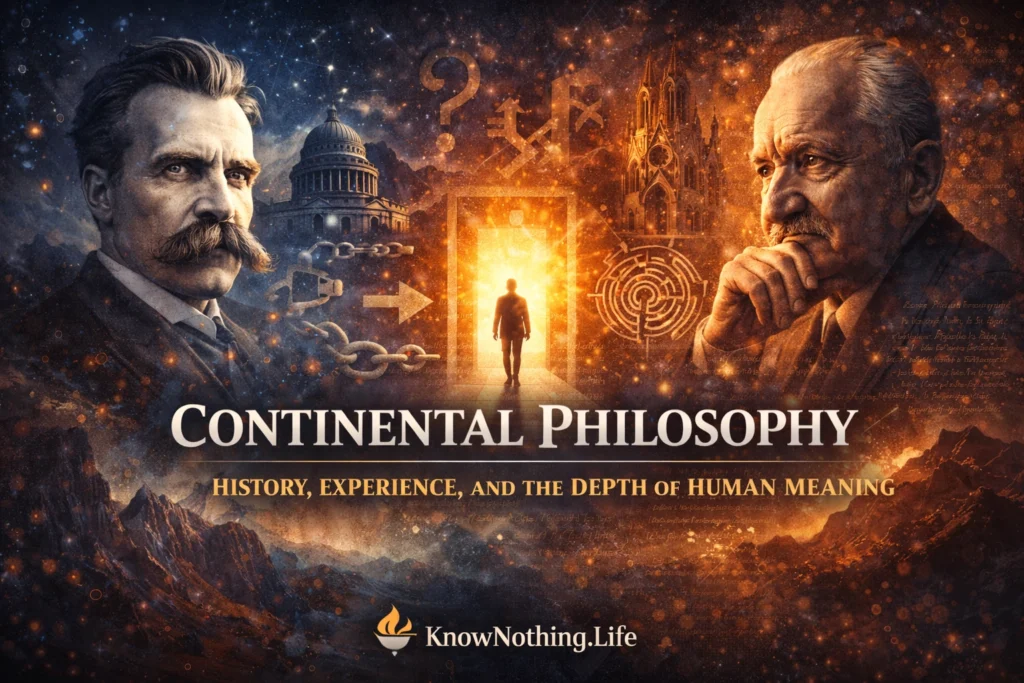
Continental philosophy is a broad and evolving tradition that emphasizes history, culture, lived experience, and the complexity of human existence. Unlike analytic philosophy, which often prioritizes logical clarity and linguistic precision, continental philosophy tends to explore meaning through interpretation, critique, and reflection on the human condition. It is less defined by a single method and more by a shared sensibility—one that embraces ambiguity, historical context, and the richness of subjective experience. Emerging primarily from mainland Europe, particularly Germany and France, this tradition has profoundly shaped modern thought in philosophy, literature, politics, and the social sciences.
At its core, continental philosophy seeks to understand what it means to be human within a world shaped by history, language, and power. It often challenges the assumption that knowledge can be fully objective or detached from the conditions in which it arises. Instead, thinkers in this tradition emphasize that human understanding is always situated—formed by culture, perspective, and historical circumstance. This orientation leads continental philosophy to engage deeply with questions of identity, freedom, existence, and meaning, often in ways that resist reduction to formal systems or rigid definitions.
Origins in German Idealism and Romanticism
The roots of continental philosophy can be traced to the tradition of German Idealism, particularly the work of Immanuel Kant, whose Critique of Pure Reason (1781) transformed philosophy by arguing that the mind actively shapes experience. Kant proposed that we do not simply perceive the world as it is in itself, but rather as it appears through the structures of human cognition. This insight shifted philosophical attention from external reality to the conditions of knowledge itself, laying the groundwork for later continental thinkers to explore subjectivity, perception, and the limits of reason.
Building on Kant’s work, Georg Wilhelm Friedrich Hegel developed a sweeping philosophical system centered on history, dialectics, and the unfolding of human consciousness. In works such as Phenomenology of Spirit, Hegel argued that reality is not static but dynamic, evolving through a process of contradictions and resolutions. He famously wrote, “The history of the world is none other than the progress of the consciousness of freedom,” capturing his belief that human freedom emerges through historical development. Hegel’s emphasis on historical process and the interconnectedness of ideas deeply influenced subsequent continental traditions.
Alongside idealism, Romanticism contributed to the development of continental philosophy by emphasizing emotion, individuality, and the creative power of the human spirit. Thinkers and writers in this movement resisted the Enlightenment’s focus on reason alone, arguing that human experience cannot be fully captured by rational analysis. This tension between reason and experience would become a defining feature of continental philosophy, shaping its engagement with art, literature, and the deeper dimensions of human life.
Phenomenology and the Study of Experience
One of the most important movements within continental philosophy is phenomenology, founded by Edmund Husserl. Husserl sought to establish philosophy as a rigorous science by examining the structures of consciousness and the ways in which objects are experienced. In works such as Logical Investigations and Ideas Pertaining to a Pure Phenomenology, he introduced the method of “epoché,” or bracketing, which involves setting aside assumptions about the external world to focus on how things appear in experience. His goal was to uncover the essential features of consciousness itself.
Husserl’s famous call, “To the things themselves,” reflects his commitment to returning philosophy to the direct examination of experience. Rather than relying on abstract theories, phenomenology emphasizes careful description of how phenomena present themselves to consciousness. This approach had a profound influence on subsequent thinkers, who expanded phenomenology into new areas, including embodiment, perception, and temporality.
Among Husserl’s most influential successors was Martin Heidegger, whose work transformed phenomenology into an inquiry into the nature of being. In Being and Time (1927), Heidegger argued that human existence, or “Dasein,” is fundamentally situated in a world of relationships, practices, and meanings. He rejected the idea of a detached subject observing an external reality, instead emphasizing that we are always already “being-in-the-world.” Heidegger’s famous statement, “Language is the house of Being,” underscores his belief that our understanding of existence is inseparable from the language we use to interpret it.
Existentialism and the Question of Freedom
Existentialism represents another central strand of continental philosophy, focusing on individual freedom, responsibility, and the search for meaning in a seemingly indifferent or absurd world. One of its most prominent figures, Jean-Paul Sartre, argued that human beings are “condemned to be free,” meaning that we are always responsible for our choices, even in the absence of predetermined values or meanings. In works such as Being and Nothingness, Sartre explored the tension between freedom and constraint, emphasizing the burden of self-creation.
Sartre’s assertion that “existence precedes essence” encapsulates the existentialist view that individuals are not defined by any fixed nature but must create themselves through their actions. This perspective places immense responsibility on the individual, as there is no external authority to dictate values or meaning. At the same time, it opens the possibility for authenticity and self-determination, as individuals are free to shape their own lives.
Another key figure in existentialism is Albert Camus, whose work explored the concept of the absurd—the conflict between the human desire for meaning and the apparent meaninglessness of the universe. In The Myth of Sisyphus, Camus famously wrote, “One must imagine Sisyphus happy,” suggesting that meaning can be found not in achieving ultimate goals but in the act of living and striving itself. Existentialism thus confronts some of the most profound questions of human existence, offering a vision of freedom that is both liberating and unsettling.
Structuralism, Post-Structuralism, and Critique
In the mid-twentieth century, continental philosophy underwent another transformation with the rise of structuralism and post-structuralism. Structuralist thinkers, such as Claude Lévi-Strauss, sought to uncover the underlying structures that shape human culture, language, and thought. Drawing on linguistics, particularly the work of Ferdinand de Saussure, they argued that meaning arises from systems of differences rather than from individual elements in isolation.
Post-structuralist philosophers challenged and expanded these ideas, emphasizing the instability of meaning and the role of power in shaping knowledge. Michel Foucault, for example, examined how institutions and discourses produce forms of knowledge that reinforce social control. In works such as Discipline and Punish, Foucault argued that power operates not only through coercion but through the normalization of behavior and the internalization of norms. His statement, “Where there is power, there is resistance,” highlights the dynamic and contested nature of social structures.
Similarly, Jacques Derrida developed the method of deconstruction, which seeks to reveal the hidden assumptions and contradictions within texts and concepts. Derrida famously declared, “There is nothing outside the text,” a provocative claim that underscores the idea that meaning is always mediated by language and interpretation. These approaches challenged the notion of fixed meanings and objective truths, opening new avenues for critical inquiry across disciplines.
Contemporary Continental Philosophy
Contemporary continental philosophy continues to evolve, drawing on its rich intellectual heritage while engaging with new challenges and perspectives. Thinkers such as Jürgen Habermas have sought to reconcile critical theory with democratic ideals, emphasizing the importance of communication and rational discourse in achieving social understanding. Habermas’s theory of communicative action highlights the potential for reason to play a constructive role in public life, even within a tradition often associated with skepticism toward universal truths.
At the same time, philosophers like Slavoj Žižek have combined continental traditions with insights from psychoanalysis, particularly the work of Jacques Lacan, to analyze ideology, culture, and politics. Žižek’s provocative style and interdisciplinary approach reflect the continued vitality and diversity of continental philosophy, which remains open to new influences and methods.
Continental philosophy has also had a significant impact beyond academic philosophy, shaping fields such as literary theory, cultural studies, and political theory. Its emphasis on interpretation, critique, and the complexity of human experience makes it particularly well-suited to addressing contemporary issues, from questions of identity and power to the ethical implications of technological change. While it is sometimes criticized for its perceived obscurity or lack of rigor, its ability to engage with the deepest dimensions of human life ensures its ongoing relevance.
Final Reflections on Continental Philosophy
Continental philosophy represents a tradition that is as expansive as it is profound, encompassing a wide range of approaches united by a concern with meaning, history, and the human condition. Its emphasis on lived experience, interpretation, and critique offers a powerful counterpoint to more formal and technical approaches, reminding us that philosophy is not only about solving problems but about understanding ourselves and our place in the world.
As Martin Heidegger observed, “The most thought-provoking thing in our thought-provoking time is that we are still not thinking.” This remark captures the spirit of continental philosophy, which continually challenges us to question assumptions, confront complexity, and engage deeply with the realities of existence. By embracing ambiguity and resisting easy answers, continental philosophy opens a space for reflection that is both intellectually demanding and profoundly human.
In the end, continental philosophy endures because it addresses the questions that matter most—questions of meaning, freedom, identity, and existence—while acknowledging that such questions may never have final or definitive answers. Its legacy lies not in providing certainty, but in cultivating a deeper awareness of the richness and complexity of human life.