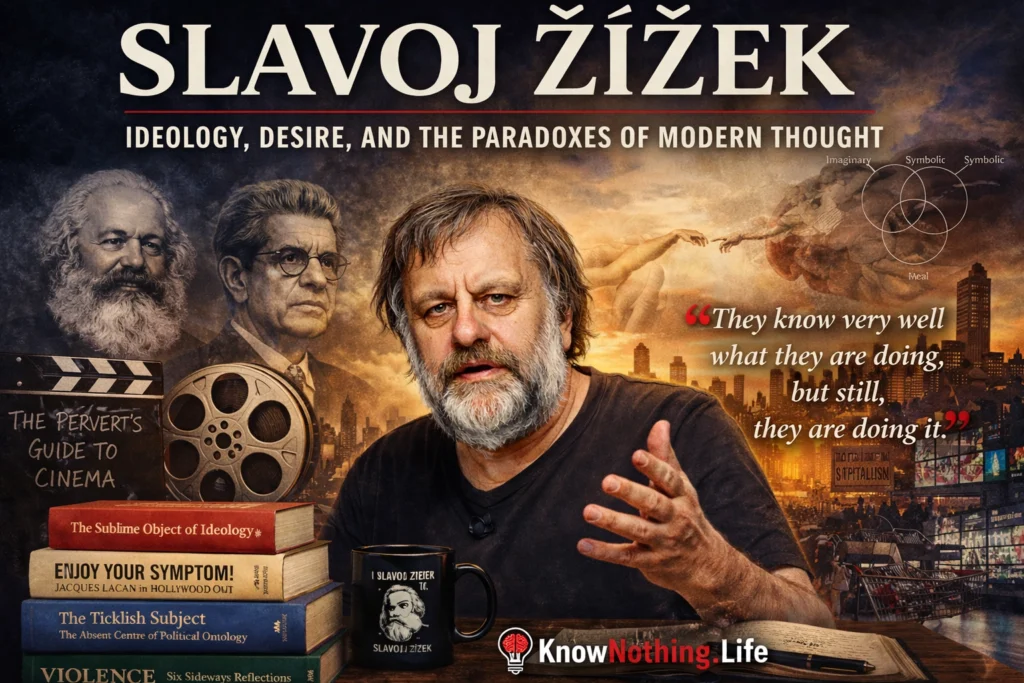
Slavoj Žižek stands as one of the most provocative and widely recognized philosophers of the late 20th and early 21st centuries. Known for his frenetic speaking style, irreverent humor, and dizzying intellectual range, Žižek occupies a rare position: a public intellectual who bridges dense theoretical traditions with popular culture. Drawing from Georg Wilhelm Friedrich Hegel, Karl Marx, and Jacques Lacan, he constructs a unique framework that interrogates ideology, subjectivity, and the contradictions of contemporary capitalism.
Žižek’s work refuses easy categorization. It is at once philosophical, psychoanalytic, political, and cultural, weaving together references to cinema, literature, theology, and everyday life. His intellectual mission centers on exposing the hidden structures that govern belief and desire, often revealing how individuals participate in systems they claim to oppose. With a style that oscillates between rigor and absurdity, Žižek has redefined what it means to engage philosophy in a globalized, media-saturated world.
Early Life and Intellectual Formation
Slavoj Žižek was born on March 21, 1949, in Ljubljana, then part of socialist Yugoslavia. Growing up in a relatively liberal socialist environment, he developed an early interest in philosophy and culture, particularly Western thought, which was often restricted or mediated through ideological filters. This exposure to both Marxist orthodoxy and its limitations would later shape his critical stance toward ideology itself.
Žižek studied philosophy at the University of Ljubljana before continuing his education in Paris, where he encountered the work of Jacques Lacan. Lacanian psychoanalysis became central to his intellectual development, offering a framework through which he could reinterpret classical philosophy and contemporary culture. His early academic career was marked by political obstacles; due to his nonconformist views, he struggled to secure stable academic positions in Yugoslavia, pushing him toward a more independent and unconventional intellectual path.
The collapse of Yugoslavia and the emergence of Slovenia as an independent nation coincided with Žižek’s rise to international prominence. His early works began to attract attention for their bold synthesis of psychoanalysis and philosophy, positioning him as a distinctive voice capable of addressing both the legacy of socialism and the complexities of post-Cold War capitalism.
Major Works and Philosophical Contributions
Žižek gained widespread recognition with the publication of The Sublime Object of Ideology, a groundbreaking text that reinterprets ideology through Lacanian psychoanalysis. In this work, he argues that ideology is not simply a set of false beliefs imposed from above, but a structure embedded in everyday practices and unconscious desires. One of his most cited insights captures this paradox: “They know very well what they are doing, but still, they are doing it.”
This early success was followed by a prolific output of books that expanded his theoretical framework. Works such as Enjoy Your Symptom! and The Ticklish Subject explore the intersections of psychoanalysis, subjectivity, and ideology, often using examples from Hollywood films to illustrate complex ideas. Žižek’s ability to move seamlessly between high theory and popular culture has made his work both accessible and controversial, appealing to a broad audience while challenging traditional academic boundaries.
A recurring theme in Žižek’s philosophy is the critique of liberal capitalism and its ideological mechanisms. He argues that contemporary ideology operates not by deceiving individuals outright, but by allowing them to maintain a cynical distance from their beliefs while continuing to participate in the system. This insight reframes ideology as something that persists even when people believe themselves to be free from it, a concept that has had significant influence across philosophy, political theory, and cultural studies.
Ideology, Psychoanalysis, and the Subject
At the core of Žižek’s thought lies a reinterpretation of the subject through Lacanian psychoanalysis. For Žižek, the subject is not a stable, rational entity but a fragmented and divided being shaped by unconscious desires and symbolic structures. He draws heavily on Lacan’s notion of the “Real,” a dimension of experience that resists symbolization and disrupts the coherence of reality.
Žižek extends this psychoanalytic framework to analyze ideology, arguing that ideological systems function by organizing desire rather than merely shaping belief. This means that individuals are often attached to ideology at a deeper level than conscious conviction; they derive enjoyment, or “jouissance,” from participating in these structures. As he famously puts it, “The problem is not that we desire too much, but that we do not desire enough.”
This emphasis on desire and enjoyment allows Žižek to explain why ideological systems persist even in the face of widespread criticism. Rather than viewing ideology as a top-down imposition, he presents it as something co-produced by individuals who unconsciously sustain it. This perspective challenges traditional Marxist views and introduces a more nuanced understanding of how power operates in contemporary societies.
Cultural Criticism and Popular Influence
One of Žižek’s most distinctive contributions is his use of popular culture as a site of philosophical analysis. He frequently examines films, literature, and media to uncover the ideological structures embedded within them. Hollywood cinema, in particular, serves as a rich source of examples, allowing Žižek to illustrate abstract concepts in concrete and often humorous ways.
In The Pervert’s Guide to Cinema and related works, Žižek analyzes films not merely as entertainment but as expressions of collective fantasies and anxieties. By dissecting familiar narratives, he reveals how cultural products reinforce or challenge ideological norms. This approach has made his work especially influential in fields such as film studies, cultural theory, and media analysis.
Žižek’s public persona has also contributed to his widespread recognition. His rapid, often chaotic speaking style, combined with his willingness to engage controversial topics, has made him a frequent presence in debates, lectures, and documentaries. While some critics view his style as overly performative, others see it as an integral part of his philosophical method, reflecting the complexity and contradictions he seeks to expose.
Political Thought and Critique of Contemporary Society
Žižek’s political philosophy is deeply rooted in a critique of global capitalism, which he sees as a system marked by inherent contradictions and crises. He challenges both neoliberalism and certain forms of leftist politics, arguing that many contemporary movements fail to confront the underlying structures of power. His work often calls for a return to radical thinking, drawing inspiration from figures such as Karl Marx while rejecting simplistic or dogmatic interpretations.
A key aspect of Žižek’s political thought is his critique of ideology in liberal democracies. He argues that modern societies often present themselves as post-ideological, claiming to operate on pragmatic or neutral principles. However, Žižek contends that this very claim is itself ideological, masking the ways in which power and inequality are maintained. As he provocatively states, “We feel free because we lack the very language to articulate our unfreedom.”
Žižek also engages with contemporary issues such as nationalism, identity politics, and environmental crises, often offering unconventional and controversial perspectives. His willingness to challenge dominant narratives has made him both influential and polarizing, sparking debates across political and intellectual spheres.
Legacy and Influence
Slavoj Žižek’s influence extends far beyond academic philosophy. His work has shaped discussions in political theory, cultural studies, psychoanalysis, and even theology, reflecting the breadth of his intellectual engagement. By bridging diverse traditions and disciplines, he has created a framework that continues to inspire new generations of thinkers.
Despite criticisms of his style and methodology, Žižek remains a central figure in contemporary philosophy. His ability to provoke thought, challenge assumptions, and engage with complex issues ensures that his work remains relevant in an era defined by rapid social and technological change. Whether one agrees with his conclusions or not, his contributions have undeniably expanded the scope of philosophical inquiry.
Ultimately, Žižek’s legacy lies in his relentless interrogation of ideology and desire. By revealing the hidden mechanisms that shape human thought and behavior, he invites readers to question not only the world around them but also their own participation in it. In doing so, he continues the philosophical tradition of critical reflection, pushing it into new and unexpected directions.