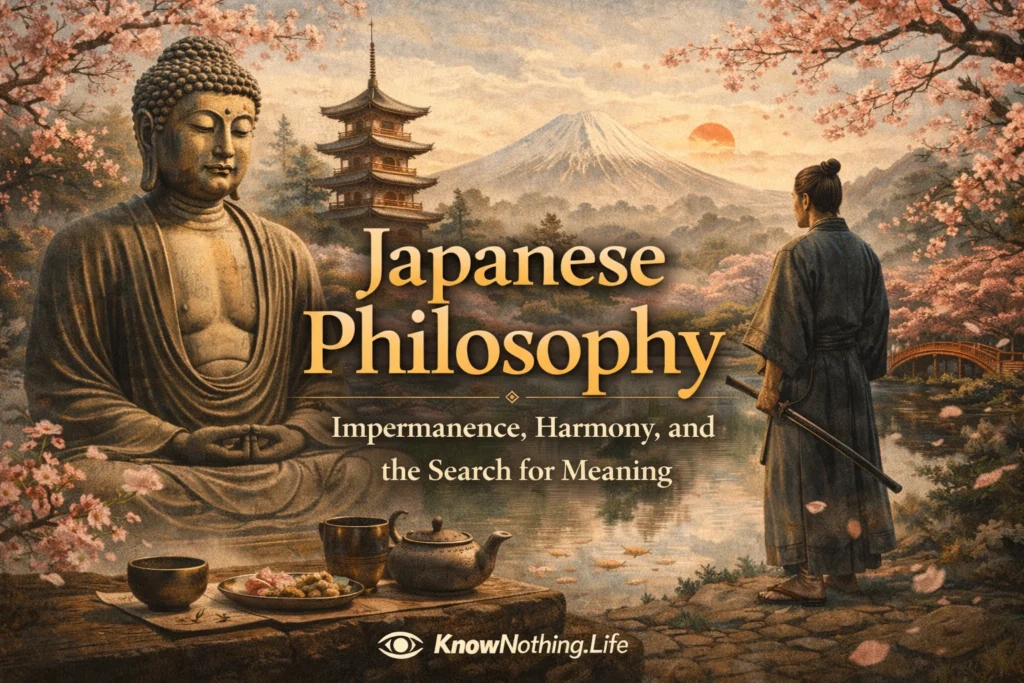
Japanese philosophy is a rich and evolving tradition shaped by the interplay of indigenous beliefs, imported systems of thought, and lived cultural experience. Unlike many philosophical traditions that develop through rigid systems or formal doctrines, Japanese philosophy often emerges through synthesis—blending elements of Shinto spirituality, Buddhist metaphysics, Confucian ethics, and later Western ideas into a distinctive and deeply aesthetic worldview. It is less concerned with abstract speculation for its own sake and more focused on lived experience, moral cultivation, and the subtle relationship between self, society, and nature. Central to this tradition are figures such as Kūkai, Dōgen, and Nishida Kitarō, whose works articulate different dimensions of Japanese philosophical thought across centuries.
At its core, Japanese philosophy is shaped by an acute awareness of impermanence and the transient nature of existence. This sensibility, often expressed through the aesthetic concept of mono no aware—the gentle sadness or sensitivity to the passing of things—infuses both philosophical reflection and artistic expression. Rather than resisting change or seeking permanence, Japanese thought frequently embraces transience as a fundamental aspect of reality. This orientation leads to a philosophy that is contemplative, experiential, and deeply attuned to the rhythms of life, where meaning is found not in permanence but in presence.
Shinto Foundations and the Sacredness of Nature
Before the arrival of Buddhism and Confucianism, the indigenous tradition of Shinto provided the spiritual and philosophical foundation of Japanese life. Shinto is not a formalized philosophical system but a way of perceiving the world in which nature, community, and the sacred are intimately connected. The concept of kami—spirits or divine presences—pervades the natural world, inhabiting mountains, rivers, trees, and even human relationships. This worldview fosters a sense of reverence for the environment and an understanding of humanity as embedded within, rather than separate from, nature.
Shinto philosophy emphasizes purity, harmony, and the maintenance of balance between human beings and the natural world. Ritual practices, such as purification rites, are not merely religious acts but expressions of an underlying philosophical commitment to restoring harmony and removing disorder. This focus on balance and interconnectedness would later resonate with Taoist and Buddhist ideas, contributing to the syncretic character of Japanese thought.
Although Shinto lacks canonical philosophical texts in the manner of other traditions, its influence can be seen in works such as the Kojiki and the Nihon Shoki, which record myths and narratives that shape the cultural imagination. These texts articulate a worldview in which the divine and the natural are inseparable, laying the groundwork for a philosophy that values immediacy, presence, and the sacredness of everyday life.
Buddhism in Japan and the Philosophy of Impermanence
The introduction of Buddhism to Japan in the sixth century marked a profound transformation in its philosophical landscape. Over time, various schools of Buddhism took root, each contributing unique perspectives on reality, suffering, and enlightenment. Among these, Zen Buddhism, particularly associated with Dōgen, became one of the most influential in shaping Japanese philosophical thought. Dōgen’s seminal work, the Shōbōgenzō, explores the nature of existence, time, and practice with remarkable depth.
Dōgen’s philosophy emphasizes the inseparability of practice and enlightenment, rejecting the notion that awakening is a distant goal to be achieved. Instead, he teaches that enlightenment is realized in the very act of practice itself. “To study the Way is to study the self,” he writes, “to study the self is to forget the self,” suggesting that true understanding arises when the boundaries of the ego dissolve. This insight reflects a broader Buddhist emphasis on non-self (anatta) and the impermanent nature of all phenomena.
The concept of impermanence (mujo) is central to Japanese Buddhist philosophy. All things arise, change, and pass away, and suffering emerges when individuals cling to what is transient. Rather than resisting this reality, Japanese philosophy often embraces it, finding beauty and meaning in the fleeting nature of existence. This perspective is not pessimistic but deeply affirmative, encouraging a heightened awareness of the present moment and a compassionate engagement with the world.
Confucian Influence and Ethical Order
Confucianism, introduced from China, played a significant role in shaping Japanese ethical and social philosophy, particularly during the Tokugawa period. Thinkers such as Hayashi Razan adapted Confucian principles to the Japanese context, emphasizing loyalty, filial piety, and social harmony. These values became integral to the organization of society, influencing everything from governance to education.
In Japanese philosophy, Confucian ethics were often integrated with existing cultural and spiritual traditions, creating a distinctive approach to moral life. The emphasis on relationships and duties resonated with the communal orientation of Japanese society, reinforcing the importance of harmony and mutual responsibility. At the same time, Japanese thinkers did not simply adopt Confucian ideas wholesale but reinterpreted them in light of local traditions and concerns.
This synthesis can be seen in the development of Bushidō, the “way of the warrior,” which combines Confucian ethics with Zen discipline and Shinto reverence. Bushidō emphasizes honor, loyalty, and self-sacrifice, reflecting a philosophical commitment to integrity and moral clarity. While often associated with the samurai class, its influence extends more broadly, shaping ideals of character and conduct in Japanese culture.
The Kyoto School and Modern Japanese Philosophy
In the modern era, Japanese philosophy engaged directly with Western thought, leading to the emergence of new intellectual movements that sought to reconcile Eastern and Western perspectives. The Kyoto School, founded by Nishida Kitarō, represents one of the most significant developments in this regard. Nishida’s work, particularly in An Inquiry into the Good, explores the nature of consciousness, experience, and reality through a synthesis of Zen Buddhism and Western philosophy.
Nishida introduces the concept of “pure experience,” a state in which subject and object are not yet divided. This idea challenges the dualistic frameworks of much Western philosophy, suggesting that the distinction between self and world is a secondary construction. “Pure experience is the direct experience prior to reflection,” he writes, emphasizing immediacy and unity as the foundation of knowledge. This perspective reflects the enduring influence of Zen thought while engaging with modern philosophical concerns.
Subsequent thinkers in the Kyoto School, such as Tanabe Hajime and Nishitani Keiji, expanded on these ideas, addressing questions of nihilism, ethics, and the nature of being in a global context. Their work represents a sophisticated attempt to articulate a philosophy that is both rooted in Japanese tradition and responsive to the challenges of modernity.
Aesthetics and the Philosophy of Everyday Life
One of the most distinctive features of Japanese philosophy is its integration with aesthetics and everyday life. Concepts such as wabi-sabi (the beauty of imperfection), yūgen (mysterious profundity), and mono no aware are not merely artistic ideals but philosophical insights into the nature of reality. They reflect a worldview in which beauty is found in simplicity, transience, and the subtle interplay of presence and absence.
This aesthetic orientation is evident in practices such as the tea ceremony, ikebana (flower arrangement), and traditional poetry. These practices are not simply cultural expressions but forms of philosophical inquiry, inviting participants to engage with the present moment and cultivate awareness. As the poet Matsuo Bashō writes in his haiku, “An old silent pond… / A frog jumps into the pond, / splash! Silence again,” capturing a moment of profound simplicity and depth.
Japanese philosophy thus blurs the boundaries between thought and practice, theory and experience. It invites individuals to find meaning not in abstract systems but in the texture of everyday life, in the way one moves, observes, and relates to the world. This integration of philosophy and aesthetics offers a unique approach to understanding existence, one that is both subtle and deeply transformative.
Final Reflections on Japanese Philosophy
Japanese philosophy is characterized by its openness, adaptability, and sensitivity to the nuances of existence. It does not seek to impose rigid frameworks or definitive answers but to cultivate a way of seeing and being that is responsive to the complexities of life. Through its engagement with impermanence, harmony, and the interplay of traditions, it offers a rich and multifaceted perspective on the human condition.
From the spiritual insights of Shinto to the meditative depth of Zen, from the ethical structures of Confucianism to the modern reflections of the Kyoto School, Japanese philosophy represents a continuous dialogue between past and present, tradition and innovation. It challenges individuals to embrace change, to find beauty in transience, and to live with awareness and compassion.
In a world often marked by speed and fragmentation, the wisdom of Japanese philosophy offers a quiet but powerful alternative. It reminds us that meaning is not something to be grasped or possessed but something to be experienced, moment by moment, in the unfolding of life itself.