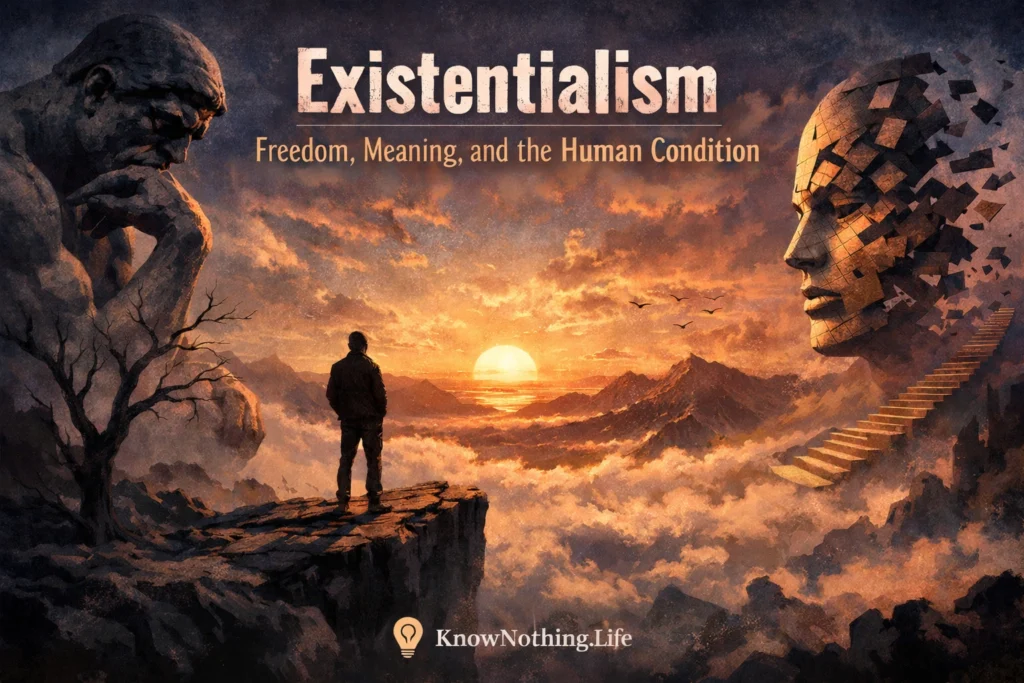
Existentialism is a philosophical movement concerned with the nature of human existence, emphasizing freedom, responsibility, and the search for meaning in a world that often appears indifferent or absurd. Emerging most prominently in nineteenth- and twentieth-century Europe, existentialism does not present a unified doctrine but rather a shared set of concerns explored by diverse thinkers such as Søren Kierkegaard, Friedrich Nietzsche, Jean-Paul Sartre, and Albert Camus. These philosophers grappled with questions of individuality, anxiety, authenticity, and the meaning—or apparent lack of meaning—of life.
At its core, existentialism begins with the individual, not as an abstract category but as a concrete being situated in a specific world. It rejects the idea that human nature is predetermined, insisting instead that individuals must create themselves through their choices and actions. This emphasis on personal responsibility is both liberating and burdensome, as it places the weight of meaning squarely on the individual. Existentialism thus confronts the tension between freedom and uncertainty, offering a framework for understanding what it means to live authentically in an unpredictable world.
Kierkegaard and the Birth of Existential Thought
The roots of existentialism can be traced to Søren Kierkegaard, whose work laid the foundation for many of its central themes. Writing in the nineteenth century, Kierkegaard focused on the individual’s relationship to existence, emphasizing subjectivity and personal commitment over objective certainty. In works such as Fear and Trembling and The Sickness Unto Death, he explores the nature of faith, despair, and the challenges of living authentically.
Kierkegaard argues that truth is not merely a matter of intellectual understanding but of lived experience. “Subjectivity is truth,” he famously declares, suggesting that the most important truths are those that individuals must confront personally. This perspective challenges the dominance of rationalism and systematic philosophy, shifting the focus toward the inner life of the individual. For Kierkegaard, existence is marked by uncertainty, and it is through confronting this uncertainty that individuals come to define themselves.
Central to his thought is the concept of the “leap of faith,” a decision to commit to a way of life despite the absence of rational certainty. This leap is not irrational but existential, reflecting the necessity of choice in the face of ambiguity. Kierkegaard’s emphasis on anxiety and despair as integral aspects of human existence would later become defining features of existentialist philosophy, influencing thinkers across generations.
Nietzsche and the Death of God
Another pivotal figure in the development of existentialism is Friedrich Nietzsche, whose critique of traditional values and proclamation of the “death of God” reshaped modern thought. In works such as Thus Spoke Zarathustra and The Gay Science, Nietzsche challenges the foundations of morality, religion, and meaning, arguing that the decline of religious belief leaves humanity without a clear source of purpose.
“The death of God” does not refer to a literal event but to the erosion of belief in a transcendent moral order. Without this foundation, individuals are confronted with the task of creating their own values. Nietzsche sees this as both a crisis and an opportunity, calling for the emergence of the Übermensch (overman), a figure who creates meaning through strength, creativity, and self-overcoming. “He who has a why to live can bear almost any how,” he writes, emphasizing the importance of purpose in the face of suffering.
Nietzsche’s philosophy is deeply concerned with the affirmation of life, even in its most difficult and chaotic aspects. He rejects nihilism not by denying its insights but by transforming it into a call for creative self-expression. His work challenges individuals to embrace their freedom and responsibility, laying the groundwork for later existentialist explorations of meaning and authenticity.
Sartre and the Burden of Freedom
In the twentieth century, Jean-Paul Sartre became one of the most prominent voices of existentialism, articulating its ideas with clarity and intensity. In his major work Being and Nothingness, Sartre develops a comprehensive account of human existence, grounded in the principle that “existence precedes essence.” This means that individuals are not defined by any predetermined nature but must create themselves through their choices.
For Sartre, freedom is the defining feature of human existence, but it is also a source of profound anxiety. Without fixed values or external guidance, individuals are “condemned to be free,” responsible for every action and its consequences. This radical freedom can lead to bad faith, a form of self-deception in which individuals deny their freedom by conforming to social roles or external expectations. Authenticity, in contrast, involves acknowledging one’s freedom and taking responsibility for one’s choices.
Sartre’s existentialism extends beyond the individual to encompass social and political dimensions. He emphasizes the interconnectedness of human freedom, arguing that one’s choices affect not only oneself but others as well. This recognition introduces an ethical dimension to existentialism, where responsibility is both personal and collective. Through his work, Sartre transforms existentialism into a powerful framework for understanding both individual existence and social engagement.
Camus and the Philosophy of the Absurd
While often associated with existentialism, Albert Camus developed a distinct but related philosophy centered on the concept of the absurd. In works such as The Myth of Sisyphus and The Stranger, Camus explores the tension between the human desire for meaning and the apparent indifference of the universe. This tension gives rise to the absurd, a condition that defines the human experience.
Camus rejects both nihilism and the escape into false meaning, advocating instead for a confrontation with the absurd. “The struggle itself toward the heights is enough to fill a man’s heart,” he writes, concluding that one must imagine Sisyphus happy as he endlessly pushes his boulder uphill. This image captures Camus’s vision of a life lived in full awareness of its limitations, yet affirmed through resilience and defiance.
Unlike Sartre, Camus does not emphasize radical freedom but focuses on the acceptance of reality as it is. His philosophy encourages individuals to live with clarity, passion, and integrity, even in the absence of ultimate meaning. By embracing the absurd, one can find a form of liberation that is grounded not in illusion but in the honest recognition of life’s conditions.
Themes of Authenticity, Anxiety, and Meaning
Across its diverse expressions, existentialism is united by a set of recurring themes that illuminate the human condition. Authenticity, for instance, involves living in accordance with one’s true self, rather than conforming to external expectations. It requires self-awareness, courage, and a willingness to confront uncomfortable truths. Existentialist thinkers consistently emphasize that authenticity is not given but achieved through conscious effort and reflection.
Anxiety, or angst, is another central theme, arising from the recognition of freedom and the uncertainty of existence. Rather than viewing anxiety as purely negative, existentialists see it as a necessary aspect of self-awareness. It reveals the openness of the future and the responsibility inherent in choice. As Kierkegaard suggests, anxiety is “the dizziness of freedom,” a condition that both challenges and enables personal growth.
The question of meaning lies at the heart of existentialism. In a world without inherent purpose, individuals must create their own meaning through action and commitment. This task is both daunting and empowering, requiring a balance between acceptance and creativity. Existentialism does not offer definitive answers but provides a framework for engaging with life’s most fundamental questions.
Final Reflections on Existentialism
Existentialism remains one of the most influential and provocative philosophical movements, addressing questions that are as relevant today as they were in its formative years. Its focus on individuality, freedom, and responsibility resonates in a world marked by complexity and uncertainty. By confronting the challenges of existence directly, existentialism offers a path toward authenticity and self-understanding.
The enduring power of existentialism lies in its refusal to simplify the human condition. It acknowledges the difficulties of life—the anxiety, the ambiguity, the absence of certainty—while affirming the possibility of meaning and fulfillment. Through its diverse voices and perspectives, existentialism invites individuals to take ownership of their lives, to create meaning in the face of uncertainty, and to embrace the freedom that defines what it means to be human.