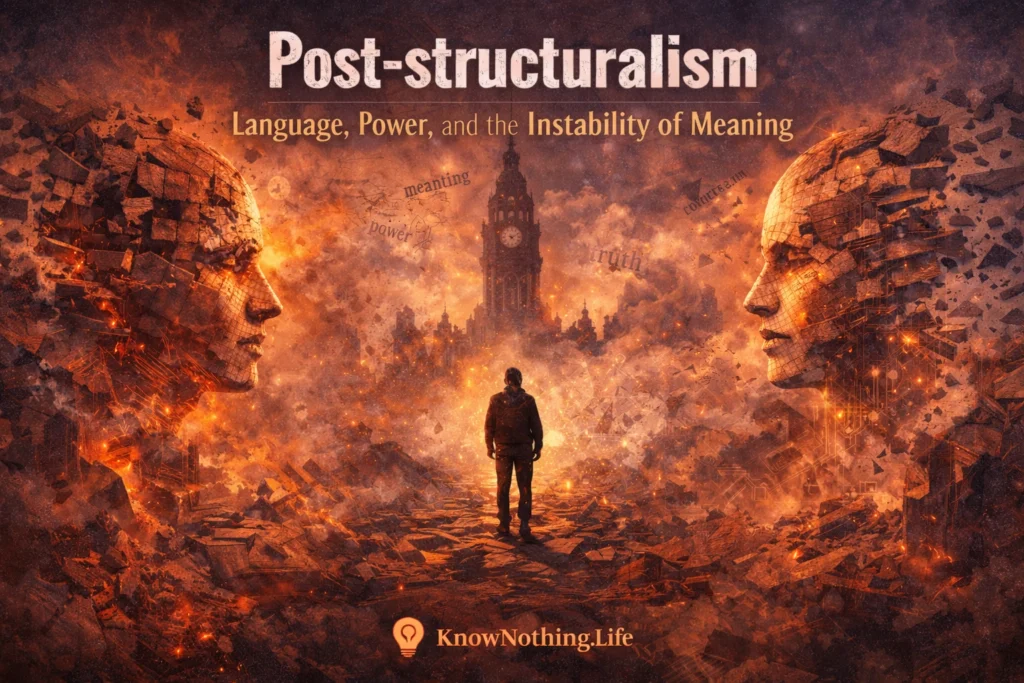
Post-structuralism is a diverse and influential intellectual movement that emerged in the mid-twentieth century as a critical response to structuralism. While structuralism sought to uncover stable systems underlying language, culture, and thought, post-structuralism challenges the very idea of fixed structures, emphasizing instead the fluidity, instability, and multiplicity of meaning. Rather than viewing systems as coherent and self-contained, post-structuralist thinkers argue that meaning is always shifting, shaped by context, interpretation, and power relations. Central figures in this movement include Jacques Derrida, Michel Foucault, Roland Barthes, and Gilles Deleuze.
At its core, post-structuralism questions the assumption that meaning can be fully determined or that language can provide a stable representation of reality. It highlights the ways in which systems of thought are contingent, historically situated, and open to reinterpretation. This perspective does not simply reject structure but seeks to expose its limits, revealing the tensions and contradictions that undermine claims to certainty. In doing so, post-structuralism opens new possibilities for understanding language, identity, and the dynamics of power.
Derrida and Deconstruction
One of the most influential contributions to post-structuralism comes from Jacques Derrida, whose method of deconstruction challenges the idea that texts have fixed meanings. In works such as Of Grammatology, Derrida argues that language is inherently unstable, with meaning constantly deferred through a process he calls différance. Words do not point directly to stable concepts but gain meaning through their differences from other words, creating an endless chain of signification.
Deconstruction involves analyzing texts to reveal the assumptions and contradictions that underlie them. Derrida shows that binary oppositions—such as speech/writing, presence/absence, or truth/error—are not neutral but hierarchical, privileging one term over the other. By examining how these oppositions function, deconstruction exposes the instability of meaning and the ways in which texts undermine their own claims. “There is nothing outside the text,” Derrida famously writes, suggesting that meaning is always mediated by language and cannot be grounded in an external reality.
This approach does not aim to destroy meaning but to open it up, revealing its complexity and multiplicity. Deconstruction invites readers to engage with texts in a more critical and reflective way, recognizing that interpretation is never final. It challenges the idea of definitive readings, emphasizing instead the dynamic and ongoing nature of meaning-making.
Foucault and the Relationship Between Knowledge and Power
While Derrida focuses on language, Michel Foucault examines the relationship between knowledge and power, offering a historical and social dimension to post-structuralist thought. In works such as Discipline and Punish and The History of Sexuality, Foucault explores how systems of knowledge shape and are shaped by power relations.
Foucault challenges the idea that knowledge is neutral or objective, arguing that it is always embedded within specific historical contexts and institutions. “Power produces knowledge,” he writes, highlighting the interdependence of these concepts. Discourses—systems of thought and language—define what can be said, thought, and known, shaping the boundaries of understanding. These discourses are not static but change over time, reflecting shifts in power and social organization.
Through his analysis of institutions such as prisons, hospitals, and schools, Foucault reveals how power operates not only through coercion but through subtle forms of regulation and normalization. Individuals internalize these structures, shaping their behavior and identity. This perspective expands post-structuralism beyond language to encompass the broader social and political dimensions of meaning, emphasizing the role of power in shaping human experience.
Barthes and the Death of the Author
Roland Barthes, who had earlier contributed to structuralism, became a key figure in post-structuralism through his rethinking of authorship and interpretation. In his essay “The Death of the Author,” Barthes argues that the meaning of a text is not determined by the intentions of its creator but emerges through the interaction between the text and its readers. This idea shifts the focus from the author as the source of meaning to the reader as an active participant in its construction.
Barthes’s work, including S/Z, explores how texts generate multiple meanings through complex systems of codes and references. He emphasizes the plurality of interpretation, suggesting that texts are open-ended and cannot be reduced to a single, authoritative reading. “A text’s unity lies not in its origin but in its destination,” he writes, underscoring the role of the reader in creating meaning.
This perspective aligns with the broader post-structuralist critique of fixed meaning, highlighting the fluid and dynamic nature of interpretation. By decentering the author, Barthes opens the possibility for diverse readings and perspectives, reflecting the multiplicity of human experience.
Deleuze and the Philosophy of Difference
Another important figure in post-structuralism is Gilles Deleuze, whose work emphasizes difference, multiplicity, and becoming. In texts such as Difference and Repetition and A Thousand Plateaus (co-authored with Félix Guattari), Deleuze challenges traditional metaphysical concepts based on identity and stability.
Deleuze argues that reality is characterized by constant change and variation, rather than fixed structures. He introduces concepts such as the “rhizome,” a non-hierarchical model of organization that contrasts with traditional tree-like structures. A rhizome spreads in multiple directions, without a central point, reflecting the complexity and interconnectedness of reality. This model has been influential in fields ranging from philosophy to cultural studies and network theory.
His emphasis on difference and becoming aligns with the post-structuralist rejection of static systems. Rather than seeking to define or categorize, Deleuze encourages a focus on processes and transformations. This approach offers a dynamic and open-ended vision of reality, where meaning is continually produced and reconfigured.
Language, Identity, and the Self
Post-structuralism has significant implications for understanding identity and the self. It challenges the idea of a stable, unified subject, suggesting instead that identity is constructed through language, discourse, and social interaction. The self is not a fixed essence but a dynamic process, shaped by the structures and forces that surround it.
This perspective has influenced fields such as gender studies, cultural theory, and postcolonial studies, where it is used to analyze how identities are formed and contested. By revealing the constructed nature of identity, post-structuralism opens the possibility for transformation and resistance. Individuals are not bound by fixed categories but can reinterpret and redefine themselves within changing contexts.
At the same time, this view raises questions about agency and responsibility. If the self is shaped by external forces, to what extent can individuals act freely? Post-structuralist thinkers do not provide simple answers but highlight the complexity of these issues, emphasizing the interplay between structure and agency.
Legacy and Contemporary Relevance
Post-structuralism has had a profound impact on contemporary thought, influencing a wide range of disciplines and intellectual movements. Its critique of fixed meaning and emphasis on context and power have reshaped approaches to literature, philosophy, and the social sciences. It has also contributed to the development of critical theories that address issues of identity, inequality, and representation.
In the modern world, where information is constantly produced and contested, the insights of post-structuralism remain highly relevant. Its emphasis on the instability of meaning encourages critical engagement with texts and discourses, fostering a deeper awareness of how knowledge is constructed. At the same time, its focus on power highlights the ways in which meaning is shaped by social and political forces.
Despite its complexity, post-structuralism offers valuable tools for navigating a world characterized by uncertainty and diversity. By challenging assumptions and opening up new perspectives, it invites individuals to think more critically and creatively about the nature of reality.
Final Reflections on Post-structuralism
Post-structuralism represents a fundamental shift in the way we understand language, meaning, and the human condition. It moves beyond the search for stable structures, embracing instead the fluidity and multiplicity of experience. Through the work of thinkers like Derrida, Foucault, Barthes, and Deleuze, it has transformed our understanding of how meaning is produced and contested.
The enduring significance of post-structuralism lies in its ability to reveal the complexity of the world without reducing it to simple explanations. It challenges us to question assumptions, to recognize the role of power and context, and to embrace the open-ended nature of interpretation. In doing so, it offers a philosophy that is both critical and generative, inviting ongoing exploration and dialogue.