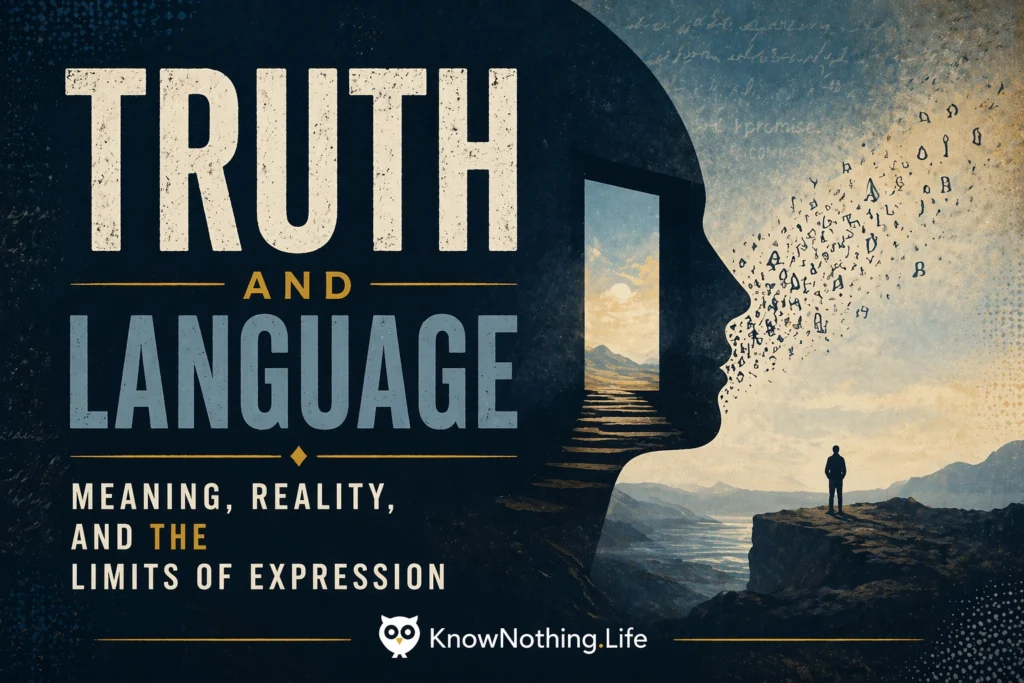
The relationship between truth and language lies at the heart of philosophy. Language is our primary tool for expressing beliefs, making claims, and describing the world, but how those claims become true—or fail to be true—raises deep and complex questions. What does it mean for a statement to be true? Does truth depend on how the world is, how we think about it, or how language is structured? And can language fully capture reality, or does it inevitably fall short?
Philosophers have long debated whether truth is a property of sentences, beliefs, or propositions, and whether it is objective or dependent on human interpretation. These questions reveal that truth is not simply a matter of matching words to the world, but involves a complex interplay between language, thought, and reality. By examining this relationship, the philosophy of truth and language seeks to clarify how we make sense of the world and how we communicate that understanding to others.
Correspondence Theories of Truth
One of the most intuitive accounts of truth is the correspondence theory, which holds that a statement is true if it corresponds to the way the world actually is. According to this view, the sentence “Snow is white” is true if and only if snow is, in fact, white. This idea suggests a direct relationship between language and reality, where truth consists in accurately representing the world.
Philosophers such as Aristotle articulated early versions of this view, emphasizing that truth involves saying of what is that it is, and of what is not that it is not. In the modern era, thinkers like Bertrand Russell developed more sophisticated accounts, attempting to explain how language maps onto facts in the world. These theories often rely on the idea that the world is composed of structured facts that correspond to the structure of true statements.
However, the correspondence theory faces challenges. It is not always clear what it means for a statement to “correspond” to reality, especially in cases involving abstract or theoretical entities. Additionally, the relationship between language and the world may be more complex than a simple one-to-one mapping, raising questions about how correspondence should be understood.
Coherence and Pragmatic Theories
In contrast to correspondence theories, coherence theories of truth define truth in terms of consistency within a system of beliefs. According to this view, a statement is true if it fits coherently with other statements in a comprehensive and logically consistent framework. Truth is thus a matter of internal relations rather than direct correspondence with an external reality.
Philosophers such as G. W. F. Hegel and later idealists emphasized the importance of coherence in understanding truth. They argued that knowledge forms an interconnected whole, and that individual statements derive their truth from their place within this system. This perspective shifts the focus from the relationship between language and the world to the relationships among beliefs themselves.
Pragmatic theories of truth offer another alternative, focusing on the practical consequences of beliefs. Thinkers like William James suggested that truth is what works in practice—what proves useful or successful in guiding action. While this approach highlights the dynamic and functional aspects of truth, it has been criticized for potentially conflating truth with utility.
Truth in Formal Languages
The development of formal logic in the twentieth century led to new approaches to truth that emphasize precision and rigor. Alfred Tarski made a significant contribution by providing a formal definition of truth for logical languages. His semantic conception of truth is often expressed in the form: “ ‘Snow is white’ is true if and only if snow is white.”
Tarski’s work aimed to avoid paradoxes, such as the liar paradox (“This sentence is false”), by carefully distinguishing between object languages (the language being analyzed) and metalanguages (the language used to describe it). This distinction allows for a consistent definition of truth within formal systems, avoiding self-referential contradictions.
While Tarski’s theory is highly influential, it applies primarily to formal languages rather than natural language. Everyday language is more flexible and context-dependent, making it difficult to apply strict formal definitions. Nevertheless, Tarski’s work has shaped modern semantics and remains a cornerstone of the philosophy of language.
Language, Meaning, and Truth Conditions
Another important approach to truth focuses on truth conditions—the circumstances under which a statement would be true. This perspective, associated with philosophers like Donald Davidson, seeks to explain meaning in terms of truth. To understand a sentence is to know what would make it true.
This approach bridges semantics and the philosophy of truth, suggesting that meaning and truth are closely intertwined. By analyzing the truth conditions of sentences, philosophers aim to uncover the structure of language and its relationship to the world. This method provides a systematic way of studying meaning, particularly in relation to logic and formal semantics.
However, truth-conditional semantics also faces challenges, particularly in accounting for context-dependent aspects of meaning. Expressions such as “I,” “here,” and “now” require reference to specific situations, complicating the idea of fixed truth conditions. This has led to increased interest in the role of pragmatics in shaping meaning and truth.
The Role of Context and Interpretation
Language does not operate in a vacuum; its meaning and truth often depend on context. The same sentence can convey different meanings in different situations, and its truth may vary accordingly. This context-dependence raises questions about whether truth is an objective property or something shaped by interpretation.
Philosophers such as Ludwig Wittgenstein emphasized the importance of use and context in understanding language. In his later work, Wittgenstein argued that meaning arises from participation in language games—shared practices governed by rules and conventions. This perspective suggests that truth is not a fixed relation between language and reality, but something that emerges within specific forms of life.
Interpretation also plays a crucial role in determining truth. Different individuals or communities may interpret the same statement in different ways, leading to disagreements about its truth. This highlights the interplay between objective facts and subjective understanding, complicating the notion of truth as a simple correspondence.
Paradoxes and the Limits of Language
The study of truth and language is deeply influenced by paradoxes that challenge our understanding of both concepts. The liar paradox, for example, arises from a sentence that refers to its own falsehood, creating a contradiction. Such paradoxes reveal limitations in our ability to define truth within language, particularly when self-reference is involved.
Philosophers have proposed various solutions to these paradoxes, including hierarchical language systems, alternative logics, and revisions to the concept of truth itself. However, no single solution has achieved universal acceptance, and paradoxes continue to be a central topic of philosophical inquiry.
These issues suggest that language may have inherent limits when it comes to expressing truth. Some aspects of reality, or certain types of statements, may resist clear classification as true or false. This raises broader questions about the scope of language and the nature of philosophical problems.
Truth, Language, and Reality
Ultimately, the relationship between truth and language is inseparable from questions about reality. If language is our primary means of describing the world, then understanding how it relates to truth is essential for understanding the world itself. This relationship is not straightforward, as it involves multiple layers of interpretation, representation, and context.
Philosophers continue to debate whether truth is an objective feature of the world or a product of linguistic and conceptual frameworks. Some argue that truth exists independently of language, while others suggest that it is shaped by the ways in which we describe and interpret reality. These debates reflect broader tensions between realism and relativism in philosophy.
By examining how language conveys truth, we gain insight into the nature of knowledge and the limits of human understanding. This inquiry reveals both the power and the limitations of language as a tool for engaging with reality.
Conclusion
The study of truth and language explores one of the most fundamental aspects of human thought and communication. From correspondence and coherence theories to formal semantics and pragmatic approaches, philosophers have developed a wide range of perspectives on how truth is expressed and understood.
Thinkers such as Aristotle, Alfred Tarski, and Ludwig Wittgenstein have shaped this field, offering insights that continue to influence contemporary debates. While no single theory has resolved all questions, the ongoing exploration of truth and language remains central to philosophy, illuminating how we make sense of the world and communicate that understanding to others.