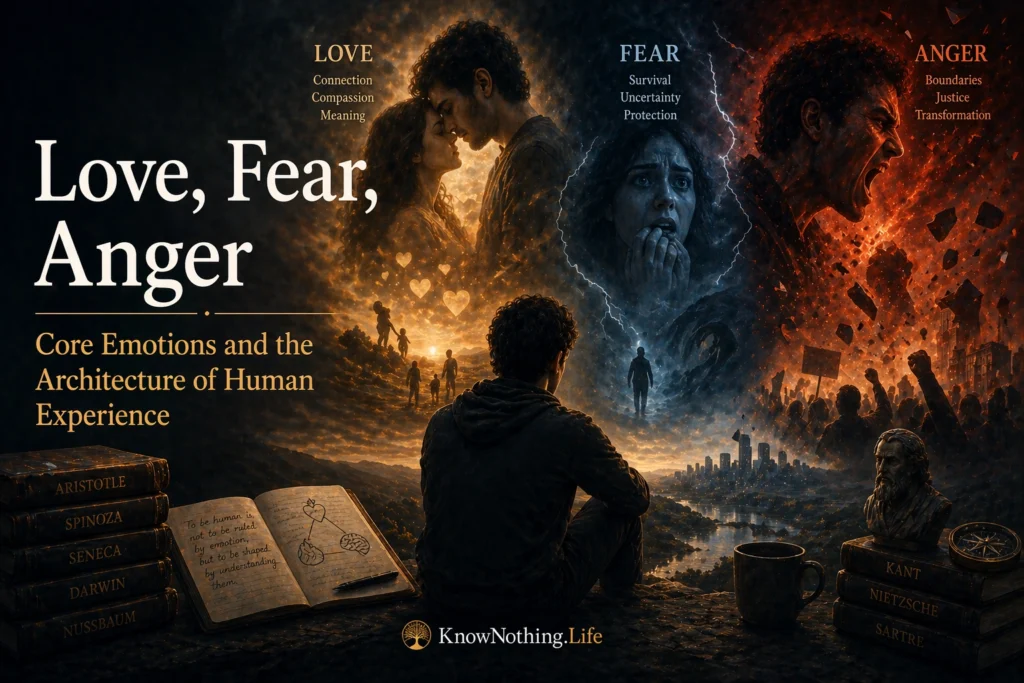
Among the vast range of human emotions, love, fear, and anger stand out as foundational forces shaping thought, behavior, and social life. These emotions are not merely fleeting states but deeply embedded responses that influence perception, decision-making, and identity. Love binds individuals together, fostering connection and meaning. Fear alerts individuals to danger, preparing them for survival. Anger arises in response to perceived injustice, motivating action and resistance. Each emotion carries its own logic, function, and philosophical significance.
The philosophy of these core emotions seeks to understand their nature, origins, and role in human life. Are they purely biological reactions, or do they involve complex judgments and values? Can they be rational, or are they inherently irrational? By examining love, fear, and anger, philosophers explore the broader question of how emotion interacts with reason and shapes the human condition. These emotions reveal not only how individuals respond to the world but also what they care about and how they define themselves.
Love: Connection, Value, and Meaning
Love is often regarded as the most profound and complex of emotions, encompassing a wide range of experiences from romantic attachment to familial bonds and altruistic concern. Philosophically, love raises questions about value, identity, and the nature of relationships. Why do individuals love particular people, and what does this reveal about their values? Is love a matter of choice, or does it arise independently of rational control?
Classical philosophers offered varying accounts of love. Plato described love as a longing for beauty and truth, a force that drives individuals toward higher understanding. In this view, love transcends mere physical attraction, becoming a pathway to intellectual and spiritual fulfillment. Aristotle, on the other hand, emphasized the role of friendship, viewing love as a mutual recognition of virtue and shared purpose. For Aristotle, the highest form of love is grounded in respect and understanding rather than desire alone.
Modern philosophy has expanded these ideas, exploring love as both an emotional and ethical phenomenon. Love can be seen as an evaluative response, recognizing the significance of another person and integrating their well-being into one’s own. At the same time, love can challenge rationality, leading individuals to act in ways that defy logic or self-interest. This dual nature highlights the complexity of love, which can both illuminate and complicate human experience.
Fear: Perception, Survival, and Uncertainty
Fear is one of the most basic and universal human emotions, closely tied to survival. It arises in response to perceived threats, triggering physiological and psychological reactions that prepare the individual for action. Fear sharpens attention, heightens awareness, and prompts behaviors aimed at avoiding danger. In this sense, it serves a vital adaptive function, enabling individuals to respond effectively to their environment.
Philosophically, fear raises questions about perception and judgment. Fear is not merely a reaction to objective danger; it depends on how situations are interpreted. Thomas Hobbes viewed fear as a central force in human life, particularly in the context of social order. According to Hobbes, fear of violence and instability drives individuals to form societies and accept authority. This perspective highlights the role of fear in shaping not only individual behavior but also political structures.
At the same time, fear can be disproportionate or misplaced. Individuals may fear situations that pose little actual threat, influenced by past experiences or cultural narratives. This raises questions about the rationality of fear and the extent to which it reflects reality. While fear can protect, it can also constrain, limiting freedom and fostering anxiety. Understanding fear involves balancing its protective function with its potential to distort perception.
Anger: Justice, Power, and Moral Response
Anger is a powerful and often controversial emotion, associated with conflict, aggression, and moral judgment. It arises in response to perceived wrongdoing, signaling that something is unjust or unacceptable. Unlike fear, which is oriented toward avoidance, anger is directed toward confrontation and change. It motivates individuals to address perceived injustices, making it a central emotion in ethical and political life.
Philosophers have offered differing evaluations of anger. Aristotle recognized that anger can be appropriate when directed at genuine injustice, provided it is expressed in a measured and proportional way. In contrast, Seneca argued that anger is inherently destructive, clouding judgment and leading to harmful actions. These contrasting views reflect an ongoing debate about whether anger can be a constructive force or must be controlled and minimized.
Modern perspectives often view anger as a response to violations of moral expectations. It reflects a judgment that one has been wronged, combined with a desire for redress. This evaluative dimension allows anger to be assessed in terms of rationality and justification. When aligned with reason, anger can drive social change and promote justice. When misdirected, it can lead to conflict and harm. The challenge lies in understanding how to harness anger’s energy without succumbing to its excesses.
Interactions Between Love, Fear, and Anger
Although love, fear, and anger are distinct emotions, they are deeply interconnected. They often arise in relation to one another, shaping complex emotional experiences. Love, for instance, can give rise to fear—the fear of loss or harm to a loved one. Similarly, anger can emerge from love when something threatens or damages a valued relationship. These interactions reveal that emotions are not isolated states but part of a dynamic system.
The interplay between these emotions highlights their shared structure as responses to perceived value. Love reflects the recognition of positive value, fear responds to threats to that value, and anger arises when value is violated. This framework provides a unified way of understanding emotional experience, emphasizing the role of evaluation in shaping feelings.
At the same time, these interactions can create tension and conflict. Fear may inhibit expressions of love, while anger may disrupt relationships. Navigating these complexities requires emotional awareness and reflection, allowing individuals to understand how their emotions influence one another. This dynamic interplay underscores the richness and complexity of human emotional life.
Rationality and Regulation of Core Emotions
A central question in the philosophy of emotion is whether love, fear, and anger can be rational. Each of these emotions involves judgments about the world, suggesting that they can be evaluated in terms of accuracy and appropriateness. Love may be rational when it reflects genuine value, fear when it responds to real danger, and anger when it addresses actual injustice.
However, these emotions are also susceptible to distortion. Love can become obsessive or misplaced, fear can become irrational or paralyzing, and anger can escalate into aggression or resentment. This potential for error highlights the importance of regulation and reflection. Emotional rationality involves not suppressing emotions but understanding and guiding them.
Philosophers such as Baruch Spinoza emphasized the role of understanding in transforming emotional experience. By examining the causes of emotions, individuals can gain greater control over them, reducing their negative effects while preserving their positive functions. This approach suggests that emotional maturity involves integrating feeling with reason, allowing emotions to inform rather than dominate behavior.
Contemporary Perspectives on Core Emotions
In modern thought, the study of love, fear, and anger has been enriched by insights from psychology and neuroscience. Research has revealed the biological mechanisms underlying these emotions, highlighting their evolutionary significance. Love is associated with bonding and cooperation, fear with survival and protection, and anger with defense and assertion. These findings reinforce the idea that emotions are integral to human functioning.
At the same time, contemporary perspectives emphasize the role of culture and context in shaping emotional experience. Different societies have varying norms regarding the expression and interpretation of emotions, influencing how love, fear, and anger are understood. This cultural dimension adds complexity to the philosophical analysis, suggesting that emotions are both universal and context-dependent.
Technological and social changes have also influenced how these emotions are experienced. Modern communication and media can amplify emotional responses, creating new challenges for regulation and understanding. Despite these changes, the fundamental role of love, fear, and anger remains constant, reflecting their deep roots in human nature.
Conclusion
Love, fear, and anger are central to the architecture of human experience, shaping how individuals perceive, evaluate, and respond to the world. Each emotion carries its own logic and function, reflecting different aspects of value and significance. Love fosters connection and meaning, fear promotes survival and caution, and anger drives responses to injustice and conflict.
Philosophical exploration reveals that these emotions are neither purely irrational nor entirely reliable. They can provide insight into the world and our values, but they can also be distorted by bias and error. Understanding these emotions requires a balanced perspective that recognizes both their strengths and their limitations.
Ultimately, the study of love, fear, and anger offers a deeper understanding of what it means to be human. It highlights the complexity of emotional life and the interplay between feeling and thought. By examining these core emotions, we gain insight into the forces that shape our actions, relationships, and sense of self.