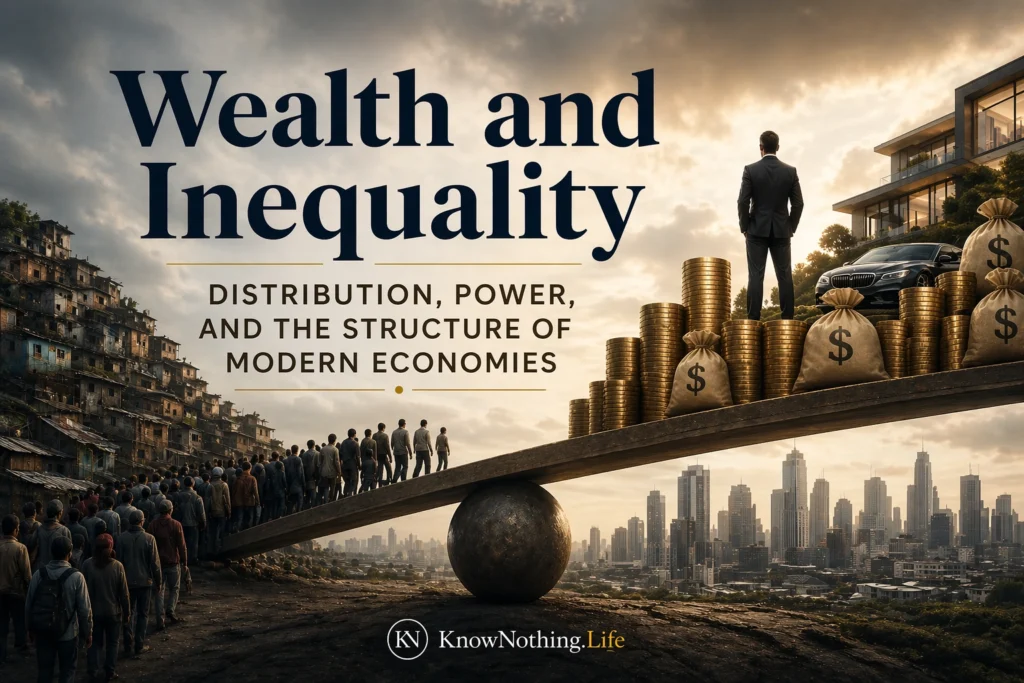
Wealth and inequality are among the most pressing and complex issues in contemporary economic and political life. While economic growth has lifted millions out of poverty, it has also produced significant disparities in income, assets, and opportunity. These disparities raise fundamental philosophical questions about fairness, social stability, and the long-term sustainability of economic systems. The study of wealth and inequality seeks to understand not only how resources are distributed, but why such distributions emerge and what consequences they carry.
At its core, inequality is not merely a matter of numbers but of lived experience. Differences in wealth influence access to education, healthcare, housing, and political power, shaping the trajectories of individuals and communities. The debate is not simply about whether inequality exists, but about how much inequality is acceptable and what role institutions should play in addressing it. As globalization, technological change, and financialization continue to reshape economies, the dynamics of wealth distribution have become increasingly central to discussions about the future of society.
Understanding Wealth and Income
A crucial distinction in analyzing inequality is the difference between income and wealth. Income refers to the flow of money earned over time, typically through wages, salaries, or investments. Wealth, by contrast, represents the stock of assets that individuals or households own, including property, savings, and financial investments. While income affects day-to-day living standards, wealth provides long-term security, influence, and the ability to generate additional income.
Wealth tends to be more unequally distributed than income, in part because it accumulates over time and can be passed down through generations. This intergenerational aspect amplifies disparities, as those born into wealth have access to opportunities that are often unavailable to others. Understanding this distinction is essential for analyzing inequality, as policies that address income disparities may not fully capture the deeper structural issues associated with wealth concentration.
Historical Perspectives on Inequality
Inequality is not a new phenomenon, but its forms and intensity have varied across history. Pre-industrial societies often exhibited rigid hierarchies based on land ownership and social status. The rise of industrial capitalism transformed these structures, creating new forms of wealth while also generating significant disparities between capital owners and workers. The Industrial Revolution, in particular, marked a period of rapid economic growth accompanied by stark inequalities.
In the 20th century, many countries experienced a reduction in inequality due to factors such as progressive taxation, social welfare programs, and the expansion of public education. However, recent decades have seen a reversal of this trend in many parts of the world. The work of economists like Thomas Piketty has highlighted how returns on capital can outpace economic growth, leading to increasing concentration of wealth over time. These historical patterns underscore the importance of institutions and policies in shaping the distribution of resources.
Causes of Economic Inequality
The causes of inequality are multifaceted, involving economic, technological, and social factors. Technological change, for example, can increase demand for skilled labor while reducing opportunities for less-skilled workers, widening income gaps. Globalization has also played a role, as the integration of markets has created new opportunities for some while exposing others to increased competition.
Institutional factors, such as labor laws, tax policies, and access to education, significantly influence how wealth is distributed. Differences in bargaining power between workers and employers can affect wages, while financial systems can amplify wealth accumulation for those with access to capital. Social factors, including discrimination and unequal access to opportunities, further contribute to disparities. These interconnected causes make inequality a complex issue that cannot be attributed to a single factor.
Wealth, Power, and Influence
Wealth is not only an economic resource but also a source of power and influence. Individuals and groups with significant wealth often have greater access to political processes, enabling them to shape policies in ways that reinforce their advantages. This relationship between wealth and power can create feedback loops, where economic inequality translates into political inequality, further entrenching disparities.
The concentration of wealth can also influence cultural and social dynamics, shaping norms, values, and opportunities. For example, access to elite education or influential networks can perpetuate advantages across generations. These dynamics raise concerns about the functioning of democratic systems, as unequal influence can undermine the principle of equal representation. Understanding the connection between wealth and power is essential for evaluating the broader implications of inequality.
Social and Economic Consequences
Inequality has far-reaching consequences for both individuals and societies. High levels of inequality can lead to reduced social mobility, making it more difficult for individuals to improve their economic circumstances. This can result in a sense of stagnation and frustration, particularly when opportunities appear to be concentrated among a small segment of the population.
From an economic perspective, inequality can affect growth and stability. While some argue that inequality provides incentives for innovation and investment, excessive disparities can reduce aggregate demand and increase financial instability. Socially, inequality can contribute to divisions and erode trust within communities. The relationship between inequality and well-being is complex, but there is growing recognition that extreme disparities can have negative effects on both economic performance and social cohesion.
Policy Responses and Solutions
Addressing inequality requires a combination of policy approaches that target both income and wealth disparities. Progressive taxation, social welfare programs, and investments in education and healthcare are commonly proposed measures. These policies aim to redistribute resources and create more equal opportunities, while also supporting economic growth.
Other approaches focus on structural changes, such as strengthening labor rights, improving access to capital, and reforming financial systems. Policies that promote inclusive growth seek to ensure that the benefits of economic expansion are more widely shared. However, designing effective policies involves trade-offs, as measures to reduce inequality may have implications for incentives, efficiency, and political feasibility. The challenge lies in balancing these considerations to achieve sustainable and equitable outcomes.
Global Inequality
Inequality is not only a domestic issue but also a global one. Differences in wealth and income between countries remain significant, reflecting historical, economic, and political factors. While globalization has contributed to economic growth in many developing countries, it has also highlighted disparities in resources and opportunities across regions.
Efforts to address global inequality involve international cooperation, including trade agreements, development aid, and policies aimed at reducing poverty. However, these efforts are often complicated by competing interests and differing priorities among nations. The global dimension of inequality underscores the interconnected nature of modern economies and the need for coordinated approaches to address shared challenges.
Ethical and Philosophical Perspectives
The question of inequality is deeply tied to ethical considerations about justice and fairness. Philosophers have long debated what constitutes a just distribution of resources and whether inequalities can be justified. Some perspectives emphasize equality of outcome, while others focus on equality of opportunity, arguing that disparities are acceptable if individuals have a fair chance to succeed.
Thinkers like John Rawls have proposed frameworks for evaluating inequality, suggesting that disparities are permissible only if they benefit the least advantaged members of society. Other approaches emphasize individual responsibility and the role of merit in determining outcomes. These differing perspectives reflect broader debates about the values that should guide economic and social systems.
Conclusion
Wealth and inequality are central to understanding the structure and dynamics of modern economies. They influence not only economic outcomes but also social relationships, political systems, and individual opportunities. While some level of inequality may be inevitable, the extent and nature of disparities raise important questions about fairness, stability, and the distribution of power.
Addressing inequality requires a nuanced understanding of its causes and consequences, as well as thoughtful consideration of the policies and values that shape economic systems. As societies continue to evolve, the challenge will be to create frameworks that promote both prosperity and equity, ensuring that the benefits of economic progress are shared in a way that supports human well-being and social cohesion.